

What Is Correlation?
In the Forex market, gold (XAU/USD), as a safe haven asset and a valuable benchmark, plays a very important role, and its correlation with currency pairs such as AUD/USD and USD/CHF is highly significant for traders and analysts. The concept of correlation refers to the degree of statistical relationship between the price movements of two assets that is, how closely the price movement of gold and a specific currency pair move together or in opposite directions. For example, gold usually has a negative correlation with the US dollar; however, it has a more complex relationship with AUD/USD and USD/CHF, influenced by the economic and monetary factors of the respective countries.
On the other hand, the concept of overlap refers to the existence of time periods or conditions in which the data of two assets show activity or similar behavior simultaneously within a specific time frame. This term is different from correlation, because correlation relates to the strength and direction of the relationship, whereas overlap simply refers to the shared timing of data. A clear understanding of the difference between these two concepts, along with an analysis of gold’s correlation with the AUD/USD and USD/CHF currency pairs, helps traders develop better strategies for risk management and position sizing, and gain deeper insight into how different markets influence one another.
Types of Correlation in Forex
The correlation between assets and currency pairs in the Forex market can generally be divided into two main categories:short term correlations and long term correlations. Within this classification, three primary types of correlation are observed:
Positive Correlation
A positive correlation occurs when two currency pairs, or an asset and a currency pair, move in the same direction at the same time.
Negative Correlation
A negative correlation occurs when the increase in the value of one currency pair leads to a decrease in the value of another currency pair or asset.
Zero Correlation
Zero correlation occurs when there is no significant relationship between the movements of currency pairs and assets. In other words, they do not have a noticeable effect on one another.
Can Correlation Cause Unexpected Market Behavior?
Sudden Changes in Correlations
Correlations that are usually considered stable and reliable may break down or change direction due to fundamental shifts in macroeconomic variables, geopolitical events, or changes in market sentiment. For example, under certain conditions, gold may move simultaneously with the US dollar and oil or equity markets, even though these assets typically exhibit divergent behavior. Such changes in correlation patterns can be a source of unpredictable market movements.
The Cumulative Effect of Positioning Across Multiple Assets
Investment funds, financial institutions, and algorithmic traders often take positions simultaneously in assets with positive or negative correlations. When the structure of correlations changes, the coordinated exit of these participants from the market can trigger sharp price movements. Such behavior, driven by liquidity pressure or risk management considerations, often appears unexpected to market observers.
Simultaneous Volatility in Related Markets
For example, gold and currency pairs such as AUD/USD, which are heavily influenced by commodity prices, may display unusual behavior in response to a single fundamental factor (such as changes in interest rates or China’s monetary policy). The simultaneous movement of several related markets in unanticipated directions can render traditional analytical models ineffective and lead to confusion among analysts.
The Role of Collective Market Psychology
When historical correlations suddenly weaken or reverse, traders especially in crowded and highly leveraged markets may react emotionally. These conditions, often accompanied by uncertainty and a lack of analytical consensus, can create an environment conducive to irregular increases in volatility and the emergence of sharp, erratic price movements.
The Most Important Gold Correlations in the Forex Market and the Reasons Behind Them
Gold and the US Dollar (XAU/USD vs. DXY)
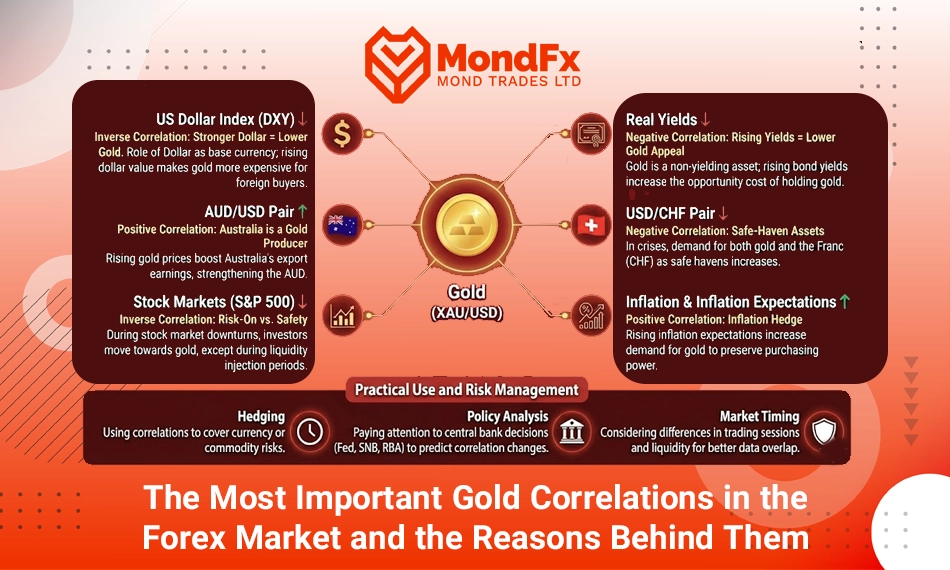
In most cases, gold has an inverse relationship with the U.S. Dollar Index. The primary reason for this negative correlation is the role of the dollar as the global base currency in gold pricing. When the value of the dollar rises, gold becomes more expensive for non U.S. buyers, leading to a decline in demand. Conversely, in situations such as interest rate increases, a weakening dollar makes gold more attractive at the international level. However, during periods of crisis, both assets may act as safe havens and move in the same direction.
Gold and Real Interest Rates (Real Yields, Especially US Treasury Yields)
Gold, as a non interest bearing asset, is highly sensitive to real interest rates. A decline in real yields increases the attractiveness of holding gold, as the opportunity cost of holding it decreases. For this reason, a drop in US 10 year Treasury yields is often accompanied by a rise in gold prices.
Gold and the AUD/USD Currency Pair
The Australian dollar typically has a positive correlation with gold. Australia is one of the world’s largest gold producers, and exports of this metal represent a significant portion of the country’s trade balance. Therefore, when gold prices rise, Australia’s export revenues tend to strengthen, which can lead to an appreciation of the AUD against the USD. This correlation is considered a valuable signal for traders active in both commodity and Forex markets.
Gold and the USD/CHF Currency Pair
The Swiss franc, like gold, is recognized as a safe haven asset. During periods of elevated systemic risk (such as financial or geopolitical crises), investors tend to move toward assets like gold and the Swiss franc. As a result, the USD/CHF currency pair often shows a negative correlation with gold; meaning that when gold prices rise, the Swiss franc usually strengthens and USD/CHF declines. However, this relationship can fluctuate during periods of aggressive policy intervention by the Swiss National Bank.
Gold and Commodity Linked Currency Pairs (Such as USD/CAD)
The Canadian dollar, as a commodity linked currency, is more closely correlated with oil; however, gold price fluctuations can also have an indirect impact on the behavior of USD/CAD, especially during periods when overall market sentiment toward commodities changes.
Gold and Equity Markets
Traditionally, gold has an inverse relationship with equity indices such as the S&P 500. During equity market downturns, investors typically shift toward safe haven assets, including gold. However, during periods of liquidity injections or accommodative monetary policies, gold and equities may rise simultaneously.
Gold and Inflation (and Inflation Expectations)
Gold is widely regarded as a hedge against inflation. When inflation expectations increase (for example, following a rise in CPI or a depreciation of the national currency), demand for gold tends to rise. This correlation is particularly important for protecting capital against the loss of purchasing power.
Gold and the USD/CHF and AUD/USD Currency Pairs
In addition to the points discussed regarding gold’s correlation with USD/CHF and AUD/USD, there are several other key considerations that help facilitate a deeper understanding of these relationships:
The Impact of Central Banks’ Monetary Policies on Correlation
Alongside macroeconomic factors, the decisions of the central banks of the United States, Australia, and Switzerland play an important role in changing correlations. For example, an increase or decrease in interest rates by the Swiss National Bank (SNB) can temporarily or long term alter the relationship between USD/CHF and gold. If the SNB adopts expansionary policies, the Swiss franc may weaken, and its correlation with gold may decrease.
The Impact of Global Commodity Market Volatility on AUD/USD
Since the Australian economy is highly dependent on exports of minerals and commodities, global prices of base commodities (such as copper, iron, and energy) affect the value of the AUD. As a result, the positive correlation between gold and AUD/USD may change under the influence of price fluctuations in other commodities. In other words, if the price of gold rises while the prices of other commodities decline, the traditional correlation may become less apparent.
The Role of Geopolitical Risks and Financial Crises in Strengthening or Weakening Correlation
During periods of economic crises or political tensions, both gold and the Swiss franc experience high demand as safe haven assets, which strengthens the negative correlation between gold and USD/CHF. However, under unusual conditions or short term market reactions, this correlation may be temporarily disrupted or change direction.
Differences in the Economic Nature of the Two Currency Pairs
USD/CHF is generally considered a safe haven currency pair, meaning that during times of economic concern, its movement tends toward capital preservation, similar to gold. In contrast, AUD/USD is more dependent on global economic growth variables and commodity prices, and its behavior is more directly linked to the price of gold. Therefore, gold’s correlation with AUD/USD more closely reflects global economic conditions, while its correlation with USD/CHF reflects the level of risk and market volatility.
The Impact of Differences in Market Hours and Liquidity
The time windows of market activity across the three countries (the United States, Australia, and Switzerland) during trading sessions, as well as differences in the liquidity of these currency pairs, may affect the overlap of price data. For example, the overlap and synchronization of gold’s movement with AUD/USD may be more pronounced during active Australian market hours, whereas with USD/CHF it may be observed more during European and U.S. market hours.
Traders’ Practical Use of Correlation for Risk Management
Typically, traders who are simultaneously active in the gold market and the USD/CHF and AUD/USD currency pairs can use these correlations to hedge currency or commodity risks. A precise understanding of correlation fluctuations, especially under conditions of changing monetary policies or sudden crises, can help prevent unexpected losses and improve trading decision making.
Conclusion
Overall, the correlation of gold with the AUD/USD and USD/CHF currency pairs is considered one of the most important intermarket relationships in the Forex market, and a proper understanding of it can significantly enhance a trader’s analytical perspective. Gold, as a safe haven and non-interest bearing asset, is influenced by factors such as the strength of the U.S. dollar, real interest rates, inflation expectations, and the market’s risk appetite, and these same variables shape the path of its correlation with different currency pairs.
The positive correlation between gold and AUD/USD is largely rooted in the commodity driven nature of the Australian economy and its dependence on global raw material markets, while the inverse relationship between gold and USD/CHF mainly reflects investor behavior during periods of heightened systemic risk and a shift toward safe haven assets. However, these relationships are not always fixed or stable and may weaken or change direction under the influence of central bank monetary policies, geopolitical crises, sudden shifts in market sentiment, and even differences in trading hours. Therefore, the professional use of gold’s correlation with AUD/USD and USD/CHF requires a dynamic perspective, multidimensional analysis, and avoidance of absolute reliance on historical patterns an approach that ultimately leads to better risk management, fewer trading surprises, and more informed decision making in the Forex market.
If you are looking to begin a reliable path in the world of trading and financial markets, collaborating with the MondFx team can be a good starting point for building your personal strategy.
Frequently Asked Questions
1) What does the correlation between gold and Forex currency pairs mean?
The correlation between gold and currency pairs refers to the degree and direction of the relationship between gold’s price movements and those of various currency pairs in the Forex market. This correlation can be positive, negative, or neutral, and it indicates whether prices usually move in the same direction, in opposite directions, or have no meaningful relationship with each other.
2) What is the difference between correlation and overlap in the Forex market?
Correlation relates to the statistical relationship and the direction of price movements between two assets, whereas overlap simply refers to the simultaneity of their activity or price behavior within a specific time period. In simple terms, overlap does not necessarily imply the existence of a strong price relationship between two assets.
3) Why does gold usually have a negative correlation with the U.S. dollar?
Since gold is priced in U.S. dollars, a strengthening dollar increases the relative price of gold for non U.S. buyers and reduces demand. Conversely, a weakening dollar often increases the attractiveness of gold, which leads to the formation of a negative correlation between these two assets.
4) What is the reason for the positive correlation between gold and AUD/USD?
The Australian economy is highly dependent on commodity exports, especially gold. An increase in gold prices can strengthen the country’s export revenues and lead to an appreciation of the Australian dollar against the U.S. dollar. For this reason, a positive correlation between gold and AUD/USD is usually observed.
5) Why do gold and USD/CHF often have an inverse relationship?
The Swiss franc and gold are both recognized as safe haven assets. During periods of increased risk and economic uncertainty, capital flows toward these assets, and the strengthening of the Swiss franc is usually accompanied by a decline in the USD/CHF currency pair, while the price of gold also rises.
6) Is the correlation between gold and currency pairs always stable?
No, correlations can fluctuate or even reverse as a result of changes in monetary policy, financial crises, geopolitical events, and shifts in market sentiment. Therefore, relying solely on historical correlations can be misleading.
7) What impact do real interest rates have on the price of gold?
A decline in real interest rates reduces the opportunity cost of holding gold and usually leads to increased demand and higher prices, whereas an increase in real interest rates can exert downward pressure on the price of gold.
8) How do traders use the correlation between gold, AUD/USD, and USD/CHF?
Traders use these correlations to confirm analyses, identify hidden risks, hedge positions, and improve capital management. Understanding changes in correlations, especially during crisis conditions, can help prevent sudden losses.
9) Can correlation lead to unexpected market movements?
Yes, a sudden change in the structure of correlations or the simultaneous exit of major market participants can create sharp volatility and unpredictable movements, reducing the effectiveness of traditional analyses.