

Ways to Start Trading in Forex with $10
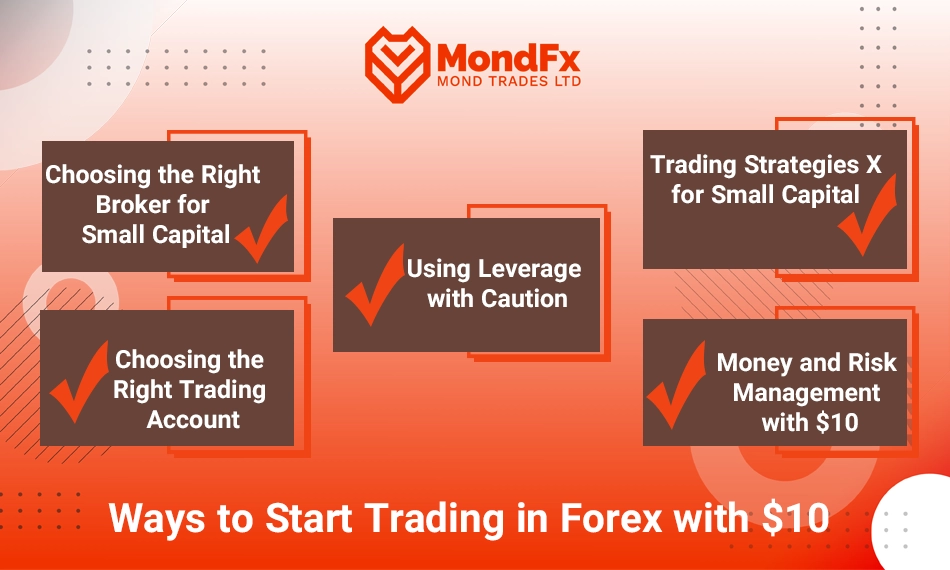
Trading forex with just $10 has its own challenges, but by choosing the right strategy and following proper money management principles, you can use this small amount to learn and gain experience. Below are the most important points for starting to trade with this level of capital.
Choosing the Right Broker for Small Capital
Not all brokers support accounts with a $10 deposit. To trade with such a small amount, you need to choose a broker that offers micro, cent, or nano accounts. A suitable broker should have a low minimum deposit requirement, allow small trade sizes, offer reasonable spreads and commissions, and provide a balanced leverage option. These features help you manage your capital more effectively.
Choosing the Right Trading Account
With a $10 investment, a standard account is not a viable option due to its high margin requirements. The best choices for such small capital are micro and cent accounts, which allow trading with smaller volumes and reduce the risk of a margin call. Additionally, choosing an account with low spreads or no commission can help reduce trading costs and increase the chances of profitability.
Using Leverage with Caution
Leverage in forex can either amplify profits or quickly wipe out your capital. To minimize risk, it is recommended to use leverage between 1:10 to 1:50. Using very high leverage, such as 1:100 or 1:500, is extremely risky and can result in losing your entire capital in a single trade. Also, avoid putting the entire $10 into one trade; instead, adjust your trade size according to your balance.
Trading Strategies for Small Capital
With a $10 account, it is crucial to adopt low-risk strategies.Scalping is generally not advisable due to the high impact of spreads and commissions on small accounts. Instead, it is better to focus on currency pairs with moderate volatility, such as EUR/USD or USD/JPY. Additionally, setting a stop loss (SL)correctly is crucial—neither too tight to cause premature exits nor too wide to result in significant losses.
Money and Risk Management with $10
One of the most important principles for preserving a small account is proper risk management. In each trade, you should not risk more than 1–2% of your total account balance. This means that with a$10 balance, you should not risk more than$0.10 to $0.20 per trade. It is also essential to have realistic expectations—instead of chasing high profits, focus on learning and managing your capital wisely. Moreover, avoid trading in highly volatile markets such as gold or cryptocurrencies, as these assets can quickly wipe out a small account.
Best Trading Accounts for Starting Forex with $10
If you plan to enter the forex market with $10, choosing the right trading account is crucial.Standard and ECN accounts are not suitable for such a small balance, but there are other options that allow you to trade with low capital.
Cent Account – The Best Option for Small Capital
A cent account is one of the best choices for beginners with low capital. In this type of account, your balance is displayed in cents, meaning that if you deposit$10, it will appear as 1,000 cents in MetaTrader. This feature allows you to trade with smaller volumes and manage risk more effectively.
Since cent accounts allow trading with very small lot sizes (0.01 cent lots), market fluctuations will have less impact on your balance, reducing the risk of wiping out the account quickly. Additionally, this type of account is ideal for learning and testing strategies, as it allows traders to experience real market conditions with minimal risk.
Micro Account – Another Option for Small Capital
A micro account is also a suitable choice for beginner traders who want to start with a low balance. Some brokers allow opening a micro account with a minimum deposit of $10. This type of account supports micro-lots (0.01 standard lots), enabling traders to manage their trades with a controlled level of risk.
However, a micro account is slightly riskier than a cent account since the lot sizes are larger. If you lack experience in risk management, it is advisable to use it with caution.
Zero Spread Account – Reducing Trading Costs
Although most Zero Spread accounts require a higher minimum deposit, if you can find a broker that offers this account type with a$10 deposit, it can be a great option. This account type provides near-zero spreads, reducing trading costs significantly.
One of the main advantages of a Zero Spread account is that trades are executed with greater transparency, and there are fewer price gaps. This feature is particularly useful for scalpers who rely on quick, short-term trades.
Demo Account – Practice Before Entering the Real Market
If you lack sufficient experience in forex, the best approach is to start with a demo account before trading with real money. A demo account allows you to learn about the market,test different strategies, and improve your skills in a real-market environment without financial risk.
Using a demo account helps traders become familiar with the broker’s platform, trading conditions,entry and exit strategies, and risk management techniques. Once you have gained enough practice in a demo account, you can transition to a real account with more confidence.
Best Currency Pairs for Trading with $10
Focusing on currency pairs with reasonable volatility, low spreads, and high liquidity helps reduce trading costs and risk. The best currency pairs for trading with $10 include:
1. EUR/USD-The Best Choice for Small Capital
Low spread:This pair is one of the most cost effective options in Forex, minimizing spread impact on your trades.
High liquidity:Due to its high trading volume, its price movements are relatively predictable with fewer unexpected jumps.
Moderate volatility:Its volatility is not too high to wipe out small accounts and not too low to limit trading opportunities.
2. USD/JPY-Suitable for Stable Trading
Controlled volatility:This pair does not have extreme fluctuations like gold or exotic currency pairs, making it ideal for small capital management.
Good for low risk strategies:If you prefer predictable price movements, USD/JPY is a strong choice.
3. GBP/USD-For Those Who Are Slightly More Risk Tolerant
More trading opportunities compared to EUR/USD
Suitable volatility for scalping and short term trades
Higher risk:Its spread is slightly higher than EUR/USD, and it has more volatility, so effective risk management is necessary.
4. AUD/USD or NZD/USD-Lower Risk Pairs for Beginners
Lower volatility compared to GBP/USD but still offering good trading opportunities
Relatively low spreads, especially during Sydney and New York trading hours
Suitable for more conservative traders with low capital
Best Brokers for Trading with $10
If you plan to enter the forex market with $10, choosing the right broker plays a crucial role in your success. Before selecting a broker, you must ensure that it meets the necessary conditions for trading with a small capital.
One of the most important factors to consider is the minimum deposit requirement. Some brokers require a large initial investment to open an account, but you should look for a broker that allows you to start trading with$10 or even less. This feature enables you to experience real trading without a significant financial commitment.
The type of trading account is also important. Standard or ECN accounts are not suitable for small capital since they usually require higher minimum trade sizes. The best options are Cent or Micro accounts, which allow you to trade with very small volumes. These accounts help reduce risk and prevent margin calls.
Trading costs, including spreads and commissions, also have a significant impact on your profits and losses. In small accounts,high spreads or high commissions can quickly erode profits. Therefore, choose a broker that offers low spreads and reasonable commissions to minimize additional trading expenses.
Additionally, the broker should allow trading with small lot sizes. In Cent or Micro accounts, you should be able to trade with a minimum of 0.01 Micro or Cent lots. If a broker only supports larger trade sizes, the risk of losing your capital quickly increases significantly.
Another crucial factor is the leverage offered by the broker. Some brokers provide high leverage options such as 1:500 or 1:1000, but using such high leverage is dangerous for small accounts. It is better to select a broker that offers a reasonable leverage range between 1:50 and 1:200 to maintain controlled risk management.
Finally, consider the deposit and withdrawal process. For small accounts, having fast and fee-free deposit and withdrawal options is essential. Some brokers charge high fees for transactions, which can be problematic for traders with low capital. Choose a broker that offers easy, fast, and cost-free payment methods.
By considering these factors, you can select a broker that provides the best conditions for trading with $10 while minimizing the risk of losing your capital.
Recommended Brokers for Starting with $10
FBS: Minimum deposit: $1, cent account available, attractive bonuses.
Exness: Minimum deposit: $1, low spreads, and fast trade execution.
XM: Minimum deposit: $5, micro account available, strong customer support.
HFM (HotForex): Minimum deposit: $5, multiple account types, competitive spreads.
OctaFX: Minimum deposit: $10, low spreads, user friendly platform.
What Are the Best Strategies for Trading Forex with $10?

For trading with $10, the following strategies are suitable:
1. Capital and Risk Management
To preserve capital in forex trading, no more than 1–2% of the balance should be risked per trade. In a$10 account, this equates to$0.10 to $0.20 per trade. Using low leverage (maximum 1:50)is essential, as high leverage can wipe out the entire account with the slightest market fluctuation.
It is advisable to trade with small lot sizes (0.01 micro or cent lots)to minimize potential losses and protect the account balance.
2. Scalping Strategy with Low Spread
The scalping strategy is suitable for low-volatility markets and currency pairs such as EUR/USD and USD/JPY. The goal is to make small profits in short timeframes, usually between 5 to 10 pips per trade. This strategy relies on indicators like Moving Averages (MA), Relative Strength Index (RSI), and Bollinger Bands.
Scalping requires quick decision-making, but if the spread is too high, profitability may decrease significantly.
3. Trend Following Strategy
How does this strategy work?
Identify the main market trend(e.g., using the 200-day Moving Average).
Trade in the direction of the trend (e.g., if the price is above the MA200, only take buy trades).
Use a proper stop-loss to manage risks effectively.
This strategy is low-risk for small accounts because trades stay open longer, reducing the impact of sudden price fluctuations. However, if the market is in a range-bound phase, this strategy may not perform well.
4. Price Action Strategy with Candlestick Patterns
This method focuses on simple candlestick patterns such as Pin Bar, Engulfing, and Doji. By identifying support and resistance levels, traders can enter positions at key points.Stop-loss should be placed behind these levels to prevent premature exits due to market fluctuations. For better understanding, practicing with a demo account is recommended before using it in live trading.
5. Breakout Trading Strategy
How does this strategy work?
Identify strong support and resistance levels.
If the price breaks through these levels and is confirmed with high volume, enter the trade in the breakout direction.
Set the stop-loss close to the broken level to limit potential losses in case of a fake breakout.
This strategy is ideal for traders looking for sudden price movements. However, if the breakout turns out to be false (Fake Breakout), losses may occur, so waiting for confirmation is crucial.
6. Using Broker Bonuses to Increase Capital
Some brokers offer no-deposit bonuses or trading bonuses, which can help increase the initial trading balance. If a broker provides such an opportunity, taking advantage of it can enhance the chances of account survival and growth.
How to Manage Risk When Trading with a Small Capital?
In this section, we will review risk management strategies for trading with a small capital.
1. Setting a Stop Loss (SL)
A stop loss is a crucial part of every trade, and without it, trading becomes gambling. It should be determined based on technical analysis, not emotions, and should not be too tight or too wide to account for natural market fluctuations. Additionally, the risk per trade should not exceed 1–2% of the account balance. In a$10 account, this means a maximum risk of$0.10 to $0.20 per trade.
2. Controlling Trade Size (Lot Size Control)
One of the biggest mistakes in small accounts is using high trade sizes, which can quickly deplete capital. To control risk, it is best to trade with small lot sizes (0.01 or even 0.001 in a cent account). In a cent account, having 1,000 cents allows for better capital management. Additionally, instead of opening multiple trades at the same time, focus on one or two high-quality trades for better precision.
3. Using Leverage with Caution
High leverage can wipe out your account in an instant. If your broker offers leverage of 1:500 or 1:1000, this does not mean a quick way to get rich—it can be the fastest way to get margin called. It is recommended to use a maximum leverage of 1:50 to 1:200 for better risk control.
Advantages and Disadvantages of Starting Forex with $10
Advantages
Lower Initial Risk
With a small capital, your potential losses are also limited. If you are a beginner, this amount allows you to gain real market experience without the fear of losing a significant sum.
Learning in a Real Trading Environment
Trading in a real account is entirely different from a demo account. Entering the market with $10 helps you understand real emotions such as fear, greed, and stress, allowing you to develop better trading psychology.
Ability to Use Cent Accounts
Some brokers offer cent accounts, where your $10 is converted into 1,000 cents. These accounts allow you to trade with smaller lot sizes, effectively simulating a larger capital base.
Practicing Capital and Risk Management
With a small investment, you are forced to practice capital management properly, as even the smallest mistake can wipe out your account. This helps in developing essential trading skills.
Starting Without Financial Pressure
Entering the market with a large capital may create pressure to generate profits quickly. However, with $10, you experience less financial stress and can focus more on learning rather than immediate profitability.
Disadvantages
Limited Risk Management Options
One of the core principles in Forex is to risk no more than 1-2% of your capital per trade. With just $10, this means risking only a few cents per trade, which is not practical.
High Impact of Trading Costs
Spreads and commissions can have a significant effect on small accounts. For example, if a currency pair has a 2 pip spread, it might consume a considerable portion of your capital as soon as you enter the trade.
High Probability of Margin Calls
With a small capital, your account is highly sensitive to minor price fluctuations. Even a slight unexpected market movement can trigger a margin call and wipe out your entire balance.
Temptation to Use High Leverage
Traders with low capital often get tempted to use high leverage (such as 1:500 or 1:1000) to maximize potential profits. However, while it may seem profitable, it is equally dangerous and can lead to rapid account liquidation.
Limited Profitability
Even if you execute a successful trade, the profits will be minimal due to the small capital. This can lead traders to take higher risks, which often results in losses rather than gains.
Who Should Start Forex Trading with $10?

Beginners Who Want to Gain Experience Without High Risk
If you are new to Forex and still lack a solid understanding of the market, starting with $10 can be a great way to learn. This small amount allows you to gain real trading experience without financial stress and with minimal risk. Unlike demo accounts, which do not involve real emotions, trading with a real account even with just $10 helps you understand market psychology and emotion management more effectively.
Traders Who Want to Test New Strategies
If you are an experienced trader looking to test a new strategy before applying it to a larger account, $10 can be a practical choice. You can trade in a cent account and evaluate your strategy’s performance in real market conditions without taking on significant risk.
Those Who Want to Trade with Cent Accounts
Some brokers offer cent accounts, where your $10 is converted into 1,000 cents. These accounts are ideal for traders who want to learn risk management and market mechanics with small amounts. This approach allows you to trade as if you have a larger account while keeping potential losses minimal.
People Who Want to Enter the Market Without Large Capital
If someone is interested in Forex trading but does not want to risk a large amount of money, starting with $10 is a logical entry point. However, it is essential to have realistic expectations and understand that this amount is primarily for educational purposes rather than generating significant profits.
Traders Looking to Improve Risk and Capital Management Skills
Capital management is one of the most crucial skills for a successful trader. Trading with $10 forces you to take capital and risk management seriously, as even the smallest mistake can wipe out your account. If you can survive with such a small balance, you will likely develop stronger risk management skills for the future.
Who Should NOT Start Forex with $10?
Impatient Individuals Who Want to Get Rich Quickly
Trading with $10 requires patience and proper management. If you are looking for fast wealth, this approach is not suitable for you.
Traders Who Plan to Use High Leverage
Using excessive leverage in a small account almost always leads to rapid account depletion.
Those Who Cannot Manage Risk
If someone cannot control their capital properly, even $10 is too much for them to risk.
People Expecting Large Profits in a Short Time
With such a limited capital, substantial profits are unrealistic, making it unsuitable for those seeking high returns quickly.