

What is a DAO or Decentralized Autonomous Organization?
A Decentralized Autonomous Organization, or DAO (Decentralized Autonomous Organization), is a type of digital entity that operates without the presence of a central authority or manager. Instead of traditional management structures, these organizations are governed by a community of individuals with a shared objective, and their operations are based on a set of predefined rules that are executed and enforced on a blockchain.
DAOs are internet native organizations whose ownership and management are collectively held by their members. These organizations typically have an internal treasury, access to which is only possible with the approval of the members. Decision making within a DAO takes place through the submission of proposals, and members vote on these proposals within a specified time frame.
How DAOs Operate
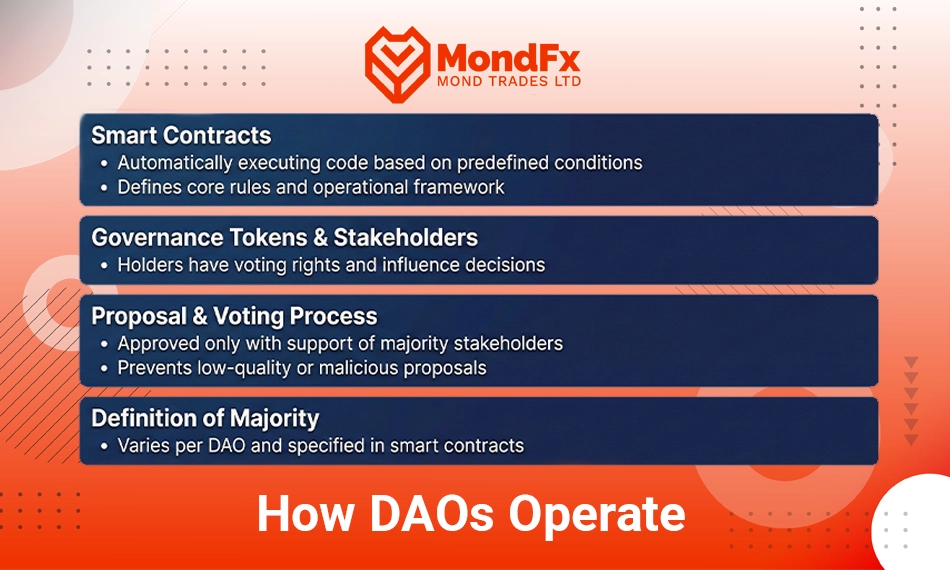
DAOs operate based on smart contracts; contracts that are essentially pieces of code which are executed automatically once predefined conditions are met. These smart contracts define the core rules of a DAO and shape its operational framework.
Individuals who hold a stake or governance tokens in a DAO are granted voting rights and can influence the organization’s direction by participating in votes or submitting new proposals. This model prevents DAOs from being overwhelmed by a flood of low quality or malicious proposals, as only those proposals that receive the support of a majority of stakeholders are approved. The definition of a “majority” varies from one DAO to another, and this is also clearly specified within its smart contracts.
Potential Advantages of DAOs
There are numerous reasons why an individual or a collective group may choose the DAO structure for their activities. One of the most significant advantages of DAOs is the decentralization of the decision making process. In this structure, key decisions are not made by a centralized authority, but rather emerge from the votes and opinions of a group of individuals.
This model eliminates the need for third party intermediaries and can contribute to the growth and maturation of the cryptocurrency ecosystem, as it places transparency, independence, and autonomy at the center of attention. Recording all decisions and transactions on the blockchain also increases the level of trust and accountability within these organizations.
Challenges and Limitations of DAOs
Despite their numerous advantages, DAOs also face significant challenges. One of the primary challenges is security. If there is a weakness or vulnerability in the smart contracts, there is a risk of exploitation and the draining of a substantial portion of the DAO’s treasury an issue that can place the entire organization in crisis.
On the other hand, the accumulation of governance tokens in the hands of a limited number of individuals may lead to a concentration of power. Such a situation can undermine the decentralized nature of a DAO and turn it into a structure closer to traditional organizations, which runs counter to the core philosophy of DAOs.
Practical Examples of DAOs
One of the earliest well known DAOs was an organization called The DAO, which was created by a group of developers with the goal of automating decision making and facilitating cryptocurrency transactions. However, this DAO was exploited due to a security flaw, resulting in the draining of a large portion of its assets.
Despite this failure, the experience of The DAO played an important role in improving the security and functionality of subsequent DAOs. Another example is ConstitutionDAO, an organization formed with the objective of purchasing a copy of the United States Constitution. Although this DAO did not succeed in achieving its ultimate goal, it demonstrated that a group of like minded individuals can quickly come together, raise capital, and work toward the realization of a shared objective.
What Is a Social DAO?
Simply put, a Social DAO refers to any type of Decentralized Autonomous Organization whose primary focus is on building and strengthening a core social network.
Although nearly all DAOs inherently possess social aspects, a DAO can only be considered a Social DAO if social interaction and networking constitute one of its core values and key value propositions. Otherwise, that DAO does not fall within the category of Social DAOs.
Like many other DAOs, Social DAOs bring like minded individuals together in the form of online communities communities that are formed around a shared interest, goal, or set of values. For example, a Social DAO may focus on creating a network of individuals with shared religious beliefs, organizing a community of enthusiasts around a particular sport such as basketball or hockey, or even providing a space for people with common interests such as creative writing or music.
However, it is important to note that Social DAOs are not the same as decentralized social platforms such as Mastodon and Minds, nor are they comparable to centralized social networks like Facebook or other traditional platforms. Decentralized social platforms typically offer a highly open and largely unmoderated environment, where almost anyone can publish virtually any type of content. In contrast, centralized social networks such as Twitter or Facebook are heavily managed, regulated, and censored.
Social DAOs sit precisely at a point between these two extremes. In this structure, although there is no centralized team directly overseeing content, this does not imply absolute freedom of expression. DAO members are not required to tolerate hateful, oppressive, or destructive viewpoints, and if such behavior occurs, they can submit a proposal to vote on the removal or expulsion of the offending individual from the DAO.
Characteristics and Structure of a Social DAO
Every Social DAO possesses a set of fundamental characteristics that distinguish it from other virtual organizational structures. The most important of these features is decentralized decision making. In this type of community, no individual or central entity holds control over affairs. All members have the ability to participate in decision making, policymaking, and the execution of projects.
Another key component is collective ownership of resources and projects. The intellectual and material assets produced within the framework of a Social DAO are distributed among members or held jointly. This feature strengthens the sense of belonging and responsibility within the community, ensuring that participants are not merely members, but also co-owners and co-decision makers.
Operational transparency is also an integral part of the Social DAO structure. Through blockchain technology, all voting processes, resource allocation, and activity records are conducted publicly and remain open to review. This level of transparency helps build sustainable trust within the community.
Finally, a variety of technical structures and management tools exist for operating a Social DAO. From communication platforms to voting systems and financial management tools, all are part of an infrastructure that enables members to collectively advance the community without the need for a central manager.
Who Are the Members of a Social DAO and What Roles Do They Play?
One of the most appealing characteristics of a Social DAO is the dynamism and diversity of member roles within it. Unlike traditional organizations, where roles are predefined, roles in a Social DAO are defined in an open, fluid manner and are based on voluntary participation. Each individual can assume an active role in the community depending on their interests, skills, or motivation.
In this type of DAO, some individuals may take responsibility for content creation, graphic design, or event coordination, while others contribute through data analysis, proposing new initiatives, or guiding discussions. Defining roles based on contribution rather than hierarchy is one of the key reasons behind the vitality of these structures.
Participation in decision making is also a central role of members. In many Social DAOs, members use online voting tools to take part in major decisions, including project selection, resource allocation, or structural changes. This form of active participation ensures that members are not merely consumers, but genuine co-creators of the community’s direction.
Alongside participation and role fulfillment, most Social DAOs also design incentive models to reward active contributors. These rewards may take the form of tokens, special access privileges, or even increased voting power. Such models foster motivation and encourage sustainable participation within the community.
Real World Applications of Social DAOs
Due to their flexible and participatory nature, Social DAOs operate across a wide range of fields. Many of them have been established to strengthen digital culture, support independent artists, expand free education, or back social movements. These applications demonstrate that a Social DAO is not merely a technological tool, but rather a means of empowering human communities within the digital environment.
In the field of culture and the arts, Social DAOs have emerged that enable artists to publish their works as NFTs, hold exhibitions, or collectively finance cultural projects. This model not only frees artists from reliance on intermediaries, but also involves audiences directly in the process of artistic creation and support.
In the area of education, there are DAOs that operate with the aim of providing free and decentralized educational resources. Members of these communities engage in knowledge sharing, translating materials, or organizing online courses. Open access to knowledge is one of the core values emphasized within these DAOs.
Likewise, in social domains such as feminism, social justice, or environmental protection, Social DAOs have been formed that, rather than relying on traditional centralized organizations, carry out effective, creative, and transparent actions through collective governance.
How to Launch a Social DAO?
To launch a Social DAO, the first step is to define a clear objective for the intended community. This goal may involve supporting an artistic movement, expanding open education, or even creating a specialized professional network. Without a well defined vision, attracting members and forming a collective identity is not possible.
In the next stage, an initial community of interested individuals needs to be formed. This small community often created through platforms such as Discord or Telegram constitutes the core of the DAO. Continuous interaction, discussion, idea exchange, and collective thinking are critical at this stage.
After the core group is established, the DAO’s infrastructure must be built. Selecting appropriate tools for voting, resource management, recording decisions, and internal interactions is among the essential steps. Tools such as Snapshot for voting or Gnosis Safe for asset management can be useful in this process.
The next step is defining the DAO’s governance and economic mechanisms. Determining how tokens are distributed, the reward model, voting methods, and the level of influence members have in decision making must be transparent and fair in order to build trust.
Finally, once the structure is prepared, the DAO can be officially launched and others can be invited to participate, create, vote, and contribute to its development. The key to successfully launching a Social DAO lies in maintaining continuous communication, motivating contributors, and remaining committed to shared values.
Conclusion
In this article, we saw that a Social DAO is not merely a technological concept, but rather a modern model for collaboration, collective thinking, and coordinated action across areas such as culture, education, art, and social issues. Despite challenges such as security concerns, the risk of power concentration, or governance complexities, the high potential of these structures to create sustainable, transparent, and independent communities has made them one of the most significant emerging trends in the future of the blockchain ecosystem.
Ultimately, the success of a Social DAO depends less on technical tools and more on the quality of member participation, the clarity of shared values, and commitment to the principles of collective governance. Social DAOs demonstrate that in today’s digital world, it is possible to build meaningful and impactful communities without a central manager, relying instead on trust, transparency, and collective decision making.
If you are looking to begin a reliable path in the world of trading, collaborating with the MondFx team can be a strong starting point for building your personal strategy.
Frequently Asked Questions (FAQ)
Are Social DAOs the same as decentralized social networks?
No. Social DAOs focus on collective governance, participatory decision making, and shared ownership, whereas decentralized social platforms are typically limited to content publishing and do not necessarily include voting mechanisms, a shared treasury, or a DAO style governance model.
What is required to join a Social DAO?
Membership requirements vary from one Social DAO to another, but generally include having a cryptocurrency wallet, accepting the community’s rules, and in some cases obtaining or purchasing a governance token as a basic prerequisite.
Does participating in a Social DAO require advanced technical knowledge?
In most cases, no. Many Social DAOs strive to simplify the participation process so that individuals without specialized blockchain knowledge can still take part in voting, discussions, and social activities.
How do Social DAOs make decisions?
Decision making in Social DAOs is carried out through the submission of proposals and collective voting. Members decide on matters such as resource allocation, project execution, or rule changes based on their voting power.
Can a Social DAO be a source of income?
Some Social DAOs have defined economic models and provide income opportunities for active members through tokens, participation rewards, or shared economic activities. However, the primary objective of many of them is community building and collective value creation, rather than purely financial profit.
What is the difference between Social DAOs and other types of DAOs?
The primary difference lies in their focus. While many DAOs concentrate on finance, investment, or protocol development, Social DAOs place human interaction, networking, and collective identity at the core of their activities.
Are Social DAOs legally recognized?
The legal status of DAOs and Social DAOs in particular varies across different countries, and there is still no unified or clearly defined legal framework governing them. As a result, operating in this space requires legal awareness and caution.
Is there a risk of abuse or concentration of power in a Social DAO?
Yes. If token distribution or voting mechanisms are not designed properly, power may become concentrated in the hands of a limited number of members. For this reason, transparent and fair governance design plays a critical role in the success of a Social DAO.