

One of the fundamental principles of professional trading is that long term success usually requires proper capital management and sufficient financial flexibility. Many traders, even with adequate knowledge and experience, are unable to fully utilize their strategies and take advantage of market opportunities due to limited capital. In such situations, prop trading accounts provide access to greater capital without placing the main risk on the trader’s own shoulders. Purchasing a prop account not only allows you to manage larger positions and more profitable opportunities, but also serves as a serious test of discipline, risk management, and practical ability under real market conditions. Prop account purchase training is, in fact, an opportunity to expand the scope of your trading activities and take an important step toward becoming a professional trader.
Before Purchasing a Prop Account
Before taking any steps toward purchasing a prop account, it is important for the trader to first evaluate their actual level of skill and experience. Having a solid foundation in technical and fundamental analysis , experience in risk management, and the ability to control emotions during volatile market conditions are essential prerequisites for entering this stage.
Without this preparation, even the best capital and conditions cannot guarantee a trader’s success. In addition, setting clear financial goals and determining the level of risk one can tolerate is a crucial step. This stage helps the trader choose a prop account that aligns with their abilities and plans, and prevents costly mistakes during the purchase process.
Choosing the Right Prop Firm
To choose the right prop firm, the following factors should be considered:
Credibility and Track Record
Selecting a reputable prop firm is the first and most crucial step in the process of purchasing a prop account. The company’s operational history, the transparency of its rules, and its reputation among professional traders are the main indicators of credibility. Prop firms with several years of experience and a consistent history of paying traders their profits are generally considered more reliable options. Additionally, genuine feedback and reviews from previous users provide valuable insights into how the company interacts with its clients and adheres to its policies. Before making any decision, traders should conduct thorough research to avoid unnecessary legal or financial risks.
Among the available options
is recognized as one of the reputable prop trading firms that provides a secure environment for trader development through professional account structures, strong support, and transparent regulations. With its focus on education, risk management, and consistent profit payouts, has earned the trust of a wide range of professional traders and has become a reliable choice for starting a prop trading journey.
Types of Accounts and Their Conditions

Prop firms typically offer various, each with its own specific terms and benefits. Some accounts are designed for beginner traders and come with lower leverage and smaller capital limits, while more advanced accounts are tailored for experienced traders with higher risk management capabilities. Moreover, profit sharing models, withdrawal limits, and liquidation rules differ from one account to another. A clear understanding of these features helps traders choose an account that matches their skill level and trading plan while remaining aware of any potential restrictions or obligations.
After becoming familiar with the different account types and their features, the next step is to choose the right account and begin trading. In this process, working with a reputable prop firm can make decision making much easier. For example, allows traders to review the detailed conditions of each account, select the option that aligns with their skills and trading plan, and enter the market with greater confidence.
Comparison of Plans and Advantages and Disadvantages
After reviewing the firm’s credibility and the available account types, the next step is to compare the plans and assess the advantages and disadvantages of each option. A trader should evaluate parameters such as initial capital, profit sharing percentage, leverage limits, liquidation conditions, and account upgrade options. This comparison enables them to make an informed decision based on their actual needs. Choosing the right account not only optimizes the trading process but also increases the likelihood of success in later stages, such as skill evaluations and managing larger positions.
Registration Process and Account Purchase
To register and purchase an account, the following steps must be completed:
Official Registration Steps
After selecting a prop firm and the appropriate account type, the trader must carefully complete the official registration process. This stage typically involves entering personal information, verifying identity, and choosing the account type. Accuracy in providing correct information such as the full name matching the passport, date of birth, and residential address is crucial, as any errors can lead to delays or rejection of the application. Many prop firms, in addition to personal details, also require documents such as proof of address, bank statements, or financial records. Therefore, preparing these documents in advance ensures a faster and smoother registration process.
Reviewing Required Documents
Each prop firm has its own specific entry requirements. Some of these conditions include minimum age, prior trading experience, and compliance with local regulations. Certain firms may also require traders to complete training courses or an initial evaluation before registration. Understanding these requirements in advance saves time and prevents application rejections. Preparing valid and up to date documents such as a passport or ID card, bank statements, and occasionally financial certificates is an essential part of this stage.
Key Points When Purchasing a Prop Account
The stage of purchasing a prop account is when the trader pays the initial capital or the required fee to acquire the account essentially obtaining the key to access the firm’s capital. At this point, attention to payment security and the use of reliable transaction methods is crucial.
The trader should also carefully review the contract terms and the company’s policies to ensure they fully understand all the limitations and requirements and agree to them. Many beginners may not have a complete understanding of the rules regarding profit sharing, withdrawal limits, permitted leverage, and liquidation conditions. A clear understanding of these factors before making the purchase not only prevents future issues but also provides a solid foundation for success in later stages, such as skill evaluation and beginning to trade with the account.
From Evaluation to Live Trading
The Importance of the Evaluation Stage
After registering and purchasing a prop account, one of the most important stages is the trader’s skill evaluation conducted by the firm. This phase, commonly known as the Challenge or Assessment, allows the company to assess your real ability to manage capital, control risk, and execute trading strategies effectively. This evaluation is not merely a short test; it serves as the foundation of the company’s trust in allocating its capital to you. In essence, success at this stage demonstrates that you are capable of trading intelligently and responsibly with other people’s funds.
How the Evaluation Is Conducted
The evaluation method varies from one firm to another, but the general principles remain similar. Typically, within a specified period, the trader must meet a set of trading objectives while adhering to risk management rules. These objectives may include achieving a certain profit target, completing a minimum number of trades, or maintaining daily loss limits. Strict compliance with these rules and precise position management are essential, as any violation can result in failing the evaluation. Before starting, it is recommended to conduct simulated practice sessions and become fully familiar with the company’s trading platform to avoid mistakes during the real evaluation.
Practical Tips for Success in the Evaluation
To succeed in the Challenge phase, a trader must demonstrate not only technical knowledge but also emotional control and financial discipline. It is recommended to use simple, well structured strategies and avoid taking harmful or impulsive risks. Moreover, adhering strictly to leverage limits and setting appropriate stop loss levels not only helps pass the evaluation but also lays the foundation for successful future trading with a prop account. Experience shows that traders who plan carefully and practice sufficiently before the evaluation have a much higher success rate and can transition more quickly to live trading with the firm’s capital.
Starting to Trade with a Prop Account
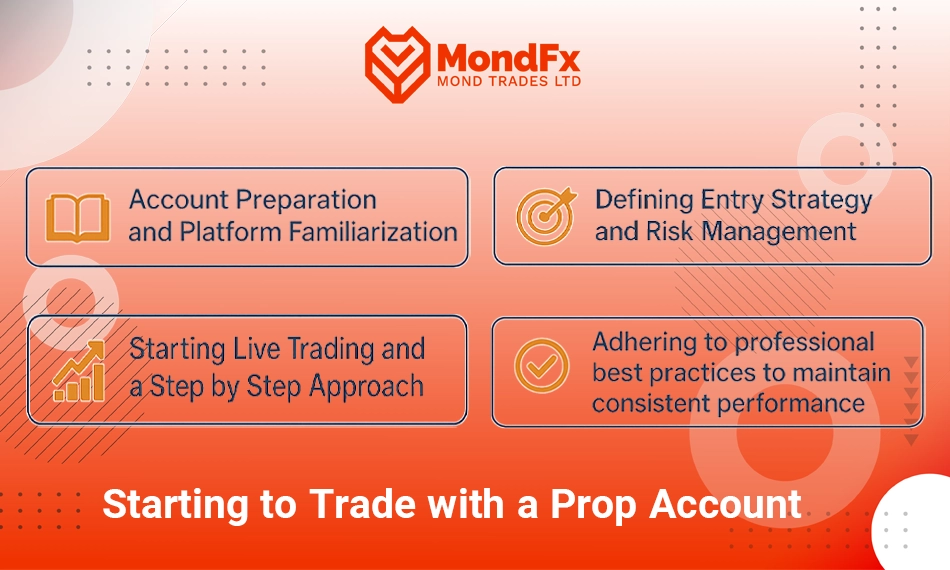
Account Preparation and Platform Familiarization
After successfully completing the evaluation stage, the trader enters the operational phase using the firm’s capital. At this point, the first and most important step is to become thoroughly familiar with the trading platform. The trader should learn precisely how to open and close positions, set stop loss and take profit levels, select appropriate leverage, and access charts and analytical tools. It is recommended to spend a few days practicing with a demo account or the platform’s simulation feature before engaging in live trades, to eliminate any mistakes caused by unfamiliarity with the interface. This preparation forms the foundation for quick and accurate decision making in real market conditions.
Defining Entry Strategy and Risk Management
The next step involves establishing a trading strategy and a clear risk management framework. For each position, the trader should predefine the acceptable level of risk, entry and exit points, trade size, and the risk to reward ratio. In prop accounts, firms typically enforce strict rules regarding daily drawdown limits, maximum leverage, and position caps. Failure to comply with these rules can result in account termination or loss of credibility. Therefore, the trader must align their strategy with these regulations and avoid emotional or high risk trades. Strict adherence to this framework not only reduces the risk of capital loss but also demonstrates the trader’s discipline and professionalism.
Starting Live Trading and a Step by Step Approach
Entering live trading with prop firm capital is an opportunity to test practical abilities and decision making under real market conditions. The best approach is to begin with small, controlled trades, allowing the trader to adapt to actual market pressure and the firm’s rules. At this stage, analyzing each trade and identifying the reasons behind success or failure are highly important. Recording and reviewing trade details, noting mistakes, and refining strategies form the foundation for professional growth and optimal use of prop capital. Over time, as experience grows, the trader can gradually increase trade size and risk exposure step by step, ultimately reaching a professional level of prop account trading.
Adhering to Professional best practices to Maintain Consistent Performance
For long term success, a trader must maintain emotional control and financial discipline while executing trades. Using leverage limits, adhering strictly to stop loss and take profit levels, and avoiding emotional reactions to market fluctuations help prevent common mistakes. It is also advisable for traders to review their performance weekly or monthly, identify strengths and weaknesses, and adjust their strategies based on actual results. This progressive and consistent approach enables traders to manage prop capital intelligently and maximize their long term success potential.
Insights from Professionals
One of the biggest mistakes beginner traders make with prop accounts is failing to thoroughly read the firm’s rules. Every prop firm has its own specific regulations regarding daily loss limits, overall drawdown limits, leverage ratios, permitted trading hours, and even allowed currency pair s. Many traders are disqualified despite solid analytical performance simply because they overlook these details. Therefore, before starting, a trader must carefully study all the firm’s rules, plan accordingly for each restriction, and understand that even a single violation can halt their entire progress. In a prop account, success is not based solely on market analysis it depends equally on precise management within the established framework.
The Importance of Personal Discipline and a Structured Trading Approach
Discipline in prop trading is the key distinction between a serious trader and an amateur one. In this field, no one supervises your actions or points out your mistakes you must be your own observer and performance manager. It is recommended to establish a clear daily trading routine that includes designated market entry hours, analysis times, appropriate trading zones, and stop trading points in case of consecutive losses. Many successful prop traders have achieved long term consistency in high capital accounts simply through maintaining this basic level of discipline.
Managing Psychology and Controlling Emotions Under Market Pressure

In a prop account, every decision can have a direct impact on the continuation of your partnership with the firm a fact that naturally increases psychological pressure. A trader must learn to avoid emotional decisions in response to consecutive losses or large profits.
For example, after a successful trade, suddenly increasing position size is one of the most fatal mistakes, as it can easily lead to violating the daily loss limit. The best way to maintain emotional control is to adhere strictly to a pre written trading plan and record every decision in a trading journal. Reviewing this journal at the end of the day not only reveals weaknesses but also enhances mental awareness and focus for future trades.
Performance Analysis and Continuous Strategy Improvement
A prop account is not merely for earning profits; it is a tool for testing, refining, and maturing your trading strategy. Every trader should regularly evaluate their performance. This evaluation includes reviewing the profit to loss ratio, the percentage of successful trades, the average risk per trade, and the trader’s reaction to losses.
Using analytical tools such as MyFXBook or Excel for data recording can provide a clear insight into your trading behavior. By analyzing this data, one can determine which trading style is more profitable, which timeframes perform better, and under what conditions the likelihood of mistakes increases. This awareness forms the foundation of genuine improvement.
Maintaining Stability and Gradual Growth on the Professional Path
In a prop account, the real goal is not rapid profit but long term stability and incremental growth. Many prop firms gradually allocate more capital to traders who demonstrate consistent performance.
Therefore, a trader should avoid high risk behavior, impulsive profit seeking, and the pursuit of unrealistic gains. Instead, focusing on reasonable and steady profits builds the company’s trust and paves the way for capital increases of up to several hundred thousand dollars.
Effective Interaction with Support and the Trader Community
Most prop trading firms have forums and channels for trader interaction. Participating in these spaces offers an excellent opportunity to learn from others’ experiences. A trader can learn from common mistakes, draw inspiration from successful methods, and seek guidance from the company’s support team when problems arise. Sometimes, such simple interactions can prevent a serious mistake.
Final Word
Purchasing a prop account may seem like a simple financial action on the surface, but in reality, it marks the beginning of a professional journey in the world of trading. Entering the realm of prop trading is not merely about gaining access to more capital; it is a test of mental maturity, behavioral discipline, and the ability to make sound decisions under real market conditions. Any trader who wishes to make proper use of this opportunity must develop in three key dimensions: analytical knowledge, capital management, and psychological control.
Throughout the process of purchasing and using a prop account, a trader learns that true success lies not in the speed of earning profits, but in the ability to maintain consistency and repeatedly execute correct performance.
Ultimately, purchasing a prop account should be regarded as an investment in oneself. This account is not merely a tool for trading but an opportunity to demonstrate mental maturity, strengthen personal discipline, and build the mindset of a professional trader one who can deliver stable and reliable performance within the framework of the prop firm’s rules.