

Entering a trade is like the moment a surfer decides to catch a rising wave; if the timing is right, the wave carries them forward with a sense of control and excitement, but even the smallest mistake can lead to a painful fall yet one that becomes a valuable lesson for future trades. In this world, entry strategies act as guiding lights; they show you when to move and when to wait, allowing you to view the market with discipline, logic, and analysis rather than relying on guesswork and emotion. Some strategies are fast and adrenaline driven, others slow and cautious; some follow the trend, while others are built around short term volatility. But they all share one goal: reducing risk and increasing the probability of success at the moment of entry.
This article from MondFx introduces you to the most popular entry strategies in Forex methods tested by thousands of traders in real markets that have helped them not only identify market waves but also ride them with greater confidence on their path toward success.
Trading Strategy definition
A trading strategy refers to a set of principles, methods, and techniques that traders in financial markets adopt to execute their trades.
These strategies are typically based on various forms of analysis including technical analysis, fundamental analysis, and market psychology and are combined with trading tools to make buying and selling decisions more logically, aim for higher profitability, and reduce trading risks.
Components of Trading Strategies
1. Trading Objectives
Every strategy must be built around clearly defined goals such as the desired level of profit, acceptable risk tolerance, the holding period of assets, and many other factors, so that trade entry points can be identified accurately.
2. Entry and Exit Points
Entry strategies (buying) and exit strategies (selling) should be determined precisely based on technical analysis such as price patterns and trading signals as well as fundamental analysis derived from economic news and market indicators.
3. Setting Take Profit and Stop Loss Levels
Traders must be well versed in risk management concepts and the use of take profit and stop loss orders so they can apply them effectively to manage risk within their trading strategies.
The Importance of Trade Entry Strategies
Entry strategies help traders enter the market at the most optimal time. A well chosen entry point can create the opportunity for greater profits while minimizing the risk of loss. Without a defined entry strategy, trading decisions become automatic and unplanned, which can lead to repeated losses.
How to choose the best entry strategy?
To select a suitable strategy for entering a trade, you must follow several professional guidelines, including testing strategies through a demo account, setting take profit and stop loss levels based on technical analysis, continuously reviewing and improving strategies, and maintaining accuracy and discipline in your trading behavior.

Choosing the best entry strategy depends on factors such as your trading style, the market type, and your level of experience. If you are an active trader operating in short term timeframes, technical analysis and tools like indicators and price patterns may be more suitable for you. However, if you prefer long term trading, fundamental analysis and economic news may prove more effective.
Types of Trade Entry Strategies
This section examines the various types of trade entry strategies:
Entry Strategies Based on Technical Analysis
Technical analysis is one of the most popular methods for identifying trade entry points. This strategy relies on the use of charts and historical price data to forecast future market movements. Traders analyze price patterns, trendlines, and support and resistance levels to pinpoint areas where price is more likely to reverse.
Typically, tools such as moving averages (MA), pivot points, and indicators are used to confirm entry signals. This strategy is especially suitable for short term traders who seek to enter the market at specific points with defined price fluctuations.
Entry Strategies Based on Fundamental Analysis
Fundamental analysis is an approach based on examining economic, political, and financial conditions to identify entry points. In this strategy, traders monitor economic news and reports such as employment data, GDP reports, the Consumer Price Index (CPI), and interest rates to anticipate when the market may shift direction due to fundamental changes.
Fundamentals based entry strategies are generally used for long term trading and in situations where structural economic shifts can significantly influence the market. In this method, traders must maintain close oversight of global economic news and developments.
Entry Strategies Based on Indicators and Oscillators
Indicator and oscillator based strategies are among the most common approaches for identifying market entry points. In these strategies, traders use tools such as RSI (Relative Strength Index), MACD (Moving Average Convergence/Divergence), Stochastic, and Bollinger Bands to pinpoint areas where price is likely to reverse. These indicators help traders identify overbought and oversold conditions and enter trades accordingly.
For example, when the RSI reaches an overbought or oversold zone, it may signal a potential buy or sell entry. Indicator and oscillator based strategies are generally suitable for traders seeking precise short term entry signals.
Entry Strategies Based on Price Action
Price action based strategies are among the simplest yet most effective methods for entering the market. In this approach, traders focus solely on price movements and price patterns without using any technical tools such as indicators or oscillators.
Price action analysts typically look at candlestick patterns (such as Doji, Engulfing, and Harami) and support and resistance levels to determine whether the market is ready to change direction. In this strategy, traders pay attention to the natural movement of price and its reactions at various levels, taking advantage of rapid market changes. This method allows traders to analyze the market directly, without relying on complex tools.
Active and Passive Entries: What is the Difference?
Trade entries in financial markets are generally divided into two main categories: Active Entry and Passive Entry.
Active Entry (Aggressive Entry) occurs when traders enter a position immediately after spotting an initial signal even when secondary confirmations have not yet formed. Active entry can offer a favorable risk to reward ratio; however, it naturally increases the likelihood of error.
Passive Entry takes place when traders wait for secondary confirmations of the signal. These confirmations typically include breakout levels, a confirming candle close, and so on.
For example, in an uptrend, a trader may wait for a price correction to the 61.8% Fibonacci level and then enter a long position upon observing a bullish engulfing candle. In this case, the entry is based on technical confirmation and is considered passive.
Common Mistakes in Trade Entry Strategies
Everything depends on choosing the right moment and identifying the proper conditions for entering trades in the market.
Recognizing common mistakes in entry strategies is one of the most important factors for achieving success in trading. However, many traders, especially beginners or those under emotional pressure make errors during the entry process that not only cause them to miss opportunities but sometimes lead to significant losses.
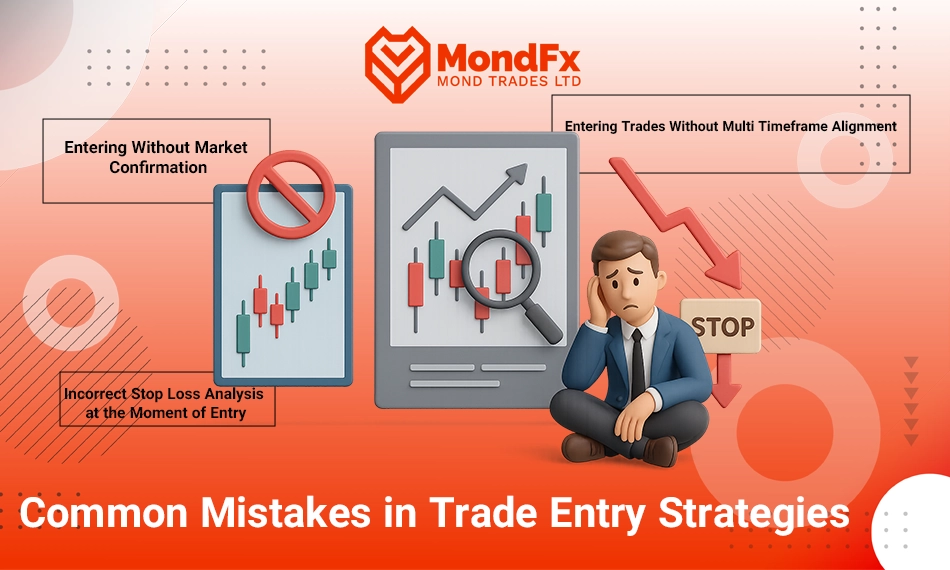
Some of the most common mistakes traders make when entering a trade include:
Entering Without Market Confirmation
One of the most common mistakes is entering a trade solely based on an initial signal or merely on guesswork and predictions. In many cases, a trader opens a position after seeing just one candle or a weak, unsupported signal without waiting for confirmation from price structure, higher timeframes, or additional analytical tools.
This type of entry generally carries high risk and a greater probability of failure, as the initial signal alone may not be reliable or may form against the prevailing market trend.
Entering Trades Without Multi Timeframe Alignment
Entering a trade based on a lower timeframe signal without checking its alignment with the trend in higher timeframes is one of the fundamental mistakes in multi timeframe analysis.
For example, if a buy signal appears on the 5 minute chart but the main trend on the 4 hour chart is bearish, entering a long position contradicts the broader market structure and is highly likely to fail.
A lack of alignment between timeframes often results in weak entries and unsupported positions.
Incorrect Stop Loss Analysis at the Moment of Entry
Every entry strategy requires a precise definition of the stop loss level. Entries made without setting an appropriate stop loss or with stops placed too close are prone to being triggered prematurely due to random fluctuations. Conversely, overly wide stop losses increase the risk to reward ratio and reduce the efficiency of the trading system.
The stop loss must be determined based on candle structure and key market levels, not on arbitrary numbers or uniform settings across all positions.
Conclusion
Entering the Forex market without a defined strategy is like jumping onto an uncertain wave; even the smallest mistake can jeopardize your profit potential or your capital.
Entry strategies help traders make disciplined and logical decisions by identifying optimal buy and sell points, managing risk, and analyzing the market keeping them away from guesswork and emotions. These strategies can be designed based on technical analysis, fundamental analysis, indicators, or even price action, and are selected according to each trader’s style, timeframe, and objectives.
Furthermore, understanding the difference between active and passive entries and avoiding common mistakes such as entering without confirmation, incorrect multi timeframe analysis, and improper stop loss placement plays a decisive role in trading success. Ultimately, successful trade entry depends not only on choosing the right tools and methods but also on a trader’s ability to read market conditions, wait patiently for confirmations, and adhere to the rules of their own strategy.
If you are looking to begin a more confident journey in the world of trading, partnering with the MondFx team can be a strong starting point for building your personal trading strategy.