
The U.S. dollar has lost more than 11 percent of its value since Donald Trump took office; a development that, contrary to expectations, has been welcomed by the President of the United States. The dollar typically strengthens during periods of economic or geopolitical crisis, but in 2025 this pattern shifted. Despite multiple risks, the dollar weakened, as a significant portion of the uncertainty originated from within the U.S. economy itself. This article examines why the dollar has depreciated and why Trump supports this trend.
Author: Sajjad Sheikhi
The U.S. dollar has lost more than 11 percent of its value since Donald Trump took office; a development that, contrary to expectations, has been welcomed by the President of the United States. The dollar typically strengthens during periods of economic or geopolitical crisis, but in 2025 this pattern shifted. Despite multiple risks, the dollar weakened, as a significant portion of the uncertainty originated from within the U.S. economy itself.
This article examines why the dollar has depreciated and why Trump supports this trend.
Why Did the Dollar Decline?
Multiple factors simultaneously contributed to the depreciation of the dollar. The Trump administration’s trade policies in 2025 were marked by significant volatility and uncertainty, with tariffs being repeatedly raised and lowered. These tariffs were implemented with the aim of supporting domestic production and weakening the exports of competitors, particularly China.
In Western countries, there is a prevailing view that China, through extensive subsidies and the supply of low cost goods, has disrupted fair competition in global trade. However, available data indicate that these tariffs had a limited impact on China’s exports, as China redirected a substantial portion of its exports to alternative markets.
On the other hand, these tariff policies, by influencing inflation, delayed interest rate cuts in the United States and intensified market uncertainty.
In late 2025, the United States experienced the longest government shutdown in its history. During this shutdown, the economy faced a high degree of uncertainty; the release of economic data was disrupted, statistical noise increased, and gross domestic product was adversely affected. The combination of these factors led to the weakening of the dollar during that period.
U.S. foreign policy also played a role in amplifying uncertainty. Support for Israel during the 12 day war, positions related to Venezuela, and the increased likelihood of confrontation with Iran were all perceived by investors as geopolitical risks.
The Federal Reserve and Its Role in the Dollar’s Depreciation
In addition to the factors mentioned above, Trump’s persistent pressure on the Federal Reserve to lower interest rates also contributed to the weakening of the dollar. Trump sought to offset potential economic weakness resulting from tariff policies through interest rate cuts.
In a developed economy such as the United States, where central bank independence is a fundamental principle, presidential commentary and intervention in monetary policy can call the institution’s independence into question and undermine investor confidence. Interest rates should be determined solely on the basis of economic variables, with the objective of controlling inflation and employment. Despite political pressure, the Federal Reserve maintained this approach under Powell’s leadership.
At the same time, as inflation declined and signs of weakness emerged in the labor market, market expectations for interest rate cuts in the second half of the year increased. Interest rate reductions, due to the decline in returns on low risk investments, typically lead to a weaker dollar.
Winners and Losers of a Weak Dollar
If the dollar remains weak against the world’s major currencies for an extended period, U.S. exporters will benefit from this situation. Under such conditions, American goods are offered at lower prices in global markets, and the purchasing power of foreign buyers increases. Overall, this development works in favor of American producers.
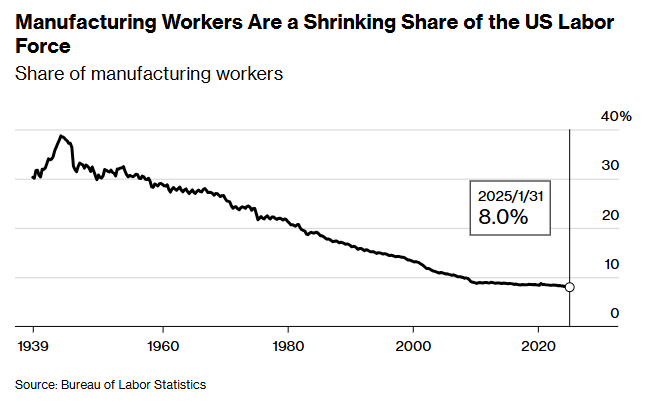
However, it should be noted that the share of manufacturing in the U.S. economy has declined significantly compared with past decades. In the 1950s, more than 30 percent of the U.S. workforce was employed in manufacturing, whereas this figure has now fallen to less than 8 percent even despite Trump’s promises to reindustrialize the country. Therefore, a revival of this sector is likely to have a limited impact on economic growth in the short term, although the administration’s tariff policy has been designed with the aim of strengthening precisely this sector.
By contrast, a weaker dollar implies higher prices for imported goods and increased inflationary pressure on American consumers. Consumers will be compelled to pay more for imported products.
Higher inflation is typically associated with higher interest rates, although there is debate as to whether rapid economic growth could offset part of the inflationary pressure and create room for interest rate cuts. Higher interest rates also mean an increase in the government’s financing costs.
A Weak Dollar and U.S. Government Debt
U.S. government debt has reached approximately $37 trillion and is often referred to as a crisis. However, the main issue is not the size of the debt, but rather how it is managed. This debt is not intended to be repaid in a lump sum; rather, it consists of a set of securities with long term maturities.
In return for this debt, the United States utilizes global capital to develop infrastructure and strengthen economic growth. This process is built upon the historical credibility of the U.S. economy and its growth capacity. In fact, what matters is economic growth, not merely the amount of debt.
If the U.S. economy maintains sustainable growth, the ability to repay debts is preserved. In recent years, the United States has recorded the highest economic growth among the G7 countries and has demonstrated significant resilience in the face of crises.
Within this framework, a weaker dollar can be beneficial for the government, as debt repayment is carried out at a lower real cost, and the debt cycle continues.
Will the Dollar Lose Its Status?
The dollar is deeply embedded in the structure of the global economy. A significant portion of U.S. Treasury securities is held by the country’s economic rivals, commodity pricing is conducted in dollars, and around 60 percent of the world’s central bank foreign exchange reserves are held in dollars.
Replacing the dollar would require extensive changes in the global financial system, economic growth patterns, and the geopolitical balance. The dollar’s strength as the world’s reserve currency stems from the economic growth and resilience of the U.S. economy. Given the sheer size of the dollar denominated asset market, the withdrawal of foreign investors from such assets would be a time consuming process.
To replace the dollar, a currency would need to be supported by a deep and highly liquid debt market a characteristic that no other country currently offers in full. The most likely scenario is a gradual shift toward a multipolar currency system, in which the dollar continues to play a dominant role, although its share may decline.
Conclusion
A weak dollar, as long as it remains within a controlled range, can generate more benefits for the U.S. government than a very strong dollar. This situation supports exports, assists the industrial sector, and reduces the real cost of government debt repayment.
However, the continuation of this trend has its limitations. The most likely scenario is the stabilization of the dollar at current levels or slightly higher, as the scope for interest rate cuts is more limited than market expectations suggest, and U.S. economic growth in 2026 could prevent a sharp depreciation of the dollar. At the same time, the Trump administration’s policy inclination is not toward a strong dollar, and this factor will influence market expectations.