

Oscillators are among the most important tools in technical analysis, used by traders to identify optimal entry and exit points in the market. Their primary function is to detect overbought and oversold conditions — moments when a price reversal or correction is likely to occur. This insight helps investors trade with greater precision and reduced risk. According to a study on the cryptocurrency market in 2023, using the RSI oscillator with a 14-day period provided successful reversal signals in over 67% of cases.
How Oscillators Work in Technical Analysis
Oscillators are designed based on specific mathematical calculations that consider past and present market prices. These tools are especially useful when the market is in a ranging state. Oscillators usually display their values within a defined range (such as 0 to 100), and when they approach the extreme points of this range, there is a higher probability of a trend reversal.
Commonly Used Oscillators
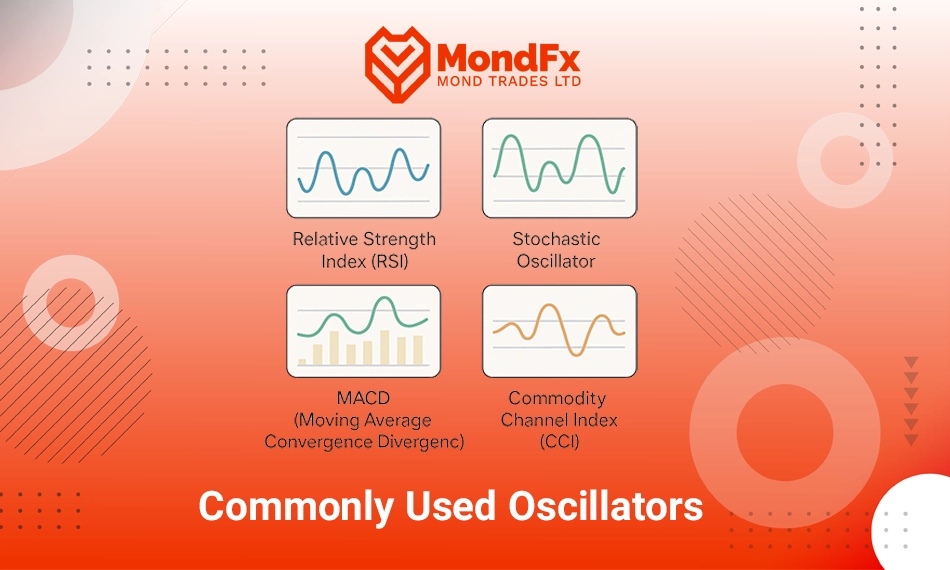
In financial markets, oscillators are considered one of the key tools in technical analysis, and various types of oscillators with distinct features and applications are available to traders. Below are some of the most widely used oscillators:
Relative Strength Index (RSI)
The Relative Strength Index (RSI) is one of the most common oscillators in technical analysis. This index is used to identify overbought and oversold conditions. RSI fluctuates between 0 and 100, and when its value exceeds 70, it indicates overbought conditions with a higher chance of a price decline. Conversely, values below 30 indicate oversold conditions, which can signal a potential price increase. RSI is popular among traders due to its simplicity in interpretation and accurate signal generation and is often used in combination with other technical analysis tools.
Stochastic Oscillator
The Stochastic Oscillator is another widely used tool in technical analysis designed to identify overbought and oversold conditions. This oscillator measures the speed and momentum of price movement within a specified range and generally performs better in ranging markets (markets without a clear trend). The Stochastic Oscillator typically fluctuates between 0 and 100, with values above 80 indicating overbought conditions and values below 20 indicating oversold conditions. An important aspect of the Stochastic Oscillator is its rapid response to price changes, which allows traders to receive reversal signals earlier than with other oscillators. However, this characteristic can occasionally lead to false signals, so it is best to use this oscillator in conjunction with other technical analysis tools.
MACD (Moving Average Convergence Divergence)
The MACD (Moving Average Convergence Divergence) indicator is one of the most popular and powerful oscillators in technical analysis. This index is calculated based on the difference between two moving averages and provides valuable information about price trends and potential reversal points. MACD consists of three main components:
MACD Line: The difference between the 26-period Exponential Moving Average (EMA) and the 12-period EMA.
Signal Line: The 9-period EMA, which is used to generate buy and sell signals.
Histogram: Bars that display the difference between the MACD line and the Signal line.
A buy signal is typically generated when the MACD line crosses above the Signal line from below. Conversely, when the MACD line crosses below the Signal line from above, a sell signal is indicated. Since MACD generally performs well in strongly trending markets, it is recommended to use it in combination with other technical analysis tools.
Commodity Channel Index (CCI)
The Commodity Channel Index (CCI) is one of the most commonly used oscillators in financial markets. Initially designed for analyzing commodity markets, it is now widely used in stock, forex, and cryptocurrency markets. CCI typically fluctuates between -100 and +100, but in some cases, it may move beyond this range. When the CCI value rises above +100, it indicates overbought conditions and a potential price decrease. Conversely, values below -100 indicate oversold conditions and a potential price increase. The CCI is also highly effective in identifying the beginning of new trends. When this index crosses above the +100 range and continues to rise, it may indicate the start of a strong upward trend. Conversely, dropping below the -100 level may signal the beginning of a downward trend.
Using these oscillators together and in combination with other technical analysis tools can significantly improve accuracy in analysis and trading decisions.
How to Use Oscillators
Oscillators are usually used alongside other technical analysis tools and play a crucial role in identifying market reversal points, confirming trends, and predicting price behavior. Given the unique characteristics of oscillators, understanding how to use them correctly can improve trading performance.
Oscillators perform best in ranging markets. In such conditions, where the price is fluctuating within a defined range, oscillators can provide reliable signals regarding entry and exit points. Conversely, in strongly trending markets (whether bullish or bearish), oscillators may generate false signals. For this reason, it is recommended to use oscillators alongside other technical tools such as trend lines, price patterns, and trading volume indicators to reduce risk.
Main Applications of Oscillators
1.Identifying Entry and Exit Points
One of the most important applications of oscillators is identifying suitable points for entering or exiting a trade. Many oscillators such as RSI, Stochastic, and CCI issue reversal signals when the price approaches overbought or oversold zones. For instance, when RSI rises above 70, the probability of a price correction increases. Conversely, when RSI falls below 30, it may indicate a buying opportunity. Combining these signals with other confirmation tools such as support and resistance can improve analysis accuracy.
2.Confirming Price Trends
Oscillators can serve as trend confirmation tools in technical analysis. For example, in the MACD indicator, when the MACD line is above the signal line, it confirms an uptrend. Conversely, when the MACD line is below the signal line, a downtrend is more likely. This type of confirmation can help traders avoid entering trades too early or too late.
3.Identifying Divergences
Divergences are one of the most powerful signals provided by oscillators. A divergence occurs when price behavior and the oscillator move in opposite directions. This phenomenon is usually a sign of weakness in the current trend and the potential for price reversal. Divergences occur in two forms:
Bullish Divergence: When the price forms lower lows, but the oscillator creates higher lows. This situation typically signals weakness in the downward trend and the possibility of a bullish reversal.
Bearish Divergence: When the price forms higher highs, but the oscillator forms lower highs. This situation indicates weakness in the upward trend and the likelihood of a bearish reversal.
Divergences are powerful signals that play a key role in identifying market reversals. However, due to the possibility of false signals in some conditions, it is recommended to use divergences alongside other technical tools for better confirmation.
Important Tips for Using Oscillators
To receive more reliable signals, it is advisable to analyze oscillators in higher timeframes (such as 4-hour, daily, and weekly).
In markets with strong trends, oscillators alone may not provide accurate signals. In such cases, combining them with trend-following indicators like moving averages can be more effective.
Analyzing multiple oscillators simultaneously can improve the accuracy of signals. For example, combining RSI and MACD can generate stronger and more reliable signals.
Ultimately, using oscillators correctly requires practice and experience. Developing a deep understanding of these tools and considering market conditions can significantly increase trading success.
Advantages and Disadvantages of Oscillators
Oscillators have both strengths and limitations that traders must be aware of to use them effectively.
Advantages of Oscillators
Oscillators are essential tools in technical analysis and possess several positive attributes that make them suitable for many traders. One of the most significant advantages of oscillators is their ability to identify price reversal points. This feature allows traders to enter or exit the market at optimal times.
Additionally, oscillators perform particularly well in ranging markets (markets without a clear trend). In such conditions, where prices fluctuate within a fixed range, oscillators can accurately identify potential price reversal points.
Another notable advantage of oscillators is their ability to be combined with other technical analysis tools. This feature enables traders to confirm oscillator signals using complementary tools such as trendlines, support and resistance, and price patterns, significantly improving decision-making accuracy.
Disadvantages of Oscillators
Despite their numerous advantages, oscillators also have certain limitations that traders should be mindful of. One of the main drawbacks of oscillators is the risk of issuing false signals in strongly trending markets. In such conditions, oscillators may signal a trend reversal prematurely, resulting in potential losses for traders.
Moreover, signals generated by oscillators typically require confirmation through other technical analysis tools. Relying solely on oscillator signals without examining overall market conditions can increase trading risk. For this reason, traders are advised to always validate oscillator signals using complementary analysis tools to improve accuracy in trading decisions.
What are Oscillators and Indicators?
Oscillators and indicators are two essential tools in technical analysis used to predict price movements and identify market trends. Both tools utilize past price data, trading volume, and time to provide valuable insights for traders. However, there are key differences between them.
What is an Indicator?
Indicators are broader tools designed to analyze price trends, identify entry and exit points, and confirm market direction. These tools are typically divided into two main categories:
Trend-Following Indicators: These indicators are used in markets with strong trends and help identify the direction and strength of the trend.
Leading Indicators: These indicators are designed to predict market reversal points and are usually used in combination with other tools.
Difference Between Oscillators and Indicators
Although oscillators are a subset of indicators, there are key differences between these two tools. Indicators are primarily focused on displaying the overall trend direction, while oscillators concentrate on identifying reversal points and price fluctuations. For this reason, combining these two tools in trading strategies can enhance decision-making accuracy.
Which is Better: Indicators or Oscillators?
The question of whether indicators or oscillators are superior is a common debate among traders. To answer this, it is essential to understand that both tools play distinct roles in technical analysis, and the choice between them depends on market conditions and individual trading styles.
Indicators are broader tools that encompass oscillators as well. Indicators are generally divided into two main categories: trend-following indicators and leading indicators. Trend-following indicators such as Moving Averages and the Ichimoku Cloud typically perform better in strongly trending markets and help confirm trend direction and strength. These indicators are better suited for trading in the direction of the trend and rarely indicate precise reversal points.
Conversely, oscillators generally perform better in ranging markets (markets without a clear trend). Tools such as RSI and Stochastic excel in these conditions by identifying overbought and oversold zones, helping traders pinpoint potential market reversal points. This characteristic makes oscillators particularly effective in volatile and sideways markets.
Which Tool is Better?
The answer to this question depends on market conditions.
In markets with strong trends, trend-following indicators tend to perform better and can prevent early entries or late exits.
In ranging markets without a clear trend, oscillators usually perform better and provide suitable trading opportunities by identifying overbought and oversold levels.
In practice, combining both tools produces better results. Many professional traders enhance their analysis accuracy by using both indicators and oscillators simultaneously. For example, using a moving average to confirm a trend along with RSI to identify optimal entry or exit points can be highly effective.
Ultimately, neither indicators nor oscillators alone can fully address market analysis needs. The best approach is to combine these tools strategically based on market conditions and your trading strategy.
What is Dominance and Its Relationship with Oscillators?
Dominance refers to the share or dominance of a particular asset compared to the entire market. In the cryptocurrency market, dominance typically refers to Bitcoin's share of the total crypto market value. For example, if Bitcoin dominance is 50%, it means that half of the total cryptocurrency market value belongs to Bitcoin.
Dominance plays a significant role in market analysis and can be used as a key indicator to identify major market trends. When Bitcoin dominance increases, it usually indicates that capital is flowing out of altcoins and into Bitcoin. Conversely, a decrease in Bitcoin dominance may indicate increased demand for altcoins.
Relationship Between Dominance and Oscillators
Dominance can be combined with oscillators to identify overbought and oversold conditions in financial markets. For example, if Bitcoin dominance is rising and oscillators like RSI or Stochastic are also in the overbought zone, this condition may indicate a potential price reversal and a decrease in Bitcoin’s dominance in the market. Conversely, if Bitcoin dominance is declining while oscillators are in the oversold zone, this may signal a potential increase in Bitcoin’s price and a return of capital to Bitcoin.
Oscillators, alongside dominance data, can also be used to identify entry and exit points in altcoin trades. For instance, when Bitcoin dominance decreases and the RSI oscillator in the altcoin market is in the oversold zone, this scenario may create a suitable opportunity to enter altcoin trades.
In general, combining dominance data with oscillator-generated signals can help traders make more informed decisions and capitalize on profitable opportunities in financial markets.
Oscillator Volatility Analysis

Oscillator volatility analysis is one of the key methods for identifying price changes and potential market reversal points. Due to their fluctuating nature, oscillators move within specific ranges, and their variations can provide crucial information about market trends.
Examining Overbought and Oversold Levels
One of the primary methods of analyzing oscillator volatility is observing overbought and oversold levels. When an oscillator enters the overbought zone (such as RSI above 70 or Stochastic above 80), the likelihood of a bearish reversal increases. Conversely, when the oscillator reaches the oversold zone (such as RSI below 30 or Stochastic below 20), this indicates a higher probability of a bullish reversal. In such conditions, traders typically look for reversal signals to enter the market.
Identifying Divergences in Oscillator Volatility
Divergences are another critical signal in oscillator volatility analysis. A bullish divergence occurs when the price forms lower lows, but the oscillator forms higher lows. This condition usually signals weakness in the downtrend and a potential bullish reversal. Conversely, a bearish divergence appears when the price creates higher highs, but the oscillator forms lower highs. This condition often indicates weakness in the uptrend and the likelihood of a bearish reversal.
Analyzing Oscillator Breakouts
Oscillator breakouts are one of the crucial signals in oscillator volatility analysis. In oscillators such as MACD, when the MACD line crosses the signal line, it may indicate the beginning of a new trend. Such breakouts usually occur following a period of low volatility and may signal the start of a strong market move.
Oscillator Performance in Ranging and Trending Markets
Oscillators generally perform more accurately in ranging markets, as in these conditions, price fluctuations occur within a limited range, and oscillators can better identify reversal points. On the other hand, in markets with strong trends, oscillators may remain in overbought or oversold zones for extended periods, potentially generating false signals. In such cases, combining oscillators with other tools such as trend lines and support/resistance levels can improve the accuracy of trades.
Importance of Timeframes in Oscillator Volatility Analysis
To enhance the accuracy of oscillator volatility analysis, traders should choose appropriate trading timeframes. In shorter timeframes, oscillators may generate multiple signals, many of which may be unreliable. Conversely, in higher timeframes, oscillator signals are generally more accurate and reliable.