

How Do Forex Spreads Change?
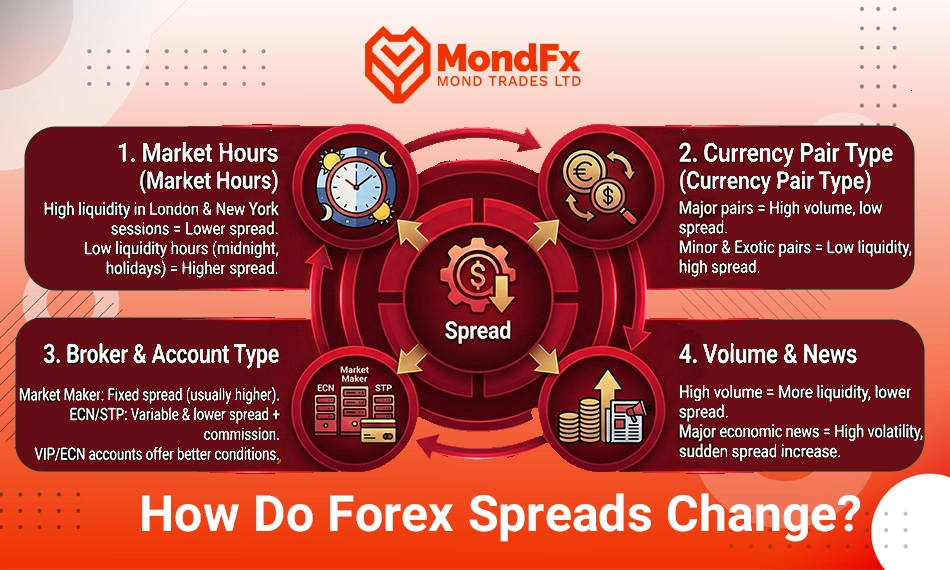
The spread of currency pairs is influenced by multiple factors, and being aware of them helps traders choose the best time and currency pair for trading. The first factor is market hours; during periods when major markets such as London and New York are open, liquidity is higher and spreads decrease. The second factor is the type of currency pair; major pairs such as EUR/USD have lower spreads due to high trading volume, while minor and exotic pairs usually have higher spreads. In addition, economic news and important events can cause sharp volatility and increase spreads. The type of broker and the structure of the trading account (such as ECN or standard accounts), as well as trade volume, also play an important role in determining the spread. Awareness of these factors helps traders optimize their trading costs.
Market hours and their impact on the spread
One of the most important factors that causes changes in currency pair spreads is market hours. The Forex market is open 24 hours a day worldwide, but liquidity in this market varies at different times of the day depending on trader activity.
During periods when major markets such as London and New York are active, trading volume rises significantly and market liquidity increases. This leads to a reduction in the difference between the bid and ask prices, known as the spread. Conversely, during low liquidity periods, such as late at night or on weekends, spreads increase because the number of traders and trading volume are lower, and the risk of executing trades is higher for brokers.
Type of currency pair and its impact on the spread
The type of currency pair is one of the key factors in determining the spread.Major pairs such as EUR/USD, USD/JPY, and GBP/USD usually have the lowest spreads due to high trading volume and strong liquidity. In contrast, minor pairs, and especially exotic pairs, have higher spreads because of lower liquidity and greater volatility. For example, currency pairs such as USD/TRY or USD/ZAR have relatively wide spreads, which increases trading costs and raises the trader’s risk in each transaction. Therefore, these types of currencies may not be a suitable choice for traders who are active in the field of prop trading.
Type of broker and trading account structure
The type of broker and the trading account model you use has a direct impact on the spread. In general, brokers are divided into three main categories: market makers, ECN (Electronic Communication Network), and STP (Straight Through Processing).
Market maker brokers offer a fixed spread, which may be slightly higher, but is generally considered suitable for beginner traders.
ECN brokers provide much lower spreads, but usually charge a separate commission for each trade.
Trading accounts also play an important role; VIP or ECN accounts typically offer lower spreads and better trading conditions. Choosing the right broker and account type can significantly reduce or increase spread related costs.
Trade volume and its relationship with the spread
Trade volume can also affect the spread. In many brokers, higher trade volume leads to lower spreads, because larger trades inject more liquidity into the market and reduce the broker’s risk. On the other hand, very small trades or trades executed during low liquidity periods may be accompanied by higher spreads. Therefore, understanding the impact of trade volume helps traders choose the most effective market entry strategy with the lowest possible cost.
The role of the spread in financial markets
The spread is not only a cost for the trader, but also serves important functions in financial markets. One of the main roles of the spread is to compensate for the risk of sharp market fluctuations, allowing brokers to cover costs arising from price volatility. In addition, the spread plays a key role in providing market liquidity, as maintaining a reasonable difference between bid and ask prices gives traders both the incentive and the opportunity to execute trades.
Moreover, the spread helps maintain price stability and prevents excessive and unrealistic price fluctuations.
How does spread reduce market volatility risk?
One of the main functions of the spread is to compensate for the risk of sharp market volatility. During periods when prices change rapidly and unpredictably, brokers and market makers are exposed to greater financial risks. The spread, as a hidden cost, allows them to cover these risks and prevent potential losses. In this way, brokers can process trades with greater confidence and maintain market stability.
Providing market liquidity
The spread plays a vital role in providing market liquidity. A reasonable difference between the bid and ask prices encourages traders and investors to execute their trades. This price difference acts as an incentive for liquidity providers to remain active in the market and supply buy and sell orders. As a result, the market becomes more active and efficient, enabling faster entry and exit of capital.
Maintaining price stability
Another important function of the spread is maintaining price stability. The existence of a difference between the bid and ask prices helps prevent excessive volatility and unrealistic price movements. The spread, in a way, contributes to market balance and prevents the formation of bubbles or sudden price crashes. This characteristic is essential for preserving the health and stability of financial markets.
A source of profitability for brokers and market makers
Ultimately, the spread is the primary source of profitability for brokers and market makers. Since many brokers do not charge a direct commission, their revenue is mainly generated from the difference between the bid and ask prices. This income allows them to offer better services, update trading platforms, and keep the market active. Therefore, the spread is essential for maintaining and developing the financial market ecosystem.
Currency Pairs With the Lowest Spreads in Forex
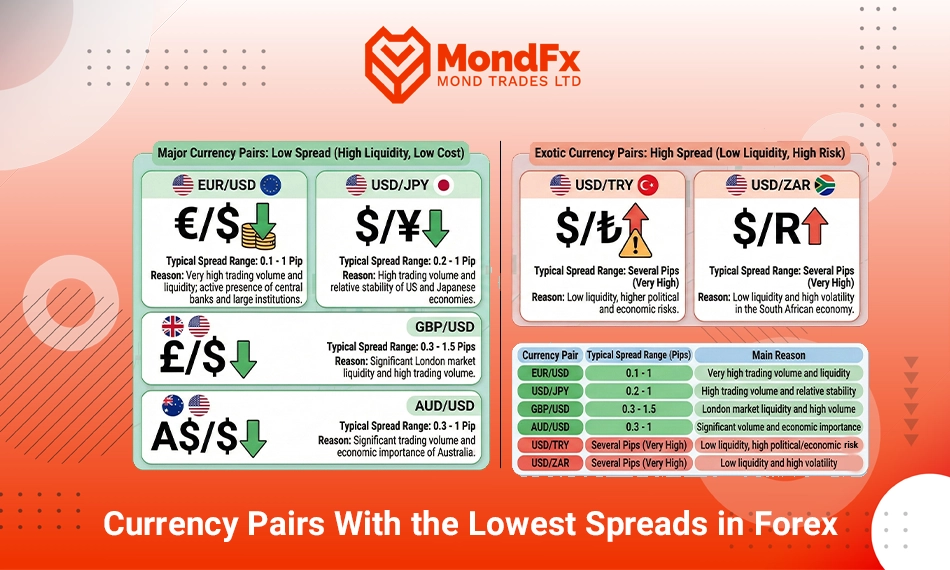
Currency pairs with the highest trading volume and liquidity usually offer the lowest spreads. Some of the most well known of these pairs include EUR/USD, USD/JPY, GBP/USD, and AUD/USD. For example, the EUR/USD pair, due to its extensive trading activity and the active presence of large banks and financial institutions, typically has a spread between 0.1 and 1 pip, which is very cost effective for traders. In contrast, exotic currency pairs such as USD/TRY or USD/ZAR, due to lower liquidity and higher risk, have much wider spreads, which can significantly increase trading costs. Therefore, choosing currency pairs with low spreads can play an important role in reducing trading costs and increasing profitability.
EUR/USD
The EUR/USD currency pair is recognized as the most popular and most actively traded currency pair in the world. The main reason for the low spread in this pair is the extremely high trading volume and strong liquidity provided by the central banks of Europe and the United States, as well as large financial institutions. This high level of liquidity results in a very small difference between the bid and ask prices (the spread), which typically fluctuates between 0.1 and 1 pip, making it cost effective and attractive for traders.
USD/JPY
The USD/JPY currency pair is also one of the major pairs in the Forex market and features a low spread. This is due to the high trading volume and the relative stability of the U.S. and Japanese economies. The active participation of central banks and large traders in this pair results in high liquidity and lower spreads; typically, the spread for this pair ranges between 0.2 and 1 pip.
GBP/USD
The GBP/USD currency pair, also known as the pound/dollar, is another major pair with a low spread. The reason for its low spread is the significant liquidity of the London market and the high volume of transactions between major banks in the United Kingdom and the United States. However, due to higher volatility compared to EUR/USD, the spread of this pair is usually slightly higher, ranging between 0.3 and 1.5 pips.
AUD/USD
The AUD/USD currency pair also offers a favorable spread due to its considerable trading volume and Australia’s economic importance as a major exporter of commodities. This pair provides lower spreads during the active hours of the Asian and Oceania markets, typically ranging between 0.3 and 1 pip.
Exotic currency pairs (such as USD/TRY and USD/ZAR)
Exotic currency pairs usually involve the currencies of developing countries or smaller economies, which tend to have lower liquidity and higher political and economic risks. As a result, the spreads on these pairs are significantly wider and can increase to several pips. For example, pairs such as USD/TRY (U.S. dollar against the Turkish lira) or USD/ZAR (U.S. dollar against the South African rand) have high spreads, which increase trading costs for traders.
| Currency Pair | Typical Spread Range (Pips) | Reason for Low or High Spread |
|---|---|---|
| EUR/USD | 0.1 – 1 | Very high trading volume and strong liquidity provided by central banks and large financial institutions |
| USD/JPY | 0.2 – 1 | High trading volume and the relative stability of the U.S. and Japanese economies |
| GBP/USD | 0.3 – 1.5 | Significant liquidity in the London market and high trading volume |
| AUD/USD | 0.3 – 1 | Considerable trading volume and Australia’s economic importance |
| USD/TRY (Exotic) | Several pips (very high) | Low liquidity and high political and economic risk |
| USD/ZAR (Exotic) | Several pips (very high) | Low liquidity and high volatility in the South African economy |
Final words
Overall, the spread is one of the most important cost components in Forex trading and has a direct impact on traders’ profitability. As discussed, factors such as market hours, the type of currency pair, broker structure, and trade volume play a decisive role in determining the level of the spread.
Major currency pairs especially EUR/USD, USD/JPY, GBP/USD, and AUD/USD due to their high liquidity and large trading volumes, offer the lowest spreads and are therefore a more logical choice for active traders, particularly those trading on short term time frames. In contrast, exotic currency pairs with higher spreads can increase trading costs and involve greater risk. Consequently, making an informed choice of currency pairs while simultaneously considering market conditions and the type of trading account can significantly reduce costs and pave the way toward more stable trading performance.
Frequently Asked Questions (FAQ)
What exactly is the spread in the Forex market and why is it important?
The spread refers to the difference between the bid and ask prices of a currency pair and is, in fact, one of the main hidden costs of trading in the Forex market. The lower the spread, the lower the cost at which a trader enters a trade, allowing them to reach profitability more quickly. For this reason, the spread plays an important role in trading strategies, especially short term trading strategies.
Which currency pairs usually have the lowest spreads?
Major Forex currency pairs such as EUR/USD, USD/JPY, GBP/USD, and AUD/USD usually have the lowest spreads. This is due to their high trading volume and strong liquidity, which keeps the difference between bid and ask prices to a minimum.
Why do exotic currency pairs have higher spreads?
Exotic currency pairs have higher spreads because of lower liquidity, higher volatility, and greater economic and political risks. Brokers widen the bid ask difference to compensate for these risks, which ultimately increases trading costs for traders.
Does the spread change at different times of the day?
Yes, the spread is strongly influenced by market hours. During the overlap of major markets such as London and New York, liquidity increases and spreads decrease, whereas during low liquidity periods or holidays, spreads usually become wider.
How does the type of trading account affect the spread?
The type of trading account can have a significant impact on the spread. ECN or VIP accounts usually offer lower spreads but may include a commission, while standard accounts often have higher spreads but do not charge a separate commission.