
Every day, millions of people sit behind their monitors, mobile phones, or laptops and make decisions about one common subject: to buy or to sell. Some are looking for additional income, some have entered with the hope of quick wealth, and others pursue trading as a full time profession. Behind these seemingly simple decisions lies an immense network of competition, excitement, fear, and analysis whose true scale can only be understood by looking at the global trader population. International estimates show that more than 300 million people around the world are in some way active in online financial markets, and around 100 to 150 million of them are considered active traders individuals who consistently trade in forex, stocks, cryptocurrency, and the commodities market, and who directly affect the intensity of volatility, liquidity depth, and price behavior. Knowing these numbers helps a trader understand the level of competitive density, the speed of market reaction, and the power of market participants they are facing.
When we know that each of our trading decisions is made within a market where millions of minds are simultaneously analyzing, erring, and competing, our perspective on capital management, risk, emotion, and even profitability becomes far more realistic. For this reason, examining the global trader population is not merely a statistical discussion; it is a window into understanding the real structure of this financial ocean. In this article from MondFx , we will explore the global trader population and its growing popularity.
What is the meaning of trader and statistical boundaries
To accurately discuss the global trader population, we must first present a precise understanding of the term “trader” in the context of financial markets. At first glance, a trader is someone who actively participates in buying and selling financial assets, but in practice, the definition of this term can vary depending on the type of market, trading style, and even the nature of one’s participation in the market.
Who is considered a trader?
A trader, in the precise sense, is an individual who conducts their trades based on analysis, a defined strategy, or a pre programmed algorithm, and whose presence in the market is not merely random or reactive.
This individual typically engages in trading on a daily, weekly, or otherwise regular basis, and their approach is founded on generating profit from market fluctuations. Such a definition includes active traders in markets such as forex, stocks, cryptocurrency, futures, options, and CFDs.
In contrast, many individuals enter the market solely for long term investment and may execute only a few trades in an entire year.
Although this group may appear to be traders, due to their inactivity in daily decision making or the absence of a trading system, they are not included in statistical analyses related to active traders. Additionally, those who use social trading platforms or copy trading without personal analysis are typically classified as passive users or investors, not professional traders.
The Difference Between a Trader, an Investor, and a Market User
In statistical analysis, distinguishing between a real trader and an individual who merely holds digital assets or stocks is highly important, because active participation in the market involves independent decision making, the use of analytical tools, risk control, and position management.
Meanwhile, many users operate in the market merely as asset holders or occasional buyers. This distinction, from a statistical perspective, results in the actual global trader population being significantly smaller than the total number of active accounts in financial markets.
How to Estimate the Global Trader Population
Research firms typically use indicators such as the number of trades per month, transaction volume, direct connection to a trading platform, and activity in real accounts to differentiate active traders from regular users.
For example, an individual who executes at least three to five real trades per month with personal decision making may be classified as a semi active trader. However, a user who enters the market only once every three months, even with high volume, is not considered an active trader.
With this approach, when we speak about the global trader population, the intention is not all individuals who possess trading accounts, but rather those users who actively, consistently, and consciously participate in the process of buying and selling assets. This more scientific definition increases the accuracy of statistics and comparative analyses across geographic regions, different markets, and behavioral trends of traders.
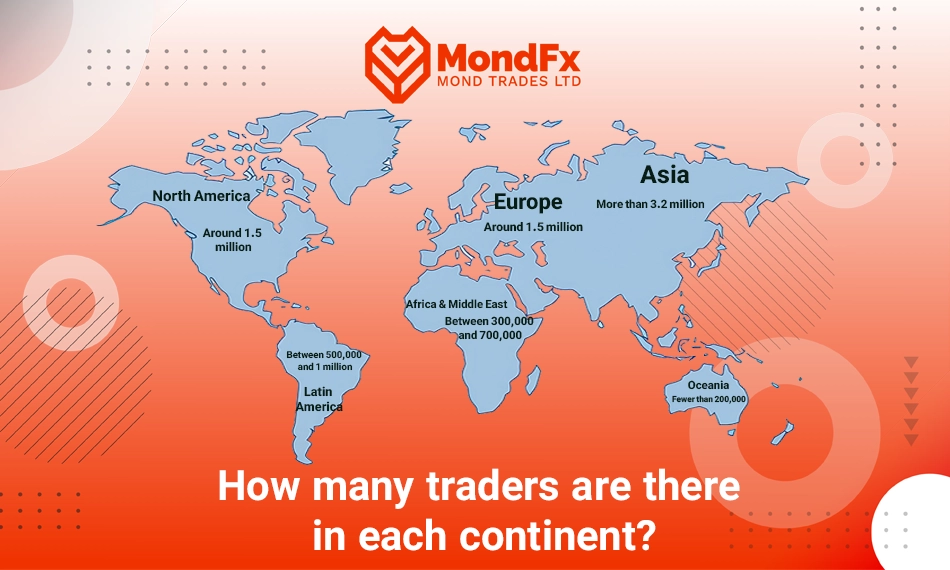
How many traders are there in each continent?
The number of active traders around the world is growing rapidly, but this growth has not been uniform across different regions and depends on various factors such as economic conditions, internet accessibility, regulatory frameworks, and the financial culture of each area. Although due to the decentralized nature of markets like forex and cryptocurrencies, there are no precise official statistics for the number of traders on each continent, relatively reliable estimates of the geographic distribution of traders can be provided based on combined data from international brokers, trading platforms, and reputable analytical reports.
| Continent | Estimated Number of Active Forex Traders | Key Regional Market Characteristics |
|---|---|---|
| Asia | More than 3.2 million | High growth rate, young population, widespread mobile access and foreign brokers |
| Europe | Around 1.5 million | Cohesive regulatory structure, high experience, focus on forex and traditional markets |
| North America | Around 1.5 million | Focus on structured markets, strong financial institutions, restrictions on retail forex |
| Latin America | Between 500,000 and 1 million | High inflation, tendency toward dollar based income, growing use of cryptocurrency |
| Africa & Middle East | Between 300,000 and 700,000 | Rapid growth, limited infrastructure, interest in cryptocurrency, use of international brokers |
| Oceania | Fewer than 200,000 | Small market, high analytical level, strict and transparent regulations |
Asia: The Highest Number of Active Traders in the World
Asia holds the largest share of the global active trader population. Highly populated countries such as India, China, Indonesia, Bangladesh, Vietnam, and the Philippines not only rank high in terms of internet users, but due to a widespread inclination toward earning dollar based income and the lack of fully developed domestic financial markets, they have become an attractive environment for forex and crypto markets in recent years. It is estimated that more than 3.2 million active traders operate in the forex market alone in this continent, while the cryptocurrency market is experiencing even faster growth.
Europe: Expertise, Strong Financial Structure, and Professional Traders
Europe has always been one of the traditional centers of global financial markets, and the presence of active traders here is accompanied by analytical depth and regulatory oversight. Countries such as the United Kingdom, Germany, the Netherlands, and the Scandinavian nations constitute a major share of traders in this region. Based on data from EU registered brokers, more than 1.5 million active forex traders are present on this continent. In addition, the stock market and derivatives trading, both at institutional and individual levels, contribute significantly to overall participation.
North America: A Broad Market with Institutional Focus
The United States and Canada, despite having specific regulatory restrictions in the forex market for retail users, possess deep and well structured markets. Many users in this region enter the market through official platforms or applications such as Robinhood and Coinbase. Although the number of retail traders is lower than in Asia, the financial volume and quality of activity are comparatively high. It is estimated that around 1.5 million active forex traders operate in this region, and the cryptocurrency market has also been growing rapidly in recent years.
Latin America: Market Response to an Inflated Economy
In Latin America, countries such as Brazil, Argentina, Mexico, and Colombia have in recent years turned to global markets due to economic pressures, national currency instability, and high inflation. A large portion of traders in this region enter the market with the goal of preserving asset value or earning dollar based income. Many of them use cryptocurrency to bypass currency controls. Estimates indicate that there are hundreds of thousands of active traders in this region who operate daily in both forex and crypto.
Africa and the Middle East: Rapid Growth but Limited Data
The African continent, despite limited internet infrastructure in some areas, is experiencing one of the fastest growth rates in online traders. Countries such as Nigeria, South Africa, Kenya, and Egypt have become emerging trading hubs within the continent. In the Middle East, with the rise of local brokers, the trading culture in countries like Iran, Turkey, Saudi Arabia, and the UAE is rapidly expanding. Although precise data on the number of traders in these regions is not available, estimates point to the presence of hundreds of thousands of active traders across these areas.
Oceania: A Small but Highly Regulated Market
Australia and New Zealand, as developed countries with strict regulatory frameworks, hold a smaller share in terms of the number of traders, but due to regulatory transparency and access to global markets, they carry significant importance in terms of trading volume. The limited population of these countries has resulted in fewer active traders compared to other continents, yet the analytical and technological level of activity in this region has made it one of the most professional markets globally.
Global Trader Statistics and Estimates
Understanding the true global trader population requires estimative analysis and the use of combined data, due to the decentralized and often anonymous nature of many online transactions. Unlike centralized markets such as traditional stock exchanges, which publish precise participant statistics, online markets such as forex, cryptocurrency, and CFDs cannot provide a definitive figure. However, field studies and statistical research from reputable sources have offered a relatively clear picture of the widespread nature of the trading community.
Statistical Sources for Trader Population Data
Since many traders use platforms whose information is not publicly reported, statistical analysis in this domain relies largely on secondary data and inter market surveys. Institutions such as Statista, Finance Magnates, Triple-A, and the World Bank are among the sources that, using user data from brokers and exchanges, have provided estimates of the global trader population.
Global Estimate of Financial Market Users
According to these reports, more than 300 million people worldwide are in some way present in online financial markets. This figure includes individuals who have registered on one or more trading platforms and have a record of executing trades, even if their activity is occasional or limited. This population has grown significantly in recent years with the expansion of the internet, trading applications, and increased financial awareness.
Active Traders vs General Users
However, if the focus is limited to active traders individuals who trade regularly, consistently, and professionally the statistics decline. Estimates show that around 100 to 150 million people from the total population are considered active traders. Active participation here refers to executing weekly or daily trades, having a defined trading system, using analytical tools, and practicing risk management. This group not only accounts for a large portion of market transactions but also has a significant impact on price behavior, liquidity flow, and even collective psychological trends in the market.
The Role of Trader Statistics in the Trading Industry
Understanding the active trader population is highly important for financial industry participants such as brokers, signal providers, educational services, and developers of analytical software. These statistics not only reflect market growth but also serve as an indicator for measuring competition, market saturation, and business expansion opportunities across different regions of the world.
Forex vs Crypto: Which Market Has More Traders?
Among all online financial markets, forex and cryptocurrencies are the two main hubs attracting retail and active traders globally. Each of these markets is appealing to a wide range of traders for different reasons from the high liquidity in forex to the extreme volatility and lucrative opportunities in the crypto market. In this section, the statistical and analytical share of each of these markets within the global trading community is examined.
Why the Forex Market Attracts the Most Global Traders
The foreign exchange market, or Forex, is one of the oldest and most structured financial markets in the world, and with a daily trading volume exceeding 6.6 trillion dollars, it is considered the largest financial market globally. According to reports published by international statistical institutions, more than 15 million active trading accounts exist in forex brokers worldwide. This statistic includes retail traders, small businesses, and individual users, and does not account for large financial institutions.
A significant portion of these accounts belongs to traders from regions such as Southeast Asia, Eastern Europe, Arab countries, and Latin America. The concentration in these areas can be attributed to easy access to international brokers, widespread educational resources, weak local markets, and the appeal of leverage in forex trading. Although not all of these accounts are active on a daily basis, it is estimated that at least 8 to 10 million people trade consistently in the forex market.
Explosive Growth of the Cryptocurrency Market
On the other hand, the cryptocurrency market has experienced unprecedented growth over the past decade. The rising popularity of digital currencies is evident not only among investors but also among short term traders. According to up to date statistics, more than 420 million users worldwide have accounts on cryptocurrency exchanges. Of course, similar to the forex market, not all of these users are active traders. However, an analysis of trading behavior shows that nearly 70 million of them fall into the category of active crypto traders individuals who buy and sell digital assets daily or weekly and use analytical tools for decision making.
This growth has especially accelerated among younger generations, users in developing countries, and individuals seeking markets independent of central banks. Despite its high volatility, the crypto market has become one of the most attractive venues for traders looking for faster and more diverse profit opportunities.
Forex vs Crypto Market Share: Comparison and Analysis
In comparing these two markets, forex due to its structure, liquidity volume, and historical longevity still holds a more established position. Meanwhile, the crypto market, with features such as borderless access, decentralization, and technological advancement, has been able to attract a rapidly expanding population of new traders. What is particularly noteworthy is that a large portion of active crypto traders had no previous experience in traditional financial markets, and their first exposure to trading began through cryptocurrency.
Number of Traders by Continent
Although the global trading community is digital and borderless in nature, statistical analyses show that trading activity is more concentrated in specific regions of the world. Various factors such as internet accessibility, financial literacy, economic conditions, the presence of local brokers, and even monetary and currency policies influence the level of participation in online financial markets.
For this reason, the geographical distribution of traders has formed in such a way that some countries, despite having smaller populations, host a larger number of active traders.
Asia: Rapid Growth of Retail Traders
The Asian continent especially the South and Southeast regions has seen the highest growth rate in attracting retail traders over the past decade. Countries such as India, China, Indonesia, the Philippines, Malaysia, and Vietnam top the list of nations whose users actively participate in forex, cryptocurrency, and international stock markets.
A combination of a young population, widespread mobile internet, and diverse financial instruments has led to the rapid expansion of online trading in these countries. In India alone, millions of trading accounts have been opened, and the crypto trading community is expanding at an astonishing pace.
Europe: Experience, Education, and Institutionalization
In Europe, financial markets have a long history, and trading is considered a common and well structured activity in many countries. The United Kingdom, as Europe’s traditional financial center, continues to host one of the largest trader communities on the continent. Germany, with its strong economic foundation, also has an active community of forex and stock market traders.
Russia, despite banking restrictions and economic challenges, has formed one of the largest online trader communities in Eastern Europe. Formal education, broad access to reputable European brokers, and a strong culture of online investing are among the key reasons behind the sustained growth in this region.
Latin America: A Reaction to Economic Crises
Latin American countries have become one of the emerging hubs of online financial markets in recent years. In nations such as Brazil, Argentina, Mexico, Colombia, and Chile, rising inflation, severe currency fluctuations, and weak domestic financial markets have driven a significant portion of the population toward international markets.
Traders in this region primarily use forex and cryptocurrencies to hedge against currency devaluation and to earn dollar based income. These conditions have prompted many international brokers and exchanges to focus specifically on expanding their market presence in these countries.
United States: A Large Market with Institutional Structure
Despite restrictive regulations regarding forex broker activity for retail users, the United States remains one of the largest financial markets in the world. A major portion of trading activity in the country is carried out by financial institutions, investment funds, and large entities. However, in recent years, the rise of cryptocurrency trading and online stock trading especially through apps such as Robinhood has led to an increase in the independent trader population.
Strict regulations and heavy oversight have limited U.S. users’ participation in international platforms, yet in terms of capital volume and financial literacy, they remain at a highly advanced level.
The Rise of a New Generation of Traders
One of the major phenomena in the evolution of online financial markets over the past decade is the increasing presence of the younger generation in the trading arena. This shift is not only statistically significant but has also influenced the behavioral structure, motivations, and trading styles within the market. The new generation of traders views the market with a mindset different from that of previous generations and uses its own tools and methods to operate within it.
How Technology Is Shaping the New Generation of Traders
With advancements in digital infrastructure, the development of trading applications, and the widespread use of social media, access to financial markets has become far easier for the younger generation compared to the past. While traders of earlier generations needed familiarity with traditional banking structures and financial institutions to enter the market, today users can access markets within minutes using nothing more than a smartphone and an internet connection.
Mobile platforms such as MetaTrader, TradingView, and dedicated cryptocurrency exchange apps have provided a simple, intuitive, and interactive environment for entering the world of trading. These features have led individuals aged 18 to 35 to account for the fastest growing segment entering financial markets.
Trading as a Profession
The new generation of traders unlike previous generations who mostly viewed the market as a place for investment approaches this field with an active, dynamic, and sometimes ambitious mindset. For many young traders, financial markets are not just a tool for generating profit, but a potential independent career path with high income possibilities.
This generation, relying on self education, online resources , informal training, and digital trading communities, not only becomes familiar with complex concepts quickly but also creates new models of activity such as day trading, scalping, algorithmic trading, content creation, and even coaching in the trading field.
How Digital Culture and Social Media Influence Modern Traders
The role of social media in shaping the identity and behavior of the new generation of traders cannot be overlooked. Platforms such as YouTube, Instagram, TikTok, and Twitter have become tools that not only provide education but also promote a trading lifestyle. Many young people are introduced to financial markets through these networks, learn technical analysis , follow the trading results of others, and even participate in trading challenges and competitions.
This combination of technological speed, online participatory culture, and the motivation for financial independence has led to trading becoming a social trend among the younger generation not merely an individual financial activity.
Conclusion
The global trader population shows that online financial markets such as Forex form a large and active ecosystem.
More than 300 million people participate in these markets, but around 100 to 150 million trade consistently and professionally. The highest concentration of traders is in Asia, and Forex along with major currency pairs such as the EUR/USD pair remains one of the main markets attracting traders for executing trades.
Additionally, the growth of the younger generation, along with easy access to technology and social media, has turned trading into an independent and dynamic career path rather than merely a tool for investment. Understanding these statistics helps improve awareness of competition, risk, and market opportunities.
If you are looking to start a reliable path in the world of trading, working with the MondFx team can be a great starting point for building your personal strategy.