
Choosing a suitable broker is one of the most important decisions for every trader; a decision that can be the difference between a secure and successful trading experience and facing issues such as price slippage, order execution delays, or even the risk of capital loss. Given the variety of broker models and the complexity of trading mechanisms, an accurate understanding of the broker's performance, structure, and credibility is a prerequisite for any smart trade.
This article analytically and practically examines all dimensions related to brokers. The reader will become familiar with the following:
The precise definition of a broker and its role in trading
Types of brokers and their execution models
Criteria for choosing a reputable broker, including regulation and security
Advantages, limitations, and risks associated with each type of broker
Practical tips and the experience of professional traders for smart decision making
By studying this article, every trader can gain a complete and practical understanding of brokers and make a confident choice suitable for their trading style.
What is Forex?
Forex is short for Foreign Exchange, meaning the foreign currency exchange market. This market is the largest financial market in the world, where the currencies of different countries are bought and sold by individuals, companies, and banks.
Features of the Forex Market
Decentralization: Forex is a global and decentralized market, with no single entity or country having complete control over it.
24 Hour Operation: This market is active 24 hours a day, from Monday to Friday, because different time zones across the globe overlap.
High Trading Volume: Over $7 trillion is traded daily in this market.
Flexibility: Investors can also operate in this market with small amounts.
How to Trade Forex
To successfully enter the Foreign Exchange (Forex) market, it is necessary to follow a cohesive and calculated process that starts with education and ends with risk management and continuous evaluation.
1. Comprehensive Education and Deep Market Understanding
The starting point for every trader is acquiring knowledge. Initially, you must become familiar with the basic concepts of this market, such as currency pairs, Pip, Leverage, and Spread. After that, mastering market analysis is essential; this analysis includes learning Technical methods (examining charts and price patterns) and Fundamental methods (reviewing news and macroeconomic data) to more accurately forecast price trends. Finally, before risking real capital, utilizing a Demo Account for practice, strategy testing, and gaining risk free practical experience is vital.
2. Choosing a Suitable and Reputable Broker
After achieving mental readiness, it is time to choose a reputable intermediary. When selecting a broker, you must strongly emphasize its regulation to ensure it operates under the supervision of reliable legal entities. Also, make sure the broker provides the standard trading platforms you need, such as MetaTrader 4 or 5. For Iranian users, the presence of Farsi support and the availability of easy and secure methods for deposit and withdrawal (such as WebMoney, Perfect Money, or Cryptocurrencies) are of high importance.
3. Creating and Funding a Trading Account
In this stage, you must complete the registration process on the broker's website and enter your personal information. After that, identity verification by providing ID documents and address confirmation is mandatory. Next, you need to select the account type (such as Micro, Standard, or Professional) suitable for your capital amount and strategy. Finally, deposit the desired amount into your trading account through the methods approved by the broker (such as bank transfer, WebMoney, or Cryptocurrency).
4. Starting Trading and Risk Management
With the account preparation complete, you can begin trading. Select your preferred currency pairs (such as EUR/USD or GBP/JPY) and predict the price trend using analytical tools. If you expect a price increase, issue a Buy order, and if you anticipate a price decrease, issue a Sell order. The critical point here is managing the trade by precisely setting a Stop Loss and a Take Profit. Always remember that you should never risk more than 1 to 2 percent of your total capital on a single trade, and be cautious with the use of Leverage, as financial leverage can drastically multiply both your profits and your losses.
5. Monitoring, Analysis, and Improvement of Results
Success in Forex is not achieved overnight. You must continuously review and analyze your past trades to identify your patterns of success and your weaknesses. This continuous analysis helps you improve your trading strategies and learn from past mistakes. Focusing on emotional management (controlling fear and greed) alongside technical knowledge is the key to sustainable success.
Required Tools and Infrastructure
Activity in Forex requires suitable infrastructure: Trading platforms (such as MetaTrader 4 or 5 or web based and mobile applications) and stable internet for fast order execution are your essential tools; however, the most important need is sufficient knowledge and experience, which is only obtained through continuous education and practice.
Entering the Forex market is appealing, but without education and risk management, it carries many risks. It is highly recommended that you ensure confidence in your knowledge and strategy before investing real capital.
Advantages of Forex
Very high liquidity.
Possibility to use Leverage to increase profit.
Easy access through brokers and trading platforms.
Risks of Forex
High Risk: Rapid price fluctuations can lead to losses.
Need for Knowledge and Skill: Successful activity in this market requires awareness of technical and fundamental analysis.
Forex is appealing as a tool for investment and profit generation, but success in it requires education, experience, and risk management.
Definition and Concept of a Broker
To better understand the importance of brokers, it is necessary to distinguish them from other financial entities and platforms and see how they differ from exchanges, banks, and trading platforms.
What is a Broker and What is Its Role in the Market?
A Broker (or Carriers) is an intermediary entity between a trader and the market that provides them with the ability to access assets and execute trading orders. Simply put, the broker is the communication bridge between the trader and the market, and without it, direct trading in many markets, especially Forex, is not possible.
The broker's role is not limited only to providing prices; guaranteeing the execution of orders, managing liquidity, offering analytical tools, and safeguarding the trader's capital security are also part of its core responsibilities.
In practice, brokers provide an environment for every trader to execute their trading strategies with appropriate speed, transparency, and security, while having online access to market data and analytical tools.
The Difference Between Broker and Brokerage
In the financial sector, Broker and Brokerage are two related but distinct terms that refer to different roles and functions. Their differences are explained below:
Broker
A Broker refers to a natural person or an entity (such as a software system) that acts as the primary intermediary between buyers and sellers in a financial market. The broker's main duty is the fast and accurate execution of trades on behalf of clients. Simply put, if you want to buy or sell stocks, currency, or commodities, the broker is the person or system that operationalizes your trade instruction. In exchange for these services, the broker usually receives a fee as a commission for each transaction. For example, an individual who works directly at a brokerage firm and advises clients or records their trades is considered a Broker.
Brokerage (Brokerage Firm)
A Brokerage or Brokerage Firm refers to a formal company or organization that offers brokerage services on a large scale. In fact, Brokers (individuals or systems) usually operate under the umbrella of a brokerage firm. The role of the brokerage is much more comprehensive than that of a broker; these organizations are responsible for providing the complete trading platform, managing and supervising their underlying brokers, offering diverse financial facilities, market analyses, and providing comprehensive customer support. If you open a trading account with a specific company (such as a Forex or Stock brokerage), that company is your Brokerage. For example, global companies like Fidelity or TD Ameritrade, or famous domestic brokerage firms, are examples of a Brokerage.
In summary, a Brokerage is the name of the company or organization that provides the platform, and a Broker is the individual or system within that organization that executes your trade.
Key Differences
| Feature | Broker | Brokerage |
|---|---|---|
| Nature | Natural Person or Software System | Financial Company or Organization |
| Role | Direct Executor of Transactions | Provider of the Trading Platform and Service Management |
| Scope | Limited to Execution and Trade Facilitation | Broader, Including Analysis, Support, and Management |
| Example | The Individual Who Executes Your Trade | The Company That Provides These Services |
The Relationship Between Broker and Brokerage
Broker: May be part of and operate within the Brokerage.
Brokerage: Is typically responsible for the management and provision of brokerage services to clients and brokers.
In summary, the Broker refers to the direct executor of transactions, while the Brokerage is the organization or company that provides and manages the brokerage services.
Why Do We Need a Broker?
Brokers play a fundamental role in providing traders with access to financial markets. Without brokers, activity in markets such as Forex, stocks, cryptocurrencies, and commodities would be virtually impossible or extremely difficult due to their complexity and decentralized structure. The reasons for needing a broker can be explained as follows:
Access to Financial Markets
Financial markets like Forex are decentralized, and direct trading with banks and liquidity providers is difficult for retail users. Brokers, as intermediaries, facilitate access to these markets and provide the conditions for buying and selling.
Provision of Trading Tools and Platforms
Brokers offer platforms such as MetaTrader 4 or 5, through which users can execute their trades. These platforms include analytical tools such as charts, indicators, and market news that help traders make better decisions.
Provision of Real Time Prices
Brokers receive up to date and accurate prices for currency pairs, stocks, and commodities from liquidity providers and present them to users. This information helps traders execute their trades based on actual market conditions.
Possibility of Trading with Small Capital
Many brokers offer the possibility of using Leverage, which allows traders to execute larger trades with smaller capital. This feature is very beneficial for retail traders who have limited financial resources.
Risk Management and Trade Facilitation
Brokers offer features such as setting a Stop Loss and a Take Profit, which aid in risk management. Furthermore, the quick execution of buy and sell orders helps prevent losses resulting from momentary market fluctuations.
Support and Consultation Services
Many brokers provide 24 hour support services in various languages (including Farsi). These services include answering technical questions, resolving financial issues, and offering trading related education.
Variety of Tradable Assets
Brokers facilitate the trading of a wide range of assets, including:
Forex Currency Pairs
Cryptocurrencies
Precious Metals (such as gold and silver)
Stocks and Stock Indices
Commodities (such as oil and gas)
Reduction of Trading Complexity
Brokers simplify the trading process and eliminate the need for direct communication with the market or financial institutions. For retail users, this easy and direct access to the markets is crucial.
What Services Do Forex Brokers Offer?
Forex brokers play an intermediary role between traders and the foreign exchange market by offering a variety of services. These services include facilitating trades, providing financial tools, and offering client support. The most important of their services are detailed below:
Access to the Forex Market
Brokers provide a trading platform that allows users to buy and sell currency pairs such as EUR/USD or GBP/JPY. They provide users with up to date and real time prices of currency pairs from global markets.
Trading Platforms
Brokers offer software such as MetaTrader 4 (MT4), MetaTrader 5 (MT5), or their own proprietary platforms. These platforms provide tools for technical analysis, indicators, charts, and economic news.
Leverage
Brokers provide the option of using financial leverage, which allows users to execute larger trades with smaller capital. Leverage is typically between 1:10 and 1:500, but its use requires precise risk management.
Diverse Trading Accounts
Brokers offer several types of accounts to meet the needs of different users:
Standard Account: Suitable for general users.
Micro or Cent Account: For beginners with small capital.
Professional or VIP Account: With advanced features for professional users.
Demo Account (Trial): For risk free practice and learning.
Opportunity to Trade Other Assets
In addition to Forex currency pairs, brokers typically also provide the opportunity to trade the following assets:
Precious Metals: Such as gold and silver.
Cryptocurrencies: Bitcoin, Ethereum, etc.
Stock Indices: Such as the S&P 500 or Dow Jones.
Commodities: Such as oil and gas.
Offering Bonuses and Discounts
Some brokers offer bonuses or financial rewards to attract customers. These bonuses may include trading credit or spread discounts.
Customer Support
Brokers provide 24 hour support services to resolve user issues. For Iranian users, brokers that offer support in the Farsi language are more popular.
Education and Consultation
Many brokers provide clients with educational resources such as tutorial videos, analytical articles, and trading signals. Some of them also offer financial consultation.
Diverse Deposit and Withdrawal Methods
Brokers support various methods for deposit and withdrawal:
Rial: Suitable for Iranian users.
WebMoney and Perfect Money.
Cryptocurrencies: Such as Bitcoin.
Credit Cards: Such as Visa and MasterCard.
Managed Accounts
Some brokers offer Managed Accounts where professional traders execute trades on behalf of the users.
Security and Regulation
Reputable brokers are supervised by regulatory bodies such as the FCA (UK) or CySEC (Cyprus). This supervision ensures the security of assets and the transparency of the brokers' performance.
Types of Brokers in Forex
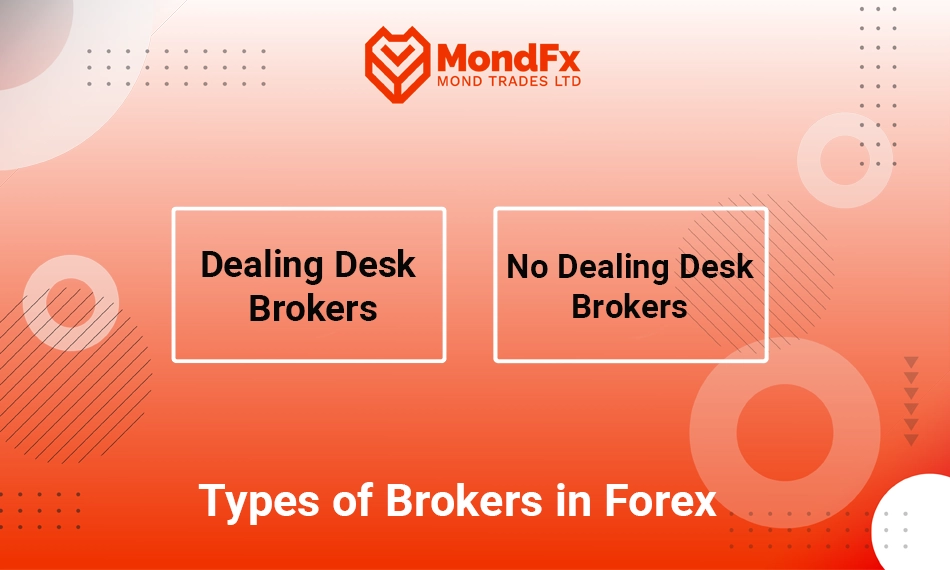
Review of Forex Broker Types:
Dealing Desk (DD) Brokers
These brokers, also known as "Market Makers," act as the counterparty to clients' trades. In this model, the broker determines the buy and sell prices and manages the transactions internally within its system. The income of these brokers is generated through the spread (the difference between the buy and sell price) and, in some cases, from client losses. The main advantage of this type of broker is providing more stable prices and faster order execution.
No Dealing Desk (NDD) Brokers
These brokers send client trades directly to the market or liquidity providers and do not interfere in the trades themselves. Their income is generated through commissions or a slight increase in the spread. NDD brokers are divided into two subcategories:
ECN Brokers (Electronic Communication Network)
These brokers connect directly to electronic networks, allowing traders to view and access the best buy and sell prices. In this model, there is high transparency, and trades are executed at high speed with variable spreads.
STP Brokers (Straight Through Processing)
In this model, client orders are sent directly and automatically to liquidity providers. STP brokers usually cooperate with several liquidity providers to offer the best prices to clients. The spread in these brokers is variable, and a commission may also be charged.
The choice of the right type of broker depends on your needs and trading strategy. For example, if you are looking for greater transparency and direct market access, ECN brokers might be a suitable option. Conversely, if you are looking for fixed spreads and fast order execution, Market Maker brokers can be appropriate.
Retail Brokers
Retail Forex brokers are companies that provide access to the large Forex market for individual traders. In the past, only banks, large financial institutions, and major investors were able to trade in the Forex market. With the emergence of the internet and the development of technology, retail brokers came into existence so that ordinary individuals could also participate in this market.
Consequently, brokers with a minimum deposit are usually categorized under this retail segment. These companies often offer accounts (such as cent or micro accounts) that can be opened with a small capital (sometimes just a few dollars). These minimum deposit brokers act as intermediaries between traders and the market and execute buy and sell orders.
Discount Brokers
Services Offered: These brokers primarily focus on the execution of buy and sell orders and generally do not provide advisory or analytical services.
Costs: Transaction fees in these brokers are lower because they do not include extra services like investment advice.
Suitable For: Investors who have sufficient experience and knowledge of the market and can make decisions independently.
Key Characteristics: Most of these brokers offer online trading platforms that provide quick and easy access to the market.
Full Service Brokers
Services Offered: In addition to trade execution, these brokers offer a variety of services such as investment advice, financial planning, market analysis, and portfolio management.
Costs: Transaction fees in these brokers are higher because they provide more comprehensive services to clients.
Suitable For: Investors who need specialized guidance and consultation or do not have enough time to manage their investments.
Key Characteristics: These brokers usually have a team of professional financial advisors who interact with clients on a personalized basis.
Choosing Between a Discount Broker and a Full Service Broker
The choice between these two types of brokers depends on the investor's needs, goals, and level of experience. If you are looking to reduce costs and execute trades independently, Discount Brokers are more suitable. However, if you require specialized consultation and services, Full Service Brokers will be the better option.
Criteria and Method for Broker Selection
Choosing a suitable broker for trading in the financial markets requires diligence and the examination of multiple criteria. In the following, we will review the most important criteria and how to evaluate them:
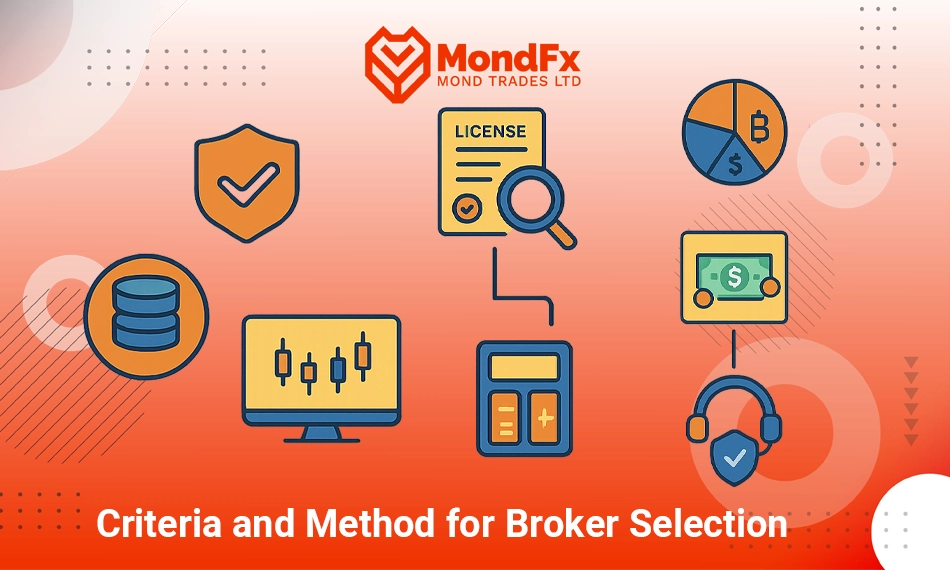
Credibility and Regulation
Licenses: Ensure that the broker operates under the supervision of reputable regulatory bodies such as the FCA (UK), CySEC (Cyprus), or ASIC (Australia). These licenses indicate the broker's commitment to maintaining financial and protective standards.
Account Diversity
Account Types: Check whether the broker offers account types suitable for your needs, such as Standard, Micro, ECN, or Islamic (Swap Free) accounts. This variety allows you to choose the appropriate account based on your trading style and capital size.
Costs and Commissions
Spread and Commission: Compare the amount of spread (the difference between the buy and sell price) and the commissions charged by the broker. Brokers with lower spreads and commissions can reduce your overall trading costs.
Trading Platform
Software: The broker should offer popular and user friendly trading platforms such as MetaTrader 4 (MT4) or MetaTrader 5 (MT5). These platforms must provide diverse analytical tools and the ability to execute trades quickly.
Asset Diversity
Trading Instruments: Verify that the broker provides access to various asset classes such as currency pairs, stocks, commodities, indices, and cryptocurrencies. This variety allows you to maintain a diversified investment portfolio.
Deposit and Withdrawal Methods
Ease and Speed: The broker should support diverse deposit and withdrawal methods, including bank transfer, credit cards, electronic wallets, and cryptocurrencies. Also, check the speed of transactions and the associated fees.
Customer Support
Accessibility and Quality: The broker should offer 24 hour support and in the Farsi language, so that you can quickly communicate with them in case of issues or when guidance is needed.
Education and Resources
Educational Content: Brokers that provide educational resources, webinars, and market analyses can help improve your trading knowledge and skills.
Leverage and Margin
Leverage Levels: Check what levels of leverage the broker offers and whether these levels are compatible with your trading strategy and risk tolerance.
Security and Data Protection
Data Protection: Ensure that the broker uses appropriate security protocols to protect your personal and financial information.
How to Evaluate and Select a Broker
Research and Comparison: Compare different brokers using credible sources and user reviews.
Demo Account: Before opening a real account, use a demo account to test the broker's platform and services.
Contact Support: Contact the broker's support team to assess the quality and speed of their responsiveness.
By considering these criteria and conducting sufficient research, you can choose a broker that aligns with your trading needs and goals.
Steps for Opening an Account with a Broker and Required Documents
Opening a trading account with a Forex broker is a standard, multi step process that requires attention to detail when submitting documents and information. By following these steps, you can begin your activity in the global market.
1. Selecting and Vetting the Appropriate Broker
Before any action, it is important to carefully select your intended broker. At this stage, you must confirm the broker's credibility and licenses; this means checking whether the broker is regulated by reputable financial entities. Furthermore, it is crucial to compare trading conditions such as spread size, commission, leverage, and the types of platforms offered. Finally, ensure the quality and easy access to customer support so that they are responsive if an issue arises.
2. Online Registration and Information Completion
After selecting the broker, visit its official website and enter the online process by choosing the "Registration" or "Open Account" option. In this part, you must complete the registration form with accurate personal information such as your first name, last name, email, phone number, and country of residence. Accuracy in providing correct information at this stage is very important to avoid problems during identity verification.
3. Determining the Trading Account Type
In the third step, you must specify your account type. Initially, you can open a Demo Account (trial) to become familiar with the platform environment and the broker's performance. Then, depending on your capital size, experience, and strategy, choose one of the Trading Account Types (such as Standard, Micro, ECN, etc.). Each account type has specific conditions regarding spread and minimum deposit, which must align with your needs.
4. Identity Verification (KYC) and Document Submission
Identity Verification, or KYC (Know Your Customer), is a legal requirement for reputable brokers. To verify your identity, you must provide a clear image of valid identification documents such as a passport, national ID card, or driver's license. To prove your address of residence, providing a utility bill (water, electricity, gas) or a bank statement that includes your name and address is usually required. Additionally, the broker may send verification codes to your phone number and email for final confirmation.
5. Account Funding and Deposit
After account approval, you can fund it. At this stage, you choose the deposit method; brokers usually provide various options including bank transfer, credit card, electronic wallets, and cryptocurrencies. Note that the minimum deposit amount differs based on the type of account you have chosen, and you must check this detail.
6. Downloading and Connecting to the Trading Platform
Now it is time for your trading tool. Choose your trading platform; this platform can be MetaTrader 4, MetaTrader 5, or a proprietary broker platform. Download and install the software, and log in using the username and trading account password provided by the broker.
7. Starting Trades with Risk Management
Finally, upon entering the platform, you must first become thoroughly familiar with its tools and features. The most critical point for starting is the strict application of Risk Management Strategies. Always trade with capital that you can afford to lose without negatively impacting your financial life. By following these steps and focusing on education and risk management, you can confidently begin your activity in the Forex market.
How Does a Forex Broker Work?
In the Forex market, brokers (Carriers) act as intermediaries between retail traders and Liquidity Providers (LPs). Liquidity Providers typically include major banks, financial institutions, and other large financial entities that provide the necessary liquidity for trade execution.
How Brokers Cooperate with Liquidity Providers
Receiving Prices: Brokers receive real time Bid (buy) and Ask (sell) prices by connecting to Liquidity Providers. These prices are presented to traders so they can base their trading decisions on them.
Order Execution: When a trader places an order, the broker sends this order to the relevant Liquidity Provider. The Liquidity Provider acts as the counterparty to the trade and executes the order. This process helps ensure liquidity and fast trade execution.
Risk Management: Brokers can manage the risks associated with market fluctuations by cooperating with Liquidity Providers. By accessing deep liquidity pools, brokers can execute large orders without significantly impacting prices.
Spread Reduction: By cooperating with multiple Liquidity Providers, brokers can reduce the spread (the difference between the buy and sell price). This is beneficial for traders as it lowers their trading costs.
What is a Regulated Broker?
A regulated broker refers to a brokerage that operates under the supervision of credible legal and financial authorities. This supervision is conducted to ensure that brokers adhere to financial standards, rules, and regulations, thereby protecting the rights and interests of traders.
The Importance of a Broker Being Regulated
Protection of Client Funds: Regulated brokers are required to hold client funds in segregated accounts to ensure the clients' capital remains secure in case of the broker's financial distress.
Prevention of Fraud: Regulatory bodies prevent illegal activities and fraud within brokerages through regular inspections and the enforcement of strict rules.
Transparency in Operations: Regulated brokers are obligated to provide regular and transparent financial reports to regulatory bodies, which helps increase trader trust.
Reputable Regulatory Bodies
Globally, several authorities oversee the activities of brokers. Some of the most reputable ones include:
CFTC (Commodity Futures Trading Commission) and NFA (National Futures Association) in the United States: These entities supervise financial and trading activities in the futures and Forex markets.
FCA (Financial Conduct Authority) in the United Kingdom: This organization is responsible for regulating and supervising financial services in the UK.
ASIC (Australian Securities and and Investments Commission) in Australia: This body oversees financial service providers in Australia.
CySEC (Cyprus Securities and Exchange Commission) in Cyprus: This organization supervises the financial markets in Cyprus, and many European brokers operate under its supervision.
How to Check if a Broker is Regulated
Broker's Official Website: Regulated brokers usually publish information regarding their licenses and regulatory bodies on their official website.
Regulatory Authority's Website: By visiting the website of the relevant regulatory authority, you can verify the authenticity of the broker's license.
User Reviews and Experiences: Checking the opinions and experiences of other traders can help you assess the broker's credibility.
Ultimately, choosing a regulated broker means greater assurance regarding the security of capital and a reduction in the risks associated with operating in financial markets.
How Do Brokers Generate Revenue?
Forex brokers utilize multiple methods to generate revenue, the most important of which are:
Spread
The Spread is the difference between the Bid (buy) price and the Ask (sell) price of a currency pair. Brokers charge this difference as a fee. For example, if the Bid price for EUR/USD is $1.1000$ and the Ask price is $1.1002$, the spread is 2 pips, which is counted as the broker's income.
Commission
Some brokers charge an amount as a Commission for each trade, in addition to the spread. This amount may be fixed or vary based on the trade volume.
Swap or Overnight Interest
If a trade remains open for more than one day, the broker may charge or pay an amount as a Swap or Overnight Interest. This amount is calculated based on the interest rate difference between the two currencies in the currency pair.
Inactivity Fees
Some brokers deduct a fee from the account as an inactivity charge if the trader does not engage in any activity within a specified time frame.
Markup
Some brokers may increase the spreads provided by liquidity providers before offering them to clients. This additional difference is considered the broker's revenue.
Additional Services
Brokers may generate revenue by offering services such as financial consultation, specialized education, advanced analytical tools, and the management of PAMM and MAM accounts.
In summary, Forex brokers generate revenue through a combination of these methods. Traders must be familiar with their broker's fee structure and costs to make more informed decisions in their trading activities.
Is It Possible to Trade Forex Without a Broker?
No, engaging in the Forex market without using a broker is not possible for retail traders. Brokers act as intermediaries between traders and the Forex market and provide individuals with access to this market. Just as you need to register in the SEJAM system and with one of the active and official brokerages in the Tehran Stock Exchange, you also need brokers for trading in the Forex market.
Brokers provide traders with access to the Forex market and trading opportunities. This financial entity can be defined as a legal entity that acts as the intermediary between sellers and buyers, or in other words, the intermediary between traders and the Forex market. Thus, with the advent of the internet and the advancement of the online platform, brokers were established, enabling individuals worldwide to enter the Forex market, earn income, and share in the market's profits and fluctuations.
Therefore, if you intend to enter and operate in Forex, you must register with a credible and trustworthy broker. Opening an account with a broker is quite similar to opening a bank account. The registration process is usually very fast, and you are required to provide identity documents and complete the identity verification stages.
Is it Possible for Iranians to Use Brokers?
Yes, it is possible for Iranians to use Forex brokers. Despite international limitations and sanctions, some reputable brokers still offer services to Iranian users. These brokers endeavor to meet the needs of Iranian traders by providing Farsi language support, deposit and withdrawal methods compatible with Iran's conditions, and Islamic accounts (Swap Free).
Are Forex Brokers Legal in Iran?
The activity of Forex brokers in Iran has been officially declared illegal. In 2011 (1390 solar year), Iran's Securities and Exchange Organization banned the activities of Forex brokerage offices and companies within the country. This decision was made for several reasons, including:
Currency Outflow from the Country: Participation in Forex transactions requires converting the Rial into foreign currencies, which can lead to the outflow of currency from the country.
High Risk of Loss: Many individuals enter this market without sufficient knowledge and experience and suffer heavy losses.
Presence of Pyramid Schemes and Fraud: Some pyramid schemes and opportunist companies have exploited the opportunity of Forex trading and engaged in fraud against citizens.
Nevertheless, some individuals trade in the Forex market personally and through foreign brokers. These activities are also accompanied by legal risks, and if identified by judicial authorities, they may be subject to legal prosecution.
Recommendation: Given the legal status and associated risks, obtain complete information and act with caution before engaging in any activity in the Forex market.
How Are Deposit and Withdrawal Services Provided by Brokers for Iranians?
Forex brokers that offer services to Iranian users have considered diverse methods for deposits and withdrawals to meet the needs of Iranian traders, given international restrictions. These methods include:
Rial Deposit and Withdrawal: Some brokers have made direct deposit and withdrawal with the Rial possible. These services are usually conducted through online exchanges or local payment systems. For example, Alpari Broker supports Rial deposit and withdrawal methods using Top Change.
Use of Cryptocurrencies: Many brokers offer the possibility of depositing and withdrawing with cryptocurrencies such as Bitcoin, Tether, and other crypto assets. This method is favored by traders due to its high speed and low fees.
Electronic Wallets: Some brokers support deposits and withdrawals using electronic wallets such as WebMoney, Neteller, and Skrill. However, due to international limitations, the use of these methods may face challenges for Iranian users.
International Bank Transfer: Some brokers allow deposits and withdrawals via international bank transfer. However, due to sanctions and banking restrictions, this method is less frequently used by Iranian users.
Important Considerations:
Fees and Processing Time: Each deposit and withdrawal method may have different fees and processing times. Check these details before selecting the appropriate method.
Security and Credibility: Ensure that your chosen broker uses secure and reliable methods for deposits and withdrawals to be confident about the safety of your capital.
Customer Support: Brokers that provide Farsi language support can assist you in the deposit and withdrawal process and offer necessary guidance if an issue arises.
Given the specific restrictions and conditions for Iranian users, it is recommended to conduct thorough research and make a careful decision before selecting a broker and a deposit/withdrawal method.
How to File a Complaint Against a Forex Broker
If you encounter an issue when dealing with a Forex broker and intend to file a complaint, you can follow these steps:
Direct Contact with the Broker: First, try to address the issue directly with the broker's support or customer service department. Many issues may be resolved at this stage. If you do not receive a response or an unsatisfactory response, you can proceed to the next steps.
Referring to the Regulatory Body (Regulator): If the broker is supervised by a credible regulatory authority, you can submit your complaint to that body. For example, if the broker is regulated by CySEC (Cyprus Securities and Exchange Commission), you can file your complaint through CySEC's official website. The complaint process for CySEC regulated brokers is designed to ensure that all complaints are reviewed comprehensively and fairly.
Using Third Party Dispute Resolution Services: Some brokers are members of independent dispute resolution bodies like the Financial Commission (FinaCom). In this case, you can pursue your complaint through these bodies. Complete training on how to file a complaint against Forex brokers with FinaCom and the complaint handling mechanism is available on the Forex 360 website.
Referring to Forums and Specialized Websites: Some specialized Forex websites and forums allow the submission of complaints and reports of broker violations. For example, the Iran Broker website has a section for reporting broker violations that you can utilize.
Important Notes:
Gathering Documentation: Collect and keep all documents, correspondence, and evidence related to your issue. This documentation will be highly effective during the complaint resolution process.
Awareness of Rules and Regulations: Familiarize yourself with the rules and regulations of the relevant regulatory body so that you can file your complaint correctly.
Continuous Follow up: After submitting the complaint, perform the necessary follow ups and provide supplementary information if needed.
By adhering to these steps and notes, you can effectively pursue your complaint and achieve the desired outcome.
Broker vs. Crypto Exchange Difference
The differences between brokers and exchanges , banks, and trading platforms are fundamental, and understanding them is vital for every trader. Exchanges usually buy and sell assets themselves and function as traditional intermediaries, while banks mainly focus on offering financial and credit services and generally do not provide traders with direct access to various markets.
On the other hand, trading platforms like MetaTrader or cTrader are merely tools for order execution and analysis, and to use them, a reputable broker is always needed. Therefore, a broker is not only a financial intermediary but also a provider of the platform that makes order execution and access to market data possible for traders.
How Brokers Connect Buyers and Sellers
Brokers usually provide traders with the ability to view prices and place orders by receiving asset prices from liquidity providers. Orders are then either sent directly to interbank markets and exchanges, or in some models, the broker itself acts as a Market Maker and manages the prices internally.
This process ensures that orders are executed with speed and accuracy, prices are presented transparently and fairly, and disputes between buyers and sellers are reduced.
Simply put, the broker plays the role of an intelligent and professional intermediary between trading parties and facilitates the flow of liquidity across different markets.
Markets Where Brokers Operate
Brokers provide traders with access to diverse markets, including Forex, Stocks, Indices, Commodities, and Cryptocurrencies. This diverse range allows the trader to choose the appropriate market and broker based on their trading style and strategy, ensuring a secure and purposeful trading experience.
For example, some brokers focus more on Forex and international currencies, while others provide access to stock or cryptocurrency markets, and some offer all these markets in one place.
Now that we are aware of how a broker works and its role in trading, we can proceed to examine the different types of brokers and their execution models, to gain a more complete view of the differences and characteristics of each type.
| Feature | Broker | Crypto Exchange | Bank | Trading Platform (MetaTrader, cTrader) |
|---|---|---|---|---|
| Role and Nature | Intelligent intermediary between the trader and financial markets. | Traditional intermediary connecting asset buyers and sellers. | Provider of financial, credit, and money custody services. | Purely technical tool for analysis and order execution. |
| Primary Focus | Executing orders, offering leverage, and providing access to diverse assets. | Directly buying and selling assets (like Bitcoin) and sometimes acting as asset custodian. | Deposit taking, lending, and management of current accounts. | Providing charting tools, analytical tools, and order entry. |
| Market Access | Provides access to global markets (Forex, commodities, indices, stocks, etc., often via CFDs). | Provides access to the cryptocurrency market and crypto pairs. | Primarily no direct access for traders to global markets; mostly credit services. | Has no market access on its own; requires connection to a broker. |
| Revenue Method | Spread, commission, and sometimes internal order management (Market Maker). | Trading Fees and withdrawal fees. | Service fees, profit from facilities (loans), and interest earned from deposits. | Subscription fees or selling fees to brokers. |
Spread and Commission in Forex Brokers
In Forex trading, Spread and Commission are two types of fees that traders pay to brokers. These costs serve as the brokers' source of income, and understanding their differences is essential for better management of trading expenses.
Spread
The Spread refers to the difference between the Bid (buy) price and the Ask (sell) price of a currency pair. This difference represents the cost a trader pays on every transaction. The spread can be fixed or variable:
Fixed Spread: In this case, the difference between the buy and sell price is always constant and is not affected by market fluctuations. This type of spread is usually offered by Dealing Desk (Market Maker) brokers.
Variable (Floating) Spread: In this type, the spread changes according to market conditions and may widen during times of high volatility. This type of spread is commonly observed with No Dealing Desk (ECN/STP) brokers.
Commission
The Commission is a fixed amount that the broker charges as a fee for executing trades on behalf of the trader. The commission amount is usually static and is calculated based on the trade volume. Some brokers charge a commission and offer a lower spread instead of charging a high spread.
Key Differences Between Spread and Commission
Calculation Method: Spread is calculated as the difference between the buy and sell price, while commission is a fixed amount that is determined based on the trade volume.
Time of Charge: The spread cost is deducted from the trader's account at the moment of trade execution, but the commission may be applied at the time the trade is opened or closed.
Impact on Trading Costs: In accounts with low spread and fixed commission, trading costs for high volume trades may be lower. In contrast, in accounts with high spread and no commission, costs may be more suitable for low volume trades.
Choosing Between Spread and Commission
The choice between accounts with spread or commission depends on your trading strategy and trade volume. For traders with high trade volumes, accounts with a low spread and a fixed commission may be more cost effective. In contrast, for traders with low trade volumes, accounts with a higher spread and no commission may be more suitable.
Ultimately, a precise understanding of the spread and commission and their impact on trading costs helps you to select the broker and account type appropriate for your needs.
Types of Broker Trading Accounts
Forex brokers offer a variety of trading accounts to cover the diverse needs and experience levels of traders. Below, we introduce the most common types of trading accounts:
Standard Account
This account type is suitable for traders with intermediate to professional experience. The trade volume in these accounts is typically 1 standard lot (100,000 units of the base currency). The minimum deposit to open these accounts varies by broker, and the spreads are usually variable.
Mini Account
The Mini Account is suitable for traders who prefer to trade with smaller volumes. In these accounts, the volume of each lot is equivalent to 10,000 units of the base currency. The minimum deposit is usually lower than the Standard Account, and spreads may be fixed or variable.
Micro Account
This account is designed for beginners and individuals who want to enter the market with small capital. The volume of each lot in these accounts is 1,000 units of the base currency. The minimum deposit is very low, and spreads vary depending on the broker.
Cent Account
In this type of account, the base currency is calculated in cents (1/100 of a dollar). This feature allows traders to trade with very low capital and reduced risk. The Cent Account is suitable for testing strategies and familiarizing oneself with the market.
ECN Account (Electronic Communication Network)
These accounts provide direct access to the interbank market, and spreads are very low and variable. A commission is usually charged per trade. ECN accounts are suitable for professional traders and scalpers.
Islamic Account (Swap Free Account)
Islamic Accounts are offered to traders who, for religious reasons, do not wish to pay overnight interest (Swap). In these accounts, no interest is charged for holding trades overnight.
Demo Account
These accounts, using virtual money, allow traders to test their strategies and become familiar with the trading platform without financial risk. The Demo Account is useful for beginners and even professionals to test strategies.
Managed Account
In this type of account, the investor entrusts their capital to a professional manager to trade on their behalf. Profits and losses are determined based on the account manager's performance, and a fee is typically paid to the manager.
PAMM Account
These accounts allow investors to entrust their capital to professional managers. The profits and losses are divided between the investors and the manager on a percentage basis.
MAM Account
This is similar to a PAMM account, but the manager can manage several accounts simultaneously and has more settings for capital allocation.
The choice of trading account type should be made based on your experience level, capital size, trading strategy, and financial goals. Before opening an account, carefully review the terms and features of each account type and consult with the respective broker.
Types of Broker Trading Platforms
Trading platforms are software that connect traders to financial markets and enable trade execution, market analysis, and account management. By providing these platforms, brokers make access to markets like Forex, stocks, commodities, and cryptocurrencies available to users. Below, we introduce and compare some of the most popular trading platforms:
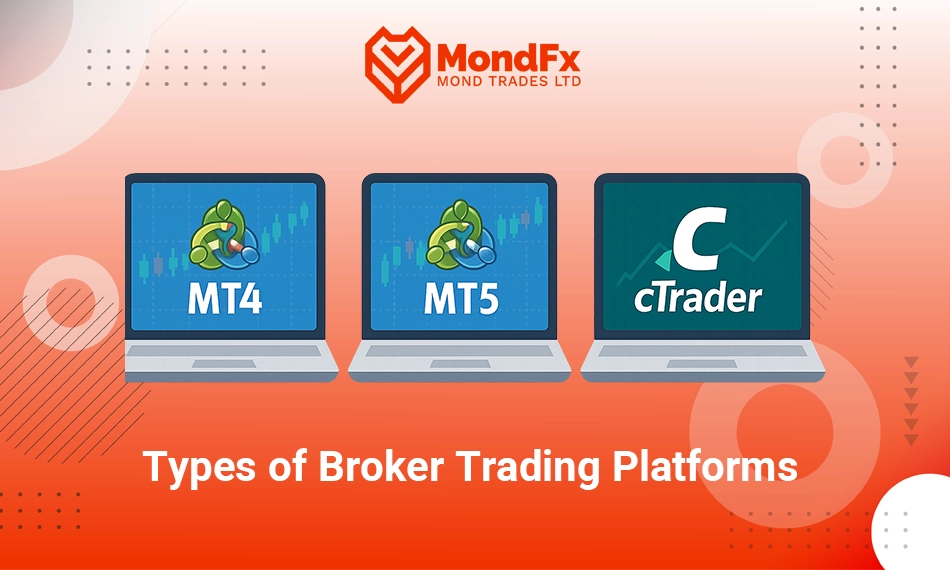
MetaTrader 4 (MT4)
MetaTrader 4 is one of the most widely used trading platforms, developed by MetaQuotes in 2005. With its simple user interface and diverse analytical tools, this platform allows for trading in the Forex market and other markets. MT4's main features include:
Diverse Analytical Tools and Indicators: Over 30 pre installed indicators and the ability to add custom indicators.
Automated Trading (Expert Advisors): Support for trading robots to execute automated strategies.
Extensive Support: Many brokers support this platform.
MetaTrader 5 (MT5)
MetaTrader 5 is the updated version of MT4, introduced in 2010. This platform offers a better trading experience with more advanced features and analytical tools. MT5's features include:
More Indicators and Analytical Tools: Over 38 indicators and 44 graphical objects.
Advanced Order Types: The ability to use various pending orders and trailing stop loss.
Integrated Economic Calendar: Access to important economic news and events.
cTrader
cTrader is a platform developed by Spotware in 2011 and is specifically designed for ECN accounts. cTrader's notable features are:
Modern and User Friendly Interface: Attractive design and easy access to tools.
Fast Order Execution: Suitable for scalpers and traders who require high execution speed.
Advanced Risk Management Tools: The ability to set trailing stop loss and manage positions.
TradingView
TradingView is a platform that, in addition to providing powerful analytical tools, functions as a social network for traders. Its main features include:
Advanced Analytical Tools: Over 100 indicators and 15 different timeframes.
Idea Sharing Capability: Traders can share their analyses and ideas with others.
Access to Economic Calendar: Information on important economic events impacting the market.
Choosing the Right Platform
Selecting the appropriate trading platform depends on your trading needs and strategies. Some brokers may support multiple platforms, while others may offer only one specific platform. For example, the FxPro broker offers four trading platforms: MetaTrader 4, MetaTrader 5, cTrader, and the proprietary FxPro platform, each with unique features.
Ultimately, it is recommended that before choosing a broker and a trading platform, you specify your needs and goals and select the most suitable option by reviewing the features of each platform.
Regulation and Oversight of Forex Brokers
The importance of regulation and oversight of Forex brokers in commercial and investment activities within the Forex market is very significant. The existence of laws and regulatory bodies for these brokers is essential for the following reasons:
Protection of Client Funds
One of the most important objectives of regulations is the protection of the capital of individuals who invest in the Forex market. Oversight of brokers prevents misuse or fraud by non credible companies. Regulations guarantee that client capital is held in segregated accounts and is preserved against unnecessary risks.
Assurance of Operational Transparency
Brokers that operate under the supervision of reputable authorities are obliged to provide transparent financial reports and present accurate information about trading conditions, spreads, commissions, and other costs. This transparency helps traders make better decisions.
Prevention of Fraud and Deception
Regulatory bodies prevent the activities of illegal or fraudulent brokers by enacting strict regulations. This ensures that investors only cooperate with companies that comply with legal standards.
Assurance of Fair Trade Execution
One of the main duties of regulatory bodies is to guarantee the fair execution of orders. Regulated brokers are obliged to execute client orders with accuracy and speed and refrain from price manipulation or unusual spreads.
Reduction of Systemic Risk
The Forex market can be highly unstable, and proper oversight prevents the creation of systemic problems. This oversight includes restrictions on leverage, Anti Money Laundering (AML) controls, and adherence to Know Your Customer (KYC) regulations.
Dispute Resolution and Legal Support
In case of problems or disputes between clients and brokers, regulatory bodies play the role of an intermediary. They ensure that the rights of traders are respected by providing legal structures and official complaint systems.
Enhancement of Market Confidence
Regulation and oversight lead traders to feel greater security and confidence. This confidence results in more individuals entering the Forex market, consequently increasing the market's liquidity and efficiency.
Most Important Regulatory Bodies in the Forex Market
Some of the credible international bodies that oversee brokers include:
CFTC and NFA (United States)
FCA (United Kingdom)
ASIC (Australia)
CySEC (Cyprus)
BaFin (Germany)
Oversight and regulations are the main foundation of a healthy and secure Forex market. Traders must ensure a broker is regulated by credible authorities before cooperating with them to protect their capital and have a safe trading experience.
Credible Regulatory Organizations and Regulators
In the Forex market, regulatory organizations (regulators) play a vital role in ensuring transparency, fairness, and security of trades. Below, we introduce some of the most reputable global regulatory bodies:
Commodity Futures Trading Commission (CFTC) – United States of America Description: The CFTC is the main regulatory body for financial markets in the United States and oversees all financial markets, including Forex.
Financial Conduct Authority (FCA) – United Kingdom Description: The FCA is the financial services regulator and consumer protection organization in the UK and oversees the regulation process for Forex and CFD trading.
Australian Securities and Investments Commission (ASIC) – Australia Description: ASIC is the supervisor of financial market providers in Australia and is considered one of the most credible Forex regulatory bodies.
Cyprus Securities and Exchange Commission (CySEC) – Cyprus Description: CySEC is the supervisor of financial markets in Cyprus and emphasizes transparency and compliance with European Union regulations.
Federal Financial Supervisory Authority (BaFin) – Germany Description: BaFin is the German Federal Financial Supervisory Authority that regulates financial services, including Forex trading.
Monetary Authority of Singapore (MAS) – Singapore Description: MAS is Singapore's central bank and financial regulatory authority, which oversees Forex and financial activities.
Financial Services Agency (FSA) – Japan Description: The FSA is the supervisor of financial markets in Japan and emphasizes assuring stability and investor protection.
Financial Sector Conduct Authority (FSCA) – South Africa Description: FSCA is the supervisory organization in South Africa that oversees fair conduct and customer protection in the financial sector, including Forex.
Securities and Futures Commission (SFC) – Hong Kong Description: SFC is the primary regulatory body in Hong Kong that oversees financial markets, including Forex.
National Commission for Companies and the Stock Exchange (CONSOB) – Italy Description: CONSOB is the Italian regulatory authority for financial markets, which is responsible for guaranteeing transparency and investor protection.
Note: Each of these bodies has its own specific rules and regulations, and brokers that operate under their supervision are obliged to comply with these regulations. To ensure a broker's credibility, check whether it is supervised by one of these reputable bodies.
Verification of Broker Licenses
To ensure the credibility and legality of a Forex broker, verifying its licenses and regulations is essential. The following are the step by step procedures for conducting this verification:
1. Visit the Broker's Official Website
Go to the broker's official website and look for information such as the license number, the name of the parent company, and the relevant regulatory body. This information is usually located at the bottom of the main page or in the "About Us" section.
2. Find the Company Name and License Number
Note down information such as the full company name and the license number. Note that the broker's trading name might differ from the registered company name.
3. Refer to the Regulatory Body's Website
Go to the official website of the relevant regulatory body (such as FCA, CySEC, ASIC, etc.). These bodies usually have sections for searching authorized firms.
4. Search the Company in the Regulatory Body's Database
Use the company name or license number to search the regulatory body's database to find the license status and related information.
5. Review the License Details
Ensure that the license is active and has no restrictions. Also, verify that the license pertains to the services the broker offers.
6. Contact the Regulatory Body if Necessary
In case of ambiguity or a need for more information, you can contact the relevant regulatory body.
Important Notes:
Always use official sources to verify licenses.
Pay attention to the difference between the trading name and the registered company name.
If you cannot find the license information, refrain from cooperating with the broker.
By following these steps, you can ensure the credibility and legality of the broker in question.
Cooperating with Brokers
Cooperating with Forex brokers can provide profitable opportunities, but it comes with risks and challenges that every trader must be aware of. Below, we address the most important of these risks and challenges:
Risks Associated with Brokers
Lack of Proper Oversight and Regulation: Some brokers are not supervised by credible authorities, which can lead to fraud or misuse of client funds. Cooperating with brokers without a valid license can pose serious dangers to investors.
Liquidity Issues: Brokers that lack sufficient liquidity may face delays in order execution or be unable to execute orders correctly. This can lead to slippage and unintentional losses for traders.
Conflict of Interest: Some brokers may act as the counterparty in client trades, which can result in a conflict of interest and negatively impact client trades. This issue is especially observed in B-Book type brokers.
Market Related Risks
Extreme Market Volatility: The Forex market, due to its susceptibility to economic and political news, may experience sharp fluctuations that can lead to significant losses.
Geopolitical Risks: Global political and economic events can have unexpected effects on the Forex market, making market movements difficult to predict.
Operational Risks
Technical Issues: Internet outages, server problems, or defects in the trading platform can lead to the inability to execute trades on time and consequently result in financial losses.
Security Risks: Cyber attacks or security flaws in the broker's systems can lead to the loss of client information or capital.
Legal and Regulatory Risks
Changes in Laws and Regulations: Sudden changes in tax laws or market regulations can affect trading activities and lead to financial losses.
Local Law Risks: Some countries may impose restrictions on activities in the Forex market, which can lead to legal problems for traders.
Risk Reduction Strategies
Choosing a Reputable Broker: Collaborating with brokers who are supervised by reputable international bodies and have a good track record can reduce many risks.
Appropriate Risk Management: Utilizing risk management tools such as setting a Stop Loss and an appropriate trading volume can prevent large losses.
Education and Awareness: Increasing knowledge and awareness about the Forex market and its associated risks helps traders make better decisions.
Using Demo Accounts: Before entering real trades, using practice accounts can help traders become familiar with the platform and market conditions.
By considering these risks and adopting appropriate measures, one can mitigate the challenges of cooperating with Forex brokers and have a safer trading experience.
Launching a Forex Brokerage
Starting a Forex brokerage firm requires meticulous planning and adherence to a set of legal, financial, and technical requirements. This process begins with initial market research and continues through continuous risk management and regulatory compliance.
Formulating a Business Plan and Choosing a Business Model
The process begins with market research: a detailed analysis of the target market, identification of competitors, and a complete understanding of the needs of potential clients. Based on this research, a comprehensive business plan is developed, which includes setting objectives, marketing strategies, financial projections, and the business model. When choosing the business model, a decision must be made whether the company will operate as an A-Book Broker (NDD) (which passes orders directly to liquidity providers), or as a B-Book Broker (Dealing Desk) (which handles internal management of orders), or use a Hybrid Model that combines the advantages of both.
Legal Structure and Obtaining Regulatory Licenses
To gain credibility, a suitable jurisdiction with favorable financial laws must first be selected for company registration. After registering the company as a financial entity, the most crucial step is obtaining licenses and complying with regulations. This involves securing regulatory approval from reputable supervisory bodies such as the FCA, CySEC, or ASIC. Furthermore, ensuring compliance with Anti Money Laundering (AML) and Know Your Customer (KYC) laws is a non negotiable requirement for legal operation.
Technical Infrastructure, Liquidity, and Platform
Executing trades on a global level requires a strong technical infrastructure. This includes securing stable and secure servers and implementing essential back office systems such as Client Relationship Management (CRM), accounting, and reporting. On the financial side, cooperation with reputable Liquidity Providers (LP) is necessary to ensure the liquidity required for trade execution at competitive rates. Additionally, a reliable trading platform such as MetaTrader 4/5 or cTrader must be selected and customized to the specific needs of the broker and its clients.
Operations, Payment, and Human Resources
To complete the operational cycle, establishing secure and diverse payment gateways for deposits and withdrawals via credit cards, bank transfers, or e-wallets is essential. Another vital part is the recruitment and training of human resources. Specialized teams for customer support and a technical team for maintaining and improving the technical infrastructure must be formed.
Growth Strategies and Continuous Compliance
Following the initial launch, focus must be placed on marketing and client acquisition strategies. This includes strong branding, the use of digital advertising, and providing educational programs, webinars, and market analysis to attract and retain clients. Finally, the broker's operation must be accompanied by risk management and continuous compliance; this means that risk management policies must be formulated and executed to protect the company's and clients' capital, and continuous assurance must be given that the regulations of supervisory bodies are adhered to, and company policies are updated based on legal changes.
The Best Forex Brokers for Iranians
Choosing a suitable broker for Iranian traders in the Forex market requires special attention and review due to existing limitations and sanctions. To see a specialized review of 10 brokers for Iranians, refer to the following link:
The best forex broker for Iranians, expert review of 10 brokers