

If you are looking to achieve the highest possible profits in the forex market but only have a very small amount of capital, you surely know that the best option for placing larger trades in this situation is using leverage. However, leverage is always like a double edged sword: just as it can bring significant profits, it can also cause equally large losses and lead to the loss of your capital. As you know, choosing the right leverage means selecting a position size that allows you to operate in the market within your predefined risk limits, without increasing the risk of losing your capital too quickly.
Based on this logic, when we use very small amounts of capital, such as $100, to trade in the forex market and intend to participate in higher yield trades by using leverage, choosing the right leverage ratio to avoid margin calls and protect the initial capital becomes extremely important.
In this article from MondFx , stay with us to explore this topic in detail.
What is leverage in trading?
Leverage in forex is a financial tool that allows a trader, with a small amount of capital, to open a trade size larger than the actual balance of their account. In simple terms, leverage gives you the buying or selling power of several times your initial capital.
For example, if you have 100 dollars in your account and use leverage of 1:10, you can open a position worth 1,000 dollars in the market. This means that every small price change in the market will have a greater impact on your profit or loss. The higher the leverage ratio, the greater both the profit potential and the risk of losing your capital more quickly.
Leverage is like a double edged sword: if it is used correctly, it can multiply a trader’s profits, but if it is used without risk management and a trading plan, it may lead to the loss of the entire capital. Therefore, choosing the right leverage should be based on the level of risk tolerance, trading style, and the trader’s experience.
Factors influencing the choice of appropriate leverage with 100 dollars
Before introducing the best leverage for 100 dollars, we must first identify the factors influencing the choice of appropriate leverage and examine them. This is because these factors have a direct impact on how traders perform and the trades they execute, and even the smallest mistake in choosing suitable leverage with a small amount of capital can lead to the loss of all the capital. Some of the factors influencing the choice of appropriate leverage include the following:
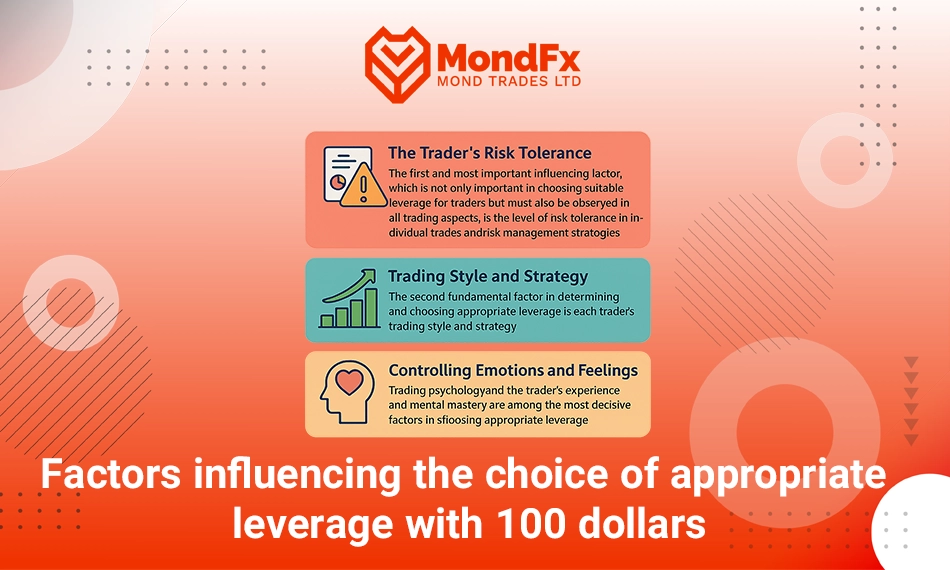
The trader’s risk tolerance
The first and most important influencing factor, which is not only important in choosing suitable leverage for traders but must also be observed in all trading aspects, is the level of risk tolerance in individual trades and risk management strategies.
The trader’s risk tolerance is not merely a numerical concept, but rather a reflection of personality, experience, financial goals, and even psychological and economic conditions. This characteristic plays a central role in the choice of leverage, because it determines to what extent the trader is willing to tolerate market fluctuations and what level of loss they accept without serious damage to their capital or mindset.
A person with low risk tolerance may consider even minor fluctuations as a threat and exit the trade quickly, while someone with high risk tolerance may trade without a stop loss and with high leverage and be exposed to a margin call. Therefore, risk tolerance is not limited to determining a fixed stop loss amount in trades, but is a foundation for designing the entire trading strategy, choosing position size, setting the stop loss, and ultimately selecting leverage that is aligned not only with the account, but also with the trader’s personality and objectives.
Trading style and strategy
The second fundamental factor in determining and choosing appropriate leverage is each trader’s trading style and strategy. Traders may operate in scalping, short term, long term, and other timeframes, which acts as an independent variable in choosing suitable leverage, but for small capital, due to the low amount of funds, it is defined as a dependent variable, because it will determine the way of entry, staying in the market, and the setting of profit and loss targets.
For example, a scalper who trades on very low timeframes (such as 1 minute or 5 minute charts) seeks to capture very small price movements, and in order for these limited fluctuations to result in meaningful profit, they need a high trade volume; as a result, they usually use leverage with high ratios. However, this style in accounts with small capital, such as a 100 dollar account, is associated with a very high risk of losing the entire capital, because even the smallest adverse movement threatens the whole account, so using the best scalping strategies in this context is a more logical approach.
In contrast, traders who operate on medium term and long term timeframes have larger price targets and consider the natural fluctuations of the market as part of the path rather than an immediate threat. And since their positions remain open for days or even weeks, using leverage with lower ratios helps them manage their trades without the psychological pressure arising from momentary volatility.
As a result, the trading style not only shapes the technical tool of leverage selection, but is also directly tied to trading psychology, capital management, and sustainability in the market.
Controlling emotions and feelings
Trading psychology and the trader’s experience and mental mastery are among the most decisive factors in choosing appropriate leverage, because high leverage ratios increase the intensity of emotional reactions in traders just as much as they increase profit potential. An experienced trader is not only familiar with concepts such as risk management, market analysis, and price structures, but also has the ability to control emotional reactions like fear, greed, anger, or despair. On the other hand, a novice trader may, under the influence of emotions and false volatility, resort to using high leverage and put their capital at risk.
High leverage, for someone who still does not know how to set a stop loss or does not remain faithful to their trading system at critical moments, is practically a destructive tool rather than a supportive one. Therefore, the choice of leverage should not be based on daydreaming about profits, but on the trader’s real ability to maintain mental discipline and execute the trading plan flawlessly. Experience here acts as a protective filter that helps leverage turn into a tool for growth instead of a threat.
High leverage can, instead of being a tool for profit, turn into a cause of heavy losses. Therefore, the choice of leverage should be based on a precise analysis of these three main dimensions, as well as a complete understanding of the broker’s limitations, market conditions, and capital management rules, so that not only is risk controlled, but the foundation for the trader’s sustainable growth and progress is also created.
Comparative table of the best leverage ratios for 100 dollars
| Leverage | Equivalent Buying Power | Risk Level | Key Features and Notes |
|---|---|---|---|
| 1:10 | $1,000 | Low | Controlled risk, suitable for beginner and conservative traders |
| 1:20 | $2,000 | Medium Low | Suitable for cautious traders who are willing to take slightly more risk |
| 1:50 | $5,000 | Medium High | Higher potential profitability but requires more precise risk management |
| 1:100 | $10,000 | High | Potential for high profits but also risk of margin call and rapid loss of capital |
As you can see in the leverage column of this table, the leverage ratio (such as 1:10 to 1:100) is the amount of leverage the broker provides to the trader so that, with their initial capital, they can open larger positions. For example, a 1:10 leverage means that for every 1 dollar of personal capital, the trader can trade up to 10 dollars; in other words, their buying power is 10 times their original capital. In a $100 account, this means the ability to open positions up to $1,000. As the leverage ratio increases, buying power increases as well, but the risk of losing capital also grows proportionally.
This table provides a simple and practical view of how choosing different leverage levels affects buying power and risk in a $100 account. The higher the leverage, the more sensitive the account becomes to small price fluctuations. For example, with 1:100 leverage, a 1% price move against your position can wipe out your entire capital, whereas with 1:10 leverage, the price would need to move around 10% to cause the same loss. Therefore, leverage should be chosen in line with the trader’s experience, trading style, and risk tolerance, so that while risk is controlled, profit opportunities are preserved.
To gain a deeper understanding of the best leverage for small amounts of capital like $100, and to be able to trade more intelligently, take a look at the following table:
| Leverage | Impact on Trader Psychology | Management Requirements | Key Risks | Typical Uses |
|---|---|---|---|---|
| 1:10 | Low psychological pressure, better control over decisions | Requires regular planning and adherence to simple stop loss levels | Small price fluctuations are easy to manage | Conservative and long term trades |
| 1:20 | Balance between excitement and emotional control | More precise use of risk management tools | Possibility of faster losses, but still relatively predictable | Medium term trades and profit optimization |
| 1:50 | Increased pressure and stress from volatility | Requires strict adherence to a precise strategy and consistent stop loss orders | Risk of margin call even with moderate price movements | Scalping and high volume short term trades |
| 1:100 | Very high psychological pressure, risk of emotional decisions | Demands extensive experience and full emotional control | Rapid loss of capital even with small price movements | Professional traders with precise, well tested strategies |
Realistic profit with a small account: how much can you expect?
With a small capital of $100, it is possible to make a profit in Forex, but you need to approach it with a realistic mindset and strict risk management. Using appropriate leverage can increase your buying power and create more profit opportunities, but at the same time it raises the risk of heavy losses and even losing your entire capital. For small accounts, preserving the initial capital and having a consistent trading strategy are very important, and focusing on steady, reasonable returns is better than chasing large, sudden gains driven by high leverage.
The maximum profit you can reasonably expect with $100 is usually in the range of 5% to 20% per month, which is achievable with proper risk management and careful planning. Profits beyond this level generally require very high risk and the use of large leverage, which is considered extremely dangerous for small accounts. Therefore, the best approach for small capital is continuous learning, practice, and choosing conservative strategies so that, while controlling risk, you can achieve consistent and sustainable profits.
Final words
Choosing the right leverage for a small capital, such as $100, plays a crucial role in the success of your Forex trading. Leverage increases your buying power and creates greater profit potential, but it also raises the risk of rapidly losing your capital. The best leverage choice depends on three main factors: the trader’s risk tolerance, trading style and strategy, and ability to control emotions.
For small accounts, using lower leverage such as 1:10 or 1:20 is safer and allows for better management of positions and stop loss levels, while high leverage increases the risk of margin calls and significant psychological pressure. Capital preservation, risk management, and conservative strategies are the keys to achieving consistent and sustainable profits with a small account.
MondFx, by providing continuous education and guidance, enables you to gradually move forward on the path of building your own strategy and trading with awareness.