

In the world of Forex, currency pairs are one of the fundamental concepts that traders use to carry out their transactions. A currency pair refers to the combination of two currencies that are set against each other for trading. These pairs are usually known by names that are referred to as nicknames. Knowing them helps traders to remember them more easily and to be more comfortable in their reviews and conversations. In this article from MondFx, stay with us so that together we can examine these currency pair nicknames.
What are Currency Pairs?
Currency pairs are a combination of two currencies that are traded against each other in the Forex market. Each currency pair includes a base currency and a quote currency. For example, in the EUR/USD currency pair, the euro (EUR) is the base currency and the U.S. dollar (USD) is the quoted currency.
In this regard, currency pairs, especially major currency pairs , may be known by using nicknames to facilitate communication among traders. These nicknames help facilitate the trading process and are known in the Forex market as simplified codes for currency pairs.
Nicknames of famous forex currency pairs
These names are usually used because of simplicity and ease in trading conversations. Traders use these nicknames as a fast and effective communication tool in analyses and business discussions.
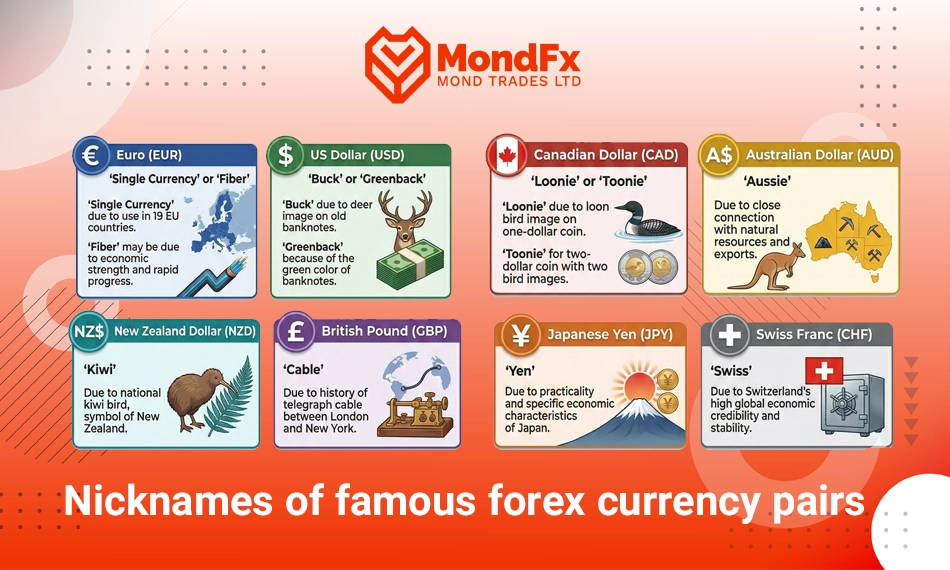
Euro (EUR) – "Single Currency" or "Fiber"
Single Currency: This name has been given because the euro is used as the official currency unit of the European Union in several different countries. Since the euro is a single currency that is used in 19 member countries of the European Union, it is known by this name.
Fiber: This name has been given to the euro especially in some financial markets and may be attributed to it due to the euro’s economic strength and rapid progress in global markets.
U.S. Dollar (USD) – "Buck" or "Greenback"
Buck: One of the most common nicknames for the U.S. dollar. This name was chosen because of the image of a buck (deer) that existed on dollar banknotes in the past.
Greenback: Due to the green color of U.S. dollar banknotes, this name is used for the U.S. dollar. In many cases, traders give the U.S. dollar this name.
Canadian Dollar (CAD) – "Loonie" or "Toonie"
Loonie: This name has been given to the Canadian dollar because of the image of the “loonie” (loon) bird that appears on Canada’s one dollar coin.
Toonie: For Canada’s two dollar coin, which has the image of two “loonie” birds engraved on it.
Australian Dollar (AUD) – "Aussie"
Aussie: This nickname is common among traders due to the Australian dollar’s close connection with natural resources and its exports to other countries.
New Zealand Dollar (NZD) – "Kiwi"
Kiwi: This name was chosen because of New Zealand’s national bird, the “kiwi,” which is a symbol of the country of New Zealand.
British Pound (GBP) – "Cable"
Cable: Due to the long trading history between the British pound and the U.S. dollar, this nickname has been given to the GBP/USD currency pair. This name refers to the history of the first telegraph cable between London and New York, which helped transmit prices between the two countries.
Japanese Yen (JPY) – "Yen"
Yen: This nickname is widely used in the Forex market for the Japanese yen. This name is popular due to its practicality and Japan’s distinct economic characteristics.
Swiss Franc (CHF) – "Swiss" or "Franc"
Swiss: Due to Switzerland’s high credibility in the global economy and the country’s economic stability, this nickname is used for the Swiss franc.
Currency Pair Nicknames in the Forex Market: A Complete Guide
In the Forex market, currency pairs are one of the most important and most widely used tools for trading. Each currency pair refers to the combination of two different currencies that are traded against each other. To make identification and communication among these pairs easier, traders use nicknames for them. These nicknames help traders identify different currency pairs faster and more easily and operate in the Forex market.
| Currency Pair | Nickname | Description |
|---|---|---|
| Euro/U.S. Dollar (EUR/USD) | Single Currency, Fiber | The euro, the single currency of the European Union, which is known as “Fiber” due to its economic strength and rapid progress in global markets. |
| U.S. Dollar/Japanese Yen (USD/JPY) | Dollar Yen | The USD/JPY currency pair is one of the most traded pairs in the world and is known as “Dollar Yen.” |
| British Pound/U.S. Dollar (GBP/USD) | Pound Dollar, Cable | The GBP/USD currency pair is known as “Pound Dollar” or “Cable,” which refers to the history of the first telegraph cable between London and New York. |
| U.S. Dollar/Canadian Dollar (USD/CAD) | Cady, Loonie | The USD/CAD currency pair is known as “Loonie” due to the image of the “loonie” bird on Canada’s one dollar coin. |
| Australian Dollar/U.S. Dollar (AUD/USD) | Aussie | This currency pair is known as “Aussie” due to the Australian dollar’s close connection with natural resources and Australia’s economy. |
| New Zealand Dollar/U.S. Dollar (NZD/USD) | Kiwi | The NZD/USD currency pair is known by this nickname due to New Zealand’s national bird, the “kiwi.” |
| Euro/British Pound (EUR/GBP) | Euro Pound | This currency pair is commonly called “Euro Pound,” reflecting the economic and political relations between the European Union and the United Kingdom. |
| U.S. Dollar/Swiss Franc (USD/CHF) | Dollar Franc | The USD/CHF currency pair is known as “Dollar Franc” due to Switzerland’s distinct economic characteristics and the country’s credibility. |
| Euro/Japanese Yen (EUR/JPY) | EuroYen | The EUR/JPY currency pair is known as “EuroYen” due to its lower volatility compared to other currency pairs. |
| Australian Dollar/Japanese Yen (AUD/JPY) | Aussie Yen | This currency pair is influenced by Australia’s economy and the global status of commodity markets and is known as “Aussie Yen.” |
Nicknames of Major and Minor Currency Pairs
In the Forex market, currency pairs are divided into different categories. The two main categories that are of particular importance to traders are major currency pairs and minor currency pairs. In the following, more comprehensive explanations about each of them are provided.
| Pair Type | Currency Pair | Nickname | Characteristics |
|---|---|---|---|
| Major Currency Pairs | Euro/U.S. Dollar (EUR/USD) | Eurodollar | High liquidity |
| Major Currency Pairs | U.S. Dollar/Japanese Yen (USD/JPY) | Dollar Yen | Lower volatility |
| Major Currency Pairs | British Pound/U.S. Dollar (GBP/USD) | Pound Dollar | Highly volatile |
| Major Currency Pairs | U.S. Dollar/Canadian Dollar (USD/CAD) | Cady | Influenced by oil prices |
| Major Currency Pairs | Australian Dollar/U.S. Dollar (AUD/USD) | Aussie | Commodity dependence |
| Major Currency Pairs | New Zealand Dollar/U.S. Dollar (NZD/USD) | Kiwi | Dependence on New Zealand’s economy |
| Minor Currency Pairs | Euro/British Pound (EUR/GBP) | Euro Pound | EU and UK analysis |
| Minor Currency Pairs | U.S. Dollar/Swiss Franc (USD/CHF) | Dollar Franc | Safe haven in crises |
| Minor Currency Pairs | Euro/Japanese Yen (EUR/JPY) | EuroYen | Low volatility |
| Minor Currency Pairs | Australian Dollar/Japanese Yen (AUD/JPY) | Aussie Yen | High volatility |
| Minor Currency Pairs | British Pound/Japanese Yen (GBP/JPY) | Pound Yen | High volatility |
| Minor Currency Pairs | Euro/Swiss Franc (EUR/CHF) | Euro Franc | Dependence on the EU economy |
| Minor Currency Pairs | British Pound/Swiss Franc (GBP/CHF) | Pound Franc | European Union economic analysis |
| Minor Currency Pairs | Australian Dollar/Japanese Yen (AUD/JPY) | Aussie Yen | Dependence on Australia’s economy |
| Minor Currency Pairs | New Zealand Dollar/Japanese Yen (NZD/JPY) | Kiwi Yen | High volatility |
Major Pairs
Major currency pairs include currencies in which the U.S. dollar (USD) is present as the quote currency. These currency pairs, due to high liquidity and a high trading volume, are considered among the most popular and most traded currency pairs in the Forex market. These currency pairs are generally known as pairs with low spreads and relatively predictable volatility. Traders usually seek trading opportunities more in these currency pairs, because these currency pairs have high liquidity.
Euro/U.S. Dollar (EUR/USD) – "Euro Dollar"
One of the most well known and most widely used currency pairs in the Forex market is the Euro/U.S. dollar pair. This currency pair, which is usually known by the nickname "Euro Dollar," is composed of the euro (EUR) as the base currency and the U.S. dollar (USD) as the quote currency. This currency pair, due to high liquidity and a high trading volume, has earned the لقب "King of Currency Pairs." The Euro Dollar is recognized in the Forex market as a major currency pair, and most traders look for trading opportunities in this currency pair.
U.S. Dollar/Japanese Yen (USD/JPY) – "Dollar Yen"
The U.S. dollar/Japanese yen currency pair is known as "Dollar Yen" and is one of the most traded currency pairs in the world. In this currency pair, the U.S. dollar (USD) is the base currency and the Japanese yen (JPY) is the quote currency. This currency pair is influenced by global economic and political developments and usually has a high trading volume at times when the market experiences severe volatility. Many traders choose this currency pair because of its lower volatility compared to other currency pairs.
British Pound/U.S. Dollar (GBP/USD) – "Pound Dollar"
The British pound/U.S. dollar currency pair, which is known as "Pound Dollar" or "Cable," is one of the highly volatile currency pairs in the Forex market. In this currency pair, the British pound (GBP) is the base currency and the U.S. dollar (USD) is the quote currency. High volatility in this currency pair, especially after the release of important economic news from the United Kingdom and the United States, makes it attractive to traders with a high risk tolerance. This currency pair also has great importance due to the United Kingdom’s trade and economic relations with other countries.
U.S. Dollar/Canadian Dollar (USD/CAD) – "Caddie"
The U.S. dollar/Canadian dollar currency pair, which is known as “Caddie” or “Loonie,” is heavily influenced by oil prices and the economic relations between the United States and Canada. In this currency pair, the U.S. dollar (USD) is the base currency and the Canadian dollar (CAD) is the quote currency. Due to Canada’s economic dependence on the oil industry, changes in oil prices usually have a significant impact on this currency pair.
Australian Dollar/U.S. Dollar (AUD/USD) – "Aussie"
The Australian dollar/U.S. dollar currency pair, which is known as “Aussie,” is another popular currency pair in the Forex market. This currency pair is influenced by Australia’s economic conditions and natural commodity prices, especially mineral resources. In this currency pair, the Australian dollar (AUD) is the base currency and the U.S. dollar (USD) is the quote currency. “Aussie,” due to its close connection with commodity markets, is popular among traders who are interested in analyzing commodity markets.
New Zealand Dollar/U.S. Dollar (NZD/USD) – "Kiwi"
The New Zealand dollar/U.S. dollar currency pair, which is known as “Kiwi,” is composed of the New Zealand dollar (NZD) as the base currency and the U.S. dollar (USD) as the quote currency. This currency pair is heavily influenced by New Zealand’s economy and the country’s trade with Asian countries. “Kiwi,” due to its high volatility and dependence on export markets, is an attractive option for traders who are looking for higher risk opportunities.
U.S. Dollar/Swiss Franc (USD/CHF) – "Dollar Franc"
The U.S. dollar/Swiss franc currency pair, which is known as “Dollar Franc,” is traditionally recognized as a “safe haven” during times of economic and political crises. In this currency pair, the U.S. dollar (USD) is the base currency and the Swiss franc (CHF) is the quote currency. Due to the high stability of the Swiss franc, this currency pair usually sees increased trading volume under conditions of economic instability.
Minor Pairs or Crosses
Minor pairs or crosses include currencies in which the U.S. dollar is not present. These currency pairs are usually made up of two currencies other than the U.S. dollar and generally have lower liquidity compared to major currency pairs. Due to their volatility and unique characteristics, minor currency pairs can provide good trading opportunities for traders who are looking for diversification.
Euro/British Pound (EUR/GBP) – "Euro Pound"
The EUR/GBP currency pair is more suitable for traders who are interested in the economic and political analyses of the European Union and the United Kingdom. Due to lower volatility compared to other currency pairs, this currency pair is attractive to conservative traders.
Euro/Japanese Yen (EUR/JPY) – "EuroYen"
This currency pair is influenced by the economic policies of the European Union and Japan. Due to lower volatility compared to other currency pairs, this currency pair is suitable for conservative traders.
British Pound/Japanese Yen (GBP/JPY) – "Pound Yen"
The GBP/JPY currency pair is influenced by the economic and political fluctuations of both the United Kingdom and Japan. Due to high volatility, this currency pair is suitable for traders who are looking for higher risk opportunities.
Euro/Swiss Franc (EUR/CHF) – "Euro Franc"
The EUR/CHF currency pair is known as one of the important currency pairs in Central Europe and is influenced by European economies.
British Pound/Swiss Franc (GBP/CHF) – "Pound Franc"
This currency pair is more influenced by the economies of the United Kingdom and Switzerland and has higher volatility.
Australian Dollar/Japanese Yen (AUD/JPY) – "Aussie Yen"
This currency pair is made up of the Australian dollar and the Japanese yen and is influenced by Australia’s economic conditions and the global oil commodity markets.
New Zealand Dollar/Japanese Yen (NZD/JPY) – "Kiwi Yen"
The NZD/JPY currency pair has high volatility due to its dependence on New Zealand’s economy and the condition of commodity markets.
Differences Between Major and Minor Currency Pairs
Major currency pairs have higher liquidity and usually show more predictable volatility. These currency pairs are more popular and include a high trading volume.
Minor currency pairs, or crosses, have lower liquidity, but they can provide attractive trading opportunities for those who are looking for greater diversification and different risks. These currency pairs usually have wider spreads, and their volatility is attractive to experienced and risk tolerant traders.
The differences mentioned will affect the selection of currency pairs and trading strategies, so traders should use each of these currency pairs depending on their style and risk tolerance.
The Importance of Currency Pair Nicknames
Currency pair nicknames enable traders to identify these currency pairs more easily and faster. In addition, these names are widely used within trader communities and provide the ability to establish faster and more accurate communication in analyses and business discussions.
Knowing currency pair nicknames in the Forex market not only helps facilitate communication, but also increases the efficiency and speed of trading. By understanding these names and the characteristics of each currency pair, you can better adjust your trading strategies and perform more successfully in the Forex market.
Why Should We Focus on One of the Major Forex Currency Pairs?
Focusing on one of the major Forex currency pairs can offer many advantages for traders and investors. Major currency pairs, such as Euro/U.S. Dollar (EUR/USD), U.S. Dollar/Japanese Yen (USD/JPY), and British Pound/U.S. Dollar (GBP/USD), are a suitable choice for many traders due to their specific characteristics. Here, we have addressed some of the main reasons why one should focus on major currency pairs:

High Liquidity
Major currency pairs have the highest trading volume in the Forex market. This means they can be bought and sold easily without having a significant impact on price. High liquidity allows traders to enter and exit at any time and make the best use of market conditions.
Low Spreads
The spread, which is the difference between the bid and ask price, is usually very low in major currency pairs. Low spreads enable traders to reduce their trading costs and earn more profit. Due to the high trading volume in these currency pairs, brokers are able to offer competitive spreads.
Predictable Market Movements
Major currency pairs are usually influenced by important economic and political factors such as economic data, monetary policies, and central bank decisions. These factors can create more predictable movements in these currency pairs. Therefore, traders who are interested in fundamental analysis can make better decisions about when to enter and exit trades.
Clearer Signals
Since major currency pairs are widely traded, technical analysis signals are usually more accurate and more reliable. For example, chart patterns, support and resistance levels, and indicators tend to work more clearly in these currency pairs, because more traders observe these signals and react to them.
Access to Economic and News Data
Major currency pairs are influenced by economic data from the world’s largest economies. These data, such as employment reports, gross domestic product, and interest rate changes, are readily available to the public. Therefore, traders can use this information to forecast market movements and make more informed decisions.
Better Risk Control
Due to high liquidity and low spreads, major currency pairs are suitable options for traders who are looking to manage risk. In these currency pairs, because of the high level of trading activity, you are less likely to face sharp and unexpected volatility, which helps reduce trading risks.
Support for Different Strategies
Major currency pairs, due to their characteristics, are suitable for use in various trading strategies. Whether you are a day trader or looking for swing trading or long term strategies, major currency pairs can align well with these strategies.
Strong Economic and Political Relationships
Major currency pairs, due to their close connection with the world’s largest economies, have up to date information and strong economic and political relationships. For example, the Euro/U.S. dollar is influenced by the monetary policies of the European Central Bank and the U.S. Federal Reserve, two central banks that have a significant impact on the global economy. These strong relationships make major currency pairs exhibit more predictable behavior.
Final Words
In conclusion, it should be said that currency pair nicknames are not merely common terms in the Forex market, but are considered part of the professional language of this market; a language in which mastery is a sign of a trader’s intellectual maturity and experience. Successful trading takes shape when a trader can understand and apply concepts simply, accurately, and without ambiguity. Knowing currency pairs, their behavioral characteristics, and consciously focusing on major currency pairs helps a trader, instead of being scattered, to analyze and decide with greater depth. More than anything else, the Forex market rewards an understanding of structure, mental discipline, and smart choices, not haste and aimless diversification in trading.
If you are looking to start a reliable path in the world of trading and financial markets, collaborating with the MondFx team can be a good starting point for building your personal strategy.