
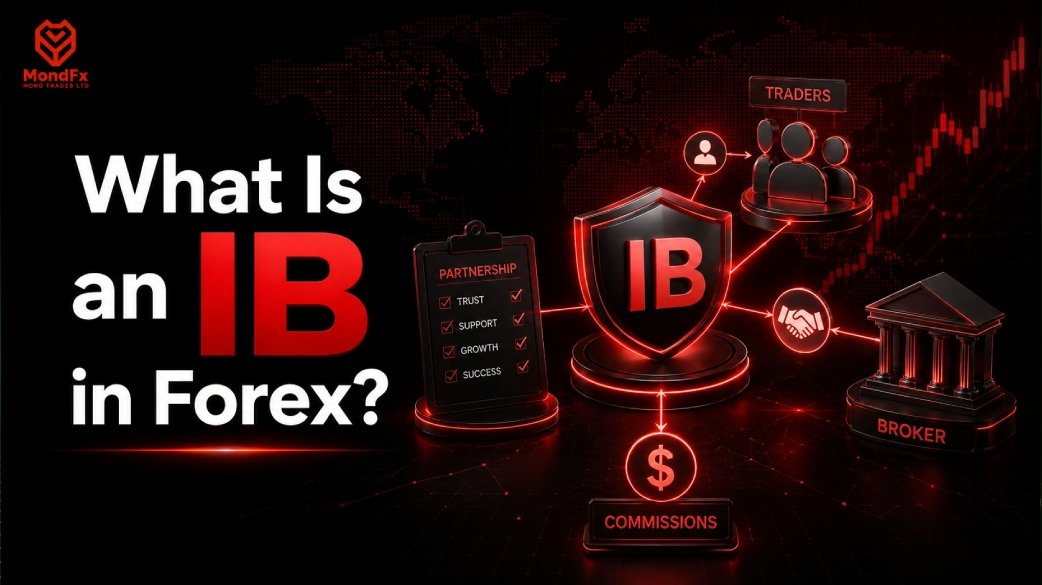
Nowadays, one of the simplest and most intelligent ways to enter the financial market and earn a risk free income is by becoming an Introducing Broker (IB). IB programs offer numerous opportunities for expanding a client base and generating income through various reward schemes. But what are the actual responsibilities of an IB? In this article, we will thoroughly examine the role of Introducing Brokers, how they operate, and the benefits of the MondFx IB program.
Someone sent you a referral link, or a local "mentor" offered to help you open a trading account. That person is probably an IB — an Introducing Broker. Before you use one, you need to know three things: what an IB is allowed to do with your account, how it gets paid, and whether that payment comes out of your spread.
This guide answers all three, then covers the other side of the question: whether becoming an IB is worth it, and what the model actually risks.
Disclosure: MondFx operates its own IB program. That program is described in one clearly marked section near the end. Everything before it is written to be useful whichever broker you use — including the parts that tell you how to check whether an intermediary is costing you money.
IB in Forex Means "Introducing Broker": the short answer
The 30-second definition
An Introducing Broker is a person or company that introduces clients to a forex broker and is paid from the trading activity of those clients. The IB never holds your money and never places your trades. The broker does both.
That split is the whole model. The IB owns the relationship — marketing, onboarding, support, education. The broker owns the infrastructure — execution, custody of funds, and the licence that makes any of it legal.
Other things "IB" can mean in trading
The acronym is overloaded, so check you're in the right place:
Initial Balance (IB) — a Market Profile concept: the price range set during the first hour of a trading session, used as a reference for breakout and range setups.
Inside bar (IB) — a price action pattern where a candle's range sits entirely within the previous candle's range.
Interactive Brokers (IBKR) — a US brokerage frequently shortened to "IB" in forums.
The rest of this article is about Introducing Brokers.
What an Introducing Broker Actually Does — and What It Is Not Allowed to Do
An IB's job is client acquisition and client service. Its limits are what protect you, and they matter more than the job description.
The job description
A working IB typically handles marketing and prospecting, helps with account opening and document submission, provides education such as webinars or written analysis, and offers first-line support — often in the client's own language and time zone. Regulated IBs in the US also carry out suitability checks and KYC steps on behalf of the firm carrying the account, and route client orders to that firm for execution (NFA).
For a trader in a market where the broker has no local presence, that layer of service is the genuine value on offer.
The hard limits
An IB cannot accept your money. Under the US statutory definition, an introducing broker solicits or accepts orders but does not accept funds, securities, or property from customers to margin, guarantee, or secure those trades (CFTC glossary).
It also cannot execute or manage trades for you, and it should not be issuing signals or specific buy and sell instructions. Trading decisions stay with the account holder.
If an "IB" asks you to deposit into their personal or company account, or offers to trade your account for you, the arrangement is either something other than an IB relationship — or a warning sign. Funds belong in the broker's client account, in your name.
Who actually holds your money
This is the question that matters if something goes wrong. Your funds sit with the broker, not the intermediary. In the US framework that firm is a Futures Commission Merchant (FCM) or a Retail Foreign Exchange Dealer (RFED), and IBs must carry all forex and futures accounts with such a firm on a fully disclosed basis (NFA).
| Function | Introducing Broker | Broker / FCM / RFED |
|---|---|---|
| Holds client funds | No | Yes |
| Executes and clears trades | No | Yes |
| Onboarding, education, support | Yes | Yes |
| Who you file a complaint against | The IB's conduct only | Fund and execution disputes |
| Paid by | The broker | Spreads, commissions, financing |
Practical consequence: a withdrawal problem, a slippage dispute, or a platform failure is a matter for the broker and its regulator. Your IB can escalate it, but it has no control over the outcome.
How the IB Model Works, Step by Step
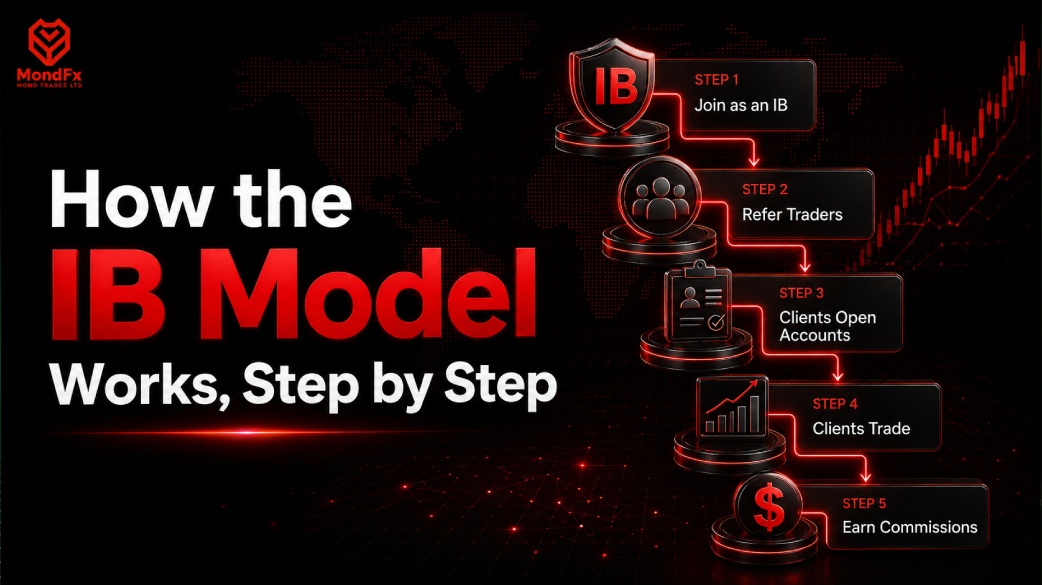
The chain from your click to someone getting paid has five links:
You open an account through the IB's referral link or code.
The account is tagged to that IB inside the broker's system.
You deposit and start trading.
The broker calculates a payout based on your trading volume or the revenue your account generates.
The IB is paid — monthly with some brokers, daily with others.
Nothing in that chain requires the IB to be a good trader, and nothing in it depends on whether your trades are profitable. The payout is driven by activity.
Master IBs, sub-IBs and multi-tier structures
Larger IB programs allow one IB to recruit others. The recruiter becomes a master IB, the recruits become sub-IBs, and commission cascades through the layers — the sub-IB earns on its own referrals, the master IB earns a smaller slice on the sub-IB's volume.
This is why a single account can sit under two or three intermediaries at once. For a trader, the number of layers is invisible and usually irrelevant; what matters is the total cost on your account, not how many people share it.
Types of IB: individual, institutional, white label, money manager
Not everything marketed as an "IB program" is the same relationship, and the difference determines how much control the partner has over your account.
Individual IB — an educator, analyst, or community owner referring their own audience.
Institutional IB — a firm with a sales team, often serving a specific region.
Affiliate-style partner — drives traffic, no ongoing client relationship.
White label partner — runs its own brand on another broker's infrastructure.
Money manager (PAMM/MAM) — trades a pooled or mirrored allocation on clients' behalf.
Only the last of these has trading authority, and it is a different regulatory animal. A pure IB never does.
How IBs Get Paid: the four commission models compared
Per-lot rebate
A fixed amount for every standard lot the referred client trades, varying by instrument. Published broker programs commonly quote figures between roughly $2 and $15 per standard lot — with major forex pairs at the lower end of that band and metals or crypto instruments carrying the highest tiers. Treat these as marketing figures rather than an industry standard; the actual rate depends on the instrument, the account type, and the partner's tier, and a program's single headline number is almost always its best-case rate on its best-paying asset class.
Spread share / revenue share
The IB receives a percentage of what the broker earns from the referred client. Quoted figures in the industry range from the mid-teens up to around 50% — but the percentage alone tells you little, because programs calculate it on different bases. A share of gross spread revenue and a share of net operational revenue (after the broker's costs and adjustments) can produce similar payouts at very different headline percentages. When comparing programs, ask what the percentage is applied to before comparing the number itself.
CPA
A one-off payment when a referred client meets a qualifying condition, usually a first deposit and minimum activity. This is the classic affiliate structure, and it ends the moment the client qualifies.
Hybrid and tiered structures
Most modern programs blend the models: a base revenue share plus per-lot bonuses, with rates that step up as monthly volume rises. Tiering is why two IBs at the same broker can be earning very different amounts on identical client behaviour.
Worked example: following one EUR/USD lot through the chain
The following is a hypothetical scenario using round numbers, not a quote from any specific broker.
Assume EUR/USD has a raw spread of 0.2 pips and the broker charges 1.2 pips on a standard account. The 1.0 pip difference is broker revenue. On a standard lot (100,000 units), one pip is worth roughly $10, so that markup is about $10 per lot traded.
If the IB is on a 30% revenue share, it receives 0.3 pips — about $3 per standard lot. The broker keeps the rest. Critically, in this structure the 1.2 pip price is what the broker charges everyone; the IB is paid out of existing revenue, not on top of it.
| Model | Funded by | Payout timing | Changes the trader's cost? | Commonly quoted range |
|---|---|---|---|---|
| Per-lot rebate | Broker revenue, or an added markup | Daily to monthly | Depends on structure | ~$2–$15 per standard lot, by asset class |
| Revenue / spread share | Existing broker revenue | Monthly | Usually no | Mid-teens to ~50%, depending on the base |
| CPA | Marketing budget | One-off | No | Fixed per qualified client |
| Hybrid / tiered | Mixed | Monthly | Depends on structure | Negotiated |
Does Trading Through an IB Cost You More?
It depends on the structure, and the honest answer is that both outcomes are real. Broker-published material tends to state flatly that the trader pays nothing extra because the broker pays the commission. Operator-side documentation describes a different mechanic for some models: the broker adds a markup to the spread specifically to fund the partner payout.
Both descriptions are accurate — for different commission structures. The problem is that almost nobody tells you which one applies to your account.
When it genuinely costs you nothing
In revenue-share and CPA structures, the IB is paid out of margin the broker was already earning. Your spread and commission are the same as they would be if you had signed up directly. In that case the IB's support and education are, from your side, free.
When you're paying a markup without seeing it
In pip-rebate structures, the payout is funded by widening the spread on the IB-linked account. Extending the hypothetical above: instead of charging 1.2 pips, the broker charges IB-referred clients 1.5 pips, and the extra 0.3 pips funds a larger partner payout.
That is roughly $3 more per standard lot. A trader doing 20 standard lots a month pays about $60 a month, or around $720 a year, for the same execution. The cost scales with frequency, so scalpers and high-volume traders absorb it hardest, while someone placing two swing trades a month will barely notice.
The five-minute check
Find the broker's published spread and commission for your exact account type on its public website.
Compare it against what your own account is actually charged on a few closed trades.
Ask the IB in writing which model it is on, and whether any part of the rebate is passed back to you.
A gap between the published rate and your rate means an intermediary is taking a slice you can see. No gap means the payout is coming from the broker's side.
The incentive problem you should know about
An IB paid per lot earns more when you trade more, whether or not that trading is good for your account. That is a structural feature of the model, not evidence of bad faith — but it does mean nobody in the chain has a financial reason to tell you to slow down.
There is a counterweight. IBs on long-term revenue share need clients who survive, so retention-focused partners have a genuine interest in your risk management. The distinction is visible in behaviour: an IB pushing higher leverage, larger position sizes, or bonus-driven volume targets is optimising for its own payout, not yours.
Two questions worth asking: How are you compensated on my account? and Does your payment change if I trade more often?
IB vs Affiliate vs White Label vs Money Manager
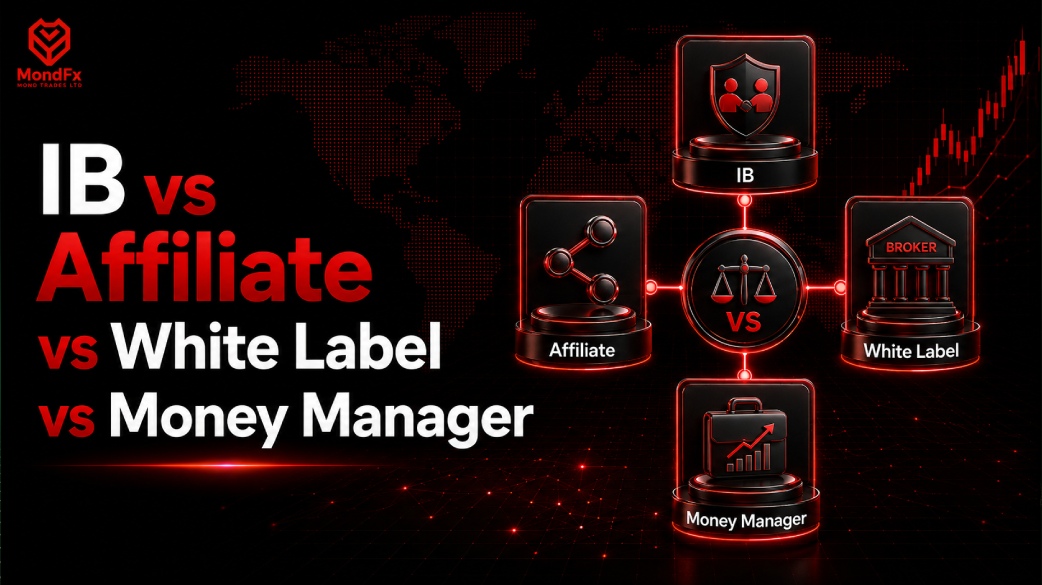
These terms are used interchangeably in marketing material, and they describe genuinely different relationships.
| Client relationship | How it is paid | Can it touch your account? | |
|---|---|---|---|
| Introducing Broker | Named, ongoing, service-based | Ongoing, on trading volume or revenue | No |
| Affiliate | Anonymous traffic | Usually one-time (CPA) | No |
| White label | Its own branded clients | Revenue split on its book | No — but it fronts the brand |
| Money manager (PAMM/MAM) | Discretionary mandate | Performance and management fees | Yes, by agreement |
| Clearing / executing broker | Operational, not commercial | Execution and clearing fees | Yes — it holds and executes |
The sharpest line is between an affiliate and an IB: an affiliate is paid once for delivering a signup, an IB keeps earning for as long as the client trades. That is also why IBs invest in support and education while affiliates generally do not.
Are Introducing Brokers Regulated?
Sometimes. "Regulated IB" means something specific in the US and the EU, and close to nothing in several offshore jurisdictions where much of the retail forex industry operates.
United States
IBs must register with the CFTC and become NFA members. Principals and Associated Persons register individually, using Form 7-R for the firm and Form 8-R for individuals, and applicants face proficiency exam and background check requirements. Registered IBs must maintain a written anti-money laundering program and a customer identification program, keep records of client communications and order transmissions, and supervise their Associated Persons (NFA compliance requirements for IB applicants).
Guaranteed vs independent IBs
US IBs fall into two structural categories, and the difference is substantial.
A guaranteed IB operates under a guarantee agreement with a single FCM or RFED, generally introduces all of its business to that one firm, and is not subject to minimum net capital or financial reporting requirements — it files the guarantee agreement instead of financial statements.
An independent IB may introduce business to any registered FCM or RFED, but must maintain adjusted net capital of at least $45,000. NFA Financial Requirements Section 5 sets the floor as the greatest of $45,000; $6,000 per office and $3,000 per Associated Person for firms holding under $1 million in adjusted net capital; or the applicable broker-dealer requirement. Independent IBs also file financial reports periodically and electronically (NFA applicant FAQ, NFA Financial Requirements Section 5).
Two figures circulate that will mislead you. Older documents cite $30,000 as the IB minimum — that is a superseded CFTC-era number. Some legal summaries also present $30,000 as a guaranteed IB requirement, which misstates the position: guaranteed IBs have no minimum net capital level at all. Separately, NFA notes that it generally expects an IB to hold around $50,000 as a practical buffer above the $45,000 floor, which is guidance to applicants rather than the rule itself.
Figures current as of August 2026 — verify at the source before relying on them.
EU and UK
In the EU, an introducing broker is generally treated as a tied agent under the MiFID II framework. A tied agent acts under the full and unconditional responsibility of exactly one investment firm, must possess appropriate professional knowledge, and must be registered in the relevant public register of tied agents. In Cyprus, CySEC maintains that register, and the requirement applies even where the introducing broker is not located in Cyprus (summary of the CySEC tied agent rules).
There is a scope nuance worth knowing. Merely introducing a client to an investment firm does not by itself amount to receiving and transmitting orders, and may fall outside MiFID's scope. An intermediary that goes further — taking client orders and passing them on — is within scope and needs the corresponding permission.
Offshore and lightly regulated jurisdictions
Most retail forex IBs operate under regimes with no registration requirement at all. There is no register to check and no conduct standard to enforce against the intermediary.
In that situation the IB's own status is not what protects you. The broker's licence is. Check where the broker is authorised, whether that licence covers clients in your country, and whether client funds are segregated — those questions determine your actual protection far more than the intermediary's credentials.
How to Check Whether an IB Is Legitimate
Verification takes a few minutes and depends on region:
| Region | Where to check |
|---|---|
| United States (futures/forex) | NFA BASIC — registration status and disciplinary history |
| United States (securities) | FINRA BrokerCheck |
| United Kingdom | The FCA Register |
| Cyprus / EU | The CySEC public register of tied agents |
| Offshore | No IB register — verify the broker's licence instead |
Red flags: guaranteed or fixed return language; any request to send funds anywhere other than the broker's own client account; an offer to trade your account for you; refusal to state the commission model in writing; pressure to raise your position size or trading frequency; a partner broker not licensed to accept clients in your country.
Green flags: written disclosure of how the IB is compensated; a registration you can independently confirm; deposits going only to the broker, in your own name; willingness to discuss risk and drawdown before discussing profit.
Should You Use an IB? Pros and cons for traders
You never need an IB to trade forex. Every broker accepts direct signups, and going direct removes an entire layer from the equation.
The case for using one is service. A good IB gives you onboarding help, local-language support, a real person to escalate to, education, and sometimes a share of its rebate passed back as cashback — which lowers your effective trading cost rather than raising it.
The case against is variance and cost. Quality ranges from genuinely useful market professionals to volume-driven salespeople. The IB adds no protection you would not have going direct, and depending on the structure, may add a spread markup you cannot see.
The decision rule is simple: an IB is worth it when the service you actually receive exceeds the cost you actually pay. Both halves of that need checking, not assuming.
Should You Become an IB? Requirements, realistic earnings, and risks
Who the model actually suits
People who already have an audience — educators, analysts, community managers, regional finance professionals — and who understand the market well enough to be credible. It is a client acquisition and retention business, not passive income. Without an existing distribution channel, the acquisition cost usually exceeds the commission.
Realistic earnings math
A hypothetical scenario: 10 referred clients, each trading 5 standard lots a month, at a $6 per lot rebate.
10 × 5 × $6 = $300 per month.
Now apply reality. Retail trading accounts churn heavily, and the ones that stop trading stop paying you immediately. If 4 of those 10 clients go inactive over the year, the figure falls to around $180 a month. Scaling to 50 or 200 clients changes the numbers but not the mechanics: earnings track active volume, and active volume decays.
These are illustrative figures. Actual results depend on rebate rates, instrument mix, client retention, and how much you spend acquiring clients in the first place.
The risks nobody advertises
The claim that being an IB carries no risk is incorrect. The exposures are real, even though you are not trading your own capital:
Clawbacks. Commissions can be reversed on charged-back deposits or clients flagged for bonus abuse.
Concentration. Income sits with one broker. A payout dispute, a licence problem, or a program change hits your entire revenue line at once.
Solicitation restrictions. Promoting a broker to clients in a country where that broker is not licensed can breach local rules, regardless of where you sit.
Registration exposure. In the US, EU, and UK, operating as an unregistered intermediary where registration is required carries penalties.
Reputational liability. If the partner broker delays or refuses withdrawals, your referred clients hold you responsible — because you are the person they know.
How to become an IB, step by step
Learn the market properly. Credibility is the product.
Vet the broker before the commission. Its regulation and withdrawal record matter more than its rebate rate.
Confirm your own registration obligations in the jurisdiction where you will actually solicit clients.
Set up the operation — entity, site, tracking, support channel, educational material.
Focus on retention. Acquisition gets you one payout; retention is what compounds.
How to evaluate an IB program
Compare programs on commission model and payout terms, the broker's regulation and withdrawal reliability, transparency of the reporting dashboard, marketing and CRM support, and retention resources for your clients.
Then read the part most partners skip: the clawback and termination clauses. Find out what happens to your commissions if the agreement ends — whether referred clients remain attributed to you, and under what conditions accrued payouts can be reversed. That clause determines what your book is actually worth.
The MondFx partnership program
This section describes our own program. Apply the same scrutiny to it that you would to any other.
MondFx runs three partner models, and the published terms are as follows (full details):
Per-lot rebate, tiered by network volume. All partners start at Tier 1 and move up automatically as the network grows. Rates differ by asset class:
| Asset class | Tier 1 | Tier 2 | Tier 3 |
|---|---|---|---|
| Forex | $2 | $4 | $7 |
| Metals | $3 | $8 | $15 |
| Indices | $3 | $8 | $10 |
| Commodities | $3 | $8 | $10 |
| Bitcoin | $5 | $10 | $15 |
The headline "$15 per lot" is the metals and Bitcoin Tier 3 rate, not the forex rate — which is a useful illustration of the earlier point that a single advertised number rarely describes what you will actually earn. Nano and MondShield accounts are excluded from the plan, and crypto pairs other than Bitcoin are not counted.
Revenue share. 15% of net operational revenue from referred clients, subject to a high-water mark so the share is calculated on real performance rather than reset gains. Note the base: this is a share of net revenue, so it is not directly comparable to programs quoting a higher percentage of gross spread revenue — the distinction covered in the revenue-share section above.
Sub-IB override. An additional 20% on a sub-IB's network, one level deep with no cascading, and not deducted from the sub-IB's own commission. Partners also receive up to $5 per lot in cashback on their own trading.
Payouts are settled in USDT on the TRC20 network, on a daily, weekly, or monthly schedule. Activation requires two active referred traders and a minimum of one lot per month.
Two things to check before you commit, here or anywhere. First, ask for the clawback and termination terms in writing — no broker publishes these on a landing page, including this one. Second, note the regulatory context: MondFx operates as Mond Trades Ltd under supervision in Mauritius and Saint Lucia, which places it in the offshore category described above. That affects the protections available to you and to the clients you refer, and it is a factor you should weigh rather than skip.
FAQ
Do I need an IB to trade forex?
Does using an IB make my spreads wider?
How do I find out if my account has an IB attached to it?
Can an IB see my trades or account balance?
Can an IB trade on my behalf?
What is the difference between a guaranteed and an independent IB?
Does an IB need a licence in my country?
What happens to my account if my IB stops working with the broker?
Does "IB" always mean introducing broker in trading?
Sources
National Futures Association — Introducing Broker (IB) Members
NFA — Compliance Requirements for Introducing Broker Applicants
NFA — Requirements for FCM, RFED and IB Applicants (FAQ)
NFA — Financial Requirements, Section 5
NFA — Independent IB Financial Requirements
Tied Agent Rules in Brief — CySEC
MondFx Partnership Program — published rates and terms
Regulatory figures reflect the position as of August 2026. Trading forex and CFDs carries a high risk of loss. This article is general information, not financial advice.