
Prop Trading refers to a method where a financial firm or trading institution uses its own capital to trade in financial markets. Unlike other trading models that rely on client funds, in proprietary trading, the firm assumes full responsibility for both the risks and rewards associated with the trades. The primary goal is for the firm to generate profits through its trading activities. One of the key features of prop trading is that traders can operate in the market using capital provided by the company. This model allows them to participate in trading without needing a significant amount of personal capital. Additionally, traders can utilize higher leverage, enabling them to take advantage of market opportunities more effectively. In return, the firms benefit from a share of the profits generated by these trading activities. Prop traders employ specific strategies to trade in various financial markets, including forex, stocks, cryptocurrencies, and commodities. Their main objective is to identify profitable opportunities and maximize returns for both themselves and the firm.
How Does Prop Trading Work?
The functioning of prop trading is as follows: Capital Provision by the Company Prop trading firms provide significant capital for trading. This capital is typically managed centrally, and traders use it to engage in various markets. The main goal of these firms is to generate profits from market fluctuations and take advantage of existing volatility. Hiring or Partnering with Traders In terms of recruiting traders, prop trading firms identify highly skilled traders and collaborate with them. This collaboration can take two forms: first, hiring traders as employees, in which case their performance is closely monitored; second, partnering with independent traders, where a percentage of the trading profits is shared with them. Access to Advanced Technology One of the notable advantages of working in prop trading is access to advanced technology. These firms provide traders with modern trading tools, complex algorithms, and efficient platforms. These technologies enable traders to make quick and accurate decisions, identify profitable opportunities, and execute trades automatically and without delay. Training and Skill Development Additionally, prop trading firms typically offer comprehensive training programs to develop the skills of traders, whether they are beginners or professionals. These training programs include technical and fundamental analysis, risk management, and the development of trading strategies aimed at optimizing performance and increasing profitability. In general, these companies provide the necessary conditions and resources to help traders succeed in financial markets. Monitoring and Performance Evaluation In this process, companies carefully monitor the performance of traders and use specific criteria to assess their abilities. One of these criteria is the overall profit generated by each trader. Risk management is also a crucial factor, focusing on how well capital is preserved during trades. Stability of performance is another important factor, evaluating the sustainability of a trader's profitability over time. Profit Sharing In the prop trading model, profits from trades are shared between the company and the traders. The distribution method varies depending on the internal policies of each firm. Typically, a percentage of the profit is given as a reward to the trader, and this percentage may change based on the trader's experience and performance results. This process not only provides motivation for traders but also contributes to improving their overall performance. Free Prop Trading The benefits of free prop trading include access to larger financial resources, allowing traders to utilize this additional capital and potentially generate higher profits.
This model, particularly beneficial for both beginner and experienced traders, provides an opportunity to learn and enhance trading skills in a real market environment. Since financial risks are covered by the firm, traders can gain valuable experience and learn from their mistakes without the fear of losing personal capital.
However, prop trading firms usually implement strict risk management rules that all traders must follow. These rules may include limitations on trade size, allowable asset classes, and approved trading strategies. Such restrictions can create specific pressures and challenges for traders, requiring a high level of discipline and attention to detail.
Iranian Prop Trading
Next, we will review the list of the best prop trading firms for Iranian traders and their key features:
| Prop Trading Name | Features |
|---|---|
| Fenefx Prop Trading | Fast and simple evaluation- One step and two step challenges- No challenge account (Pro Trader) for professionals- Fast onboarding and withdrawal process- User friendly trading environment with easy access- 24/7 support- Affordable pricing and fair profit sharing rules |
| Funded Next Prop Trading | Two step evaluation- 15% profit share during evaluation stages- Up to 90% profit share after passing- Funding available up to $4,000,000- Leverage 1:100- Ability to hold trades over the weekend- Unlimited profit withdrawal- Transparent and accurate evaluation system- 24/7 support |
| Hyro Trader Prop Trading | Fast evaluation with short duration- Offers 5 types of accounts- Three step challenge- User friendly trading platform- Suitable profit payout conditions- Active support team- Variety of trading instruments- High leverage and low fees- Daily profit payouts- Leverage up to 1:100 |
| Propy Prop Trading | Simple and fast evaluation- Supports various financial markets- Low fees- Unlimited profit withdrawals- Transparent and precise environment for professional traders- Leverage 1:100- Ability to trade during news- Two types of challenges |
| Robin Sood Prop Trading | Simple evaluation process- 24/7 support- Access to forex, stocks, and cryptocurrencies- Flexible trading programs- Three step challenge- Affordable pricing |
| Traders Combat Prop Trading | Suitable for beginner traders- Cost effective evaluation- Educational and advisory support- Access to trading accounts after passing the evaluation- Two step challenge |
| SGB Prop Trading (Best Investor) | Fast and cost effective evaluation- Supports forex and stocks- Advanced analytical tools- Educational and supportive environment for beginners and professionals- Two-step challenge (30 day and 60 day phases) |
Features of Prop Trading
In this section, we will explore the key features of proprietary trading (prop trading):
Utilizing Company Capital
One of the biggest advantages of prop trading is the ability to trade with the firm's capital. Traders do not need to risk their own personal funds, which significantly reduces financial risk. This also allows them to take larger positions in the market and benefit from greater profit potential.
Access to Advanced Technology
Prop trading firms typically provide cutting edge technology and high end trading tools. This includes powerful trading platforms, real-time market data, and automated systems. Such resources help traders make better decisions and optimize their trading performance.
High Profit Potential
In prop trading, profits are generally split between the trader and the firm. Given the professional support and access to large financial resources, traders have the opportunity to earn significant profits, especially if they perform well.
Education and Professional Support
Most prop trading firms offer comprehensive training programs to enhance traders' skills. These programs include technical analysis, fundamental analysis, and risk management training. Additionally, traders benefit from professional mentoring, which helps them improve their trading strategies and execution.
Reduced Risk for New Traders
Prop trading allows traders to gain real-market experience without risking their own capital. This is particularly beneficial for new traders, as they can develop their trading skills in a live trading environment without the fear of losing personal funds.
Market Flexibility
Prop trading firms enable traders to participate in multiple financial markets, including Forex, stocks, commodities, and cryptocurrencies. This diversity allows traders to test and refine their strategies in various market conditions, improving their adaptability and flexibility.
Performance Based Success
In prop trading, success is entirely dependent on a trader’s performance. This structure encourages traders to continuously improve their skills and strive for higher returns. As a result, prop trading serves as an excellent platform for developing trading expertise and increasing the chances of long term success in financial markets.
Challenges and Risks of Prop Trading
Traders face several challenges when engaging in prop trading:
High Performance Pressure
Traders must consistently generate profits to maintain their position within the firm, which can create significant stress and pressure.
Strict Risk Limitations
Stringent rules, such as daily loss limits, may restrict traders' flexibility and limit their ability to execute certain strategies freely.
Profit Sharing
Traders must share a portion of their earnings with the firm, which may not be appealing to some individuals who prefer full ownership of their profits.
Commitment and Continuous Effort
This profession demands dedication, knowledge, and ongoing effort. Traders who fail to adapt and improve may struggle to remain competitive.
Risk of Termination
Poor performance can lead to termination, adding to the psychological pressure traders face in an already high stakes environment.
Intense Competition
The prop trading industry is highly competitive, and only traders with strong analytical and risk management skills can succeed in the long run.
Dependency on the Firm
Traders rely on the firm's policies, tools, and infrastructure, meaning any changes or restrictions in these areas may disrupt their trading activities.
Ways to Enter Prop Trading
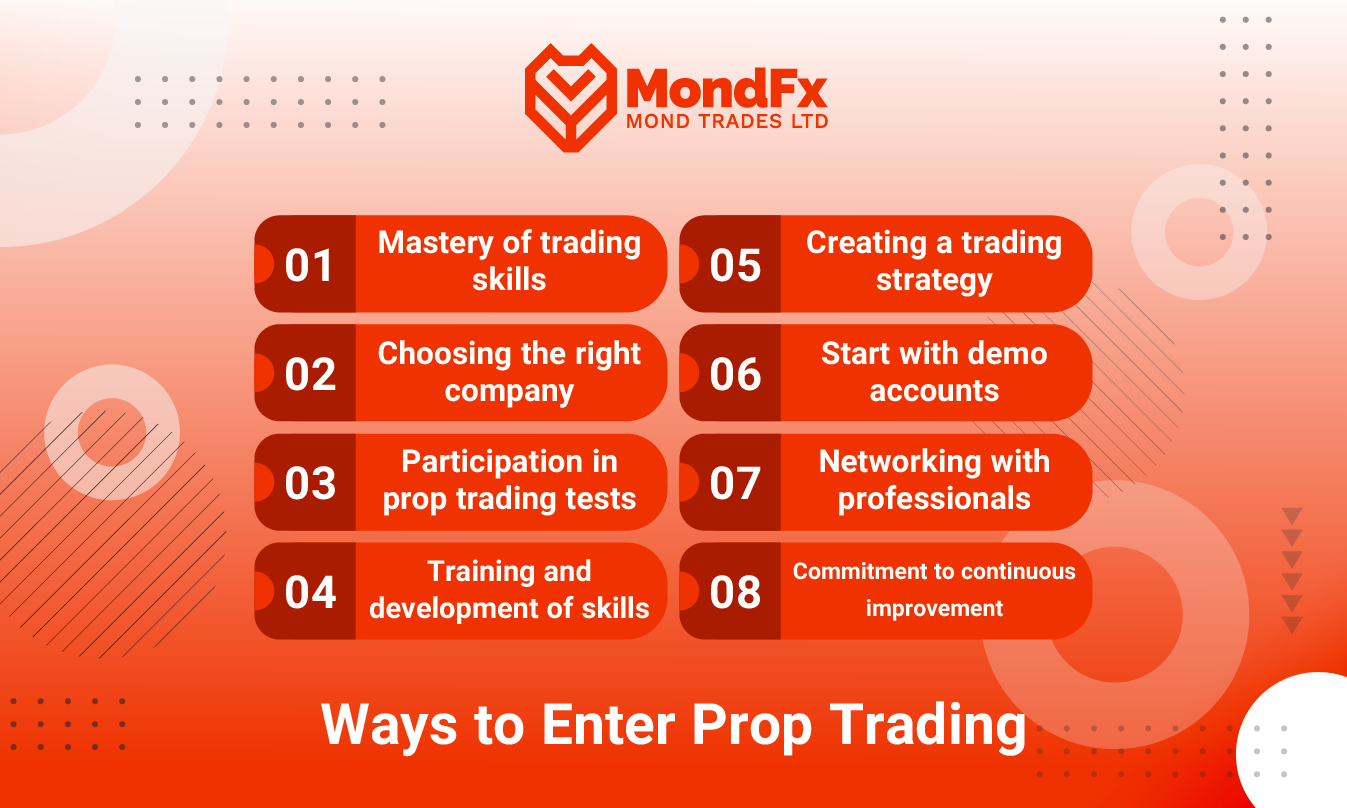
To successfully enter prop trading, the following factors are crucial:
1. Mastery of Trading Skills
To succeed in prop trading, you must have sufficient knowledge and skills in technical analysis, fundamental analysis, and risk management. These skills will help you minimize losses, protect your capital, and create sustainable profitability.
2. Choosing the Right Company
Thorough research on prop trading firms is essential. When selecting a firm, consider factors such as profit sharing conditions, training programs, and the types of markets they cover (such as Forex, stocks, or cryptocurrencies).
3. Taking Prop Trading Tests
To evaluate your skills, you should participate in the firm’s testing process. These tests typically focus on sustainable profitability, effective risk management, and adherence to time limits.
4. Education and Skill Development
Continuous improvement of trading skills is essential. By participating in educational courses, studying specialized resources, and practicing on demo accounts, you can increase your knowledge and experience.
5. Developing a Trading Strategy
Profitable and adaptable strategies that respond to various market conditions are key to success. Additionally, precise risk management within these strategies is crucial.
6. Starting with Demo Accounts
Demo accounts allow you to test your strategies risk free and familiarize yourself with real market conditions and the rules of prop trading firms.
7. Networking with Professionals
Connecting with professional traders and participating in financial forums or events can help identify opportunities and increase your chances of entering the field.
8. Commitment to Continuous Improvement
Prop trading requires persistence and a commitment to continuous improvement. Analyzing past performance, learning from mistakes, and keeping your financial knowledge up to date will assist you on this path.
How to Choose the Best Prop Trading?
To select the right prop trading firm, you need to consider the following factors:
1. Review Profit Sharing Conditions
Prop trading firms allocate a certain percentage of the profits to the trader. Assess how much of the profit you will receive and whether better performance will result in a higher share of profits.
2. Risk Management Rules
Risk management rules include limitations such as daily, monthly stop loss limits, and trade volume restrictions. These rules should be logical and compatible with your trading strategies.
3. Educational Programs and Support
If you’re looking to improve your skills, choose firms that offer educational courses, professional mentoring, and access to analytical tools.
4. Flexibility in Markets
Firms that operate in diverse markets like Forex, stocks, cryptocurrencies, and commodities allow you to trade in areas where you specialize.
5. Access to Advanced Tools
For success, you need strong trading platforms, real time market data, and automated analysis tools. Check whether the firm provides these resources without additional costs.
6. Entry Exam Conditions
Most firms have skill based tests. Check if the exam conditions (time limits, profitability targets, and fees) align with your skills and plans.
7. Reviews and Experience of Others
Gather useful information about the firm’s performance and credibility by reading reviews from users in online forums, checking ratings, and talking to experienced traders.
8. Investment Policies
Ensure that the initial capital requirements, conditions for increasing capital with better performance, and the profit withdrawal process are appropriate and transparent.
9. Reputation and Company History
A reputable firm should have a long history, approval from financial organizations, and transparent policies. These factors indicate its credibility and reliability.
10. Technical Support and Customer Service
24/7 technical support for technical issues, quick responses, and a professional team are key features of a good prop trading firm, especially during emergencies.