

From the very early days of the emergence of blockchain and cryptocurrencies, one of the most attractive concepts for users has been passive income through holding assets. This idea came to life with the introduction of the Proof of Stake (PoS) algorithm in 2012; a mechanism in which users could not only support the network’s security by delegating their digital assets, but also receive rewards in return a process that became known as staking. Simultaneously with the expansion of the crypto market and the entry of new users, the need for simpler and more automated solutions to carry out activities with minimal technical knowledge and capabilities in the world of digital cryptocurrencies became increasingly apparent. In response to this need, a concept known as auto staking emerged around 2021. Projects such as Olympus DAO and its forks paved a new path for generating returns from this market; a path that enabled users to receive periodic rewards without the need to manually lock assets or continuously interact with smart contracts. In this article from MondFx, we will examine how, since then, auto staking has been recognized as one of the innovative methods in the DeFi (Decentralized Finance) space; how exactly it works, what advantages and risks it carries, and most importantly, whether it is suitable for everyone.
What Is Staking?
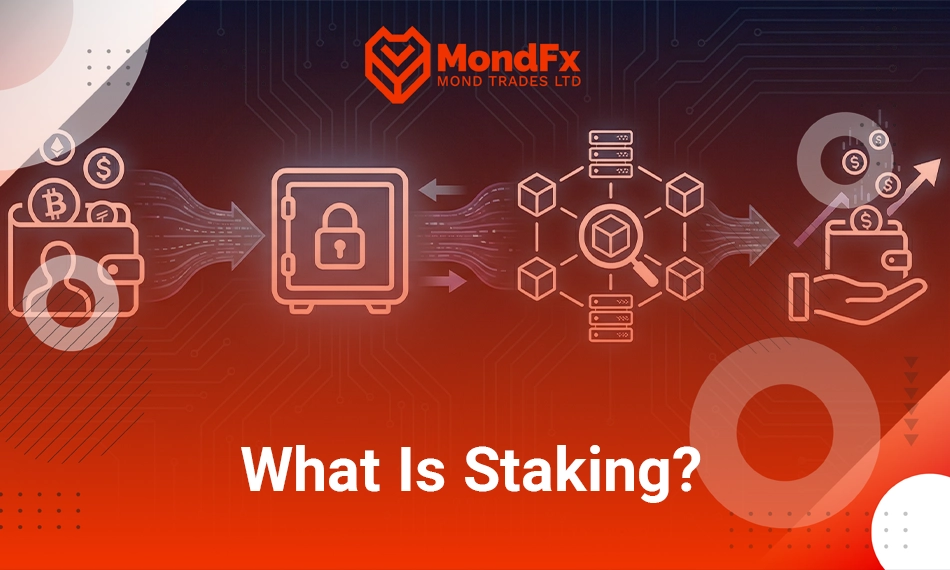
In the world of cryptocurrencies, staking refers to a process in which users lock their digital assets in order to support network operations (such as transaction validation) and, in return for this participation, receive rewards. Simply put, staking means placing your capital at the disposal of a blockchain network so it can operate, while you share in its profits.
Unlike mining , which requires expensive hardware and high electricity consumption, staking only requires owning a digital asset and locking it. For this reason, staking is recognized as a more energy efficient and simpler alternative for block production and validation in blockchain networks.
How Does Traditional Staking Work?
In traditional or manual staking, the user must lock their tokens in a specific wallet or platform. These tokens become non withdrawable for a certain period (the lock up period), and during this time, the network uses them to provide security and validation.
Staking rewards are usually calculated and distributed periodically (for example, daily, weekly, or monthly) based on the amount and duration of the locked assets. Platforms such as Ethereum 2.0, Cardano (ADA), Solana (SOL), and Binance Smart Chain (BSC) implement this model.
In this approach, the user must personally decide when to unlock the assets, withdraw the profits, or reinvest them.
What Is Auto Staking?
Auto staking of cryptocurrencies is an innovative and advanced method that enables digital asset holders to easily participate in blockchain networks. In this approach, automated scripts and tools are used to stake cryptocurrencies on behalf of the user. In other words, there is no longer a need to manually carry out complex processes yourself. It is sufficient to specify your desired settings such as the type of cryptocurrency and the staking duration and from that point onward, the automated system takes care of all stages, from staking the assets to distributing the rewards.
This level of automation represents a fundamental shift, as it makes staking accessible to a much broader range of individuals, even those without extensive technical knowledge. Whether you are an experienced investor or a newcomer to the world of cryptocurrencies, auto staking scripts help you earn rewards with ease while contributing to the security and efficiency of blockchain networks.
Advantages and Disadvantages of Auto Staking Cryptocurrencies
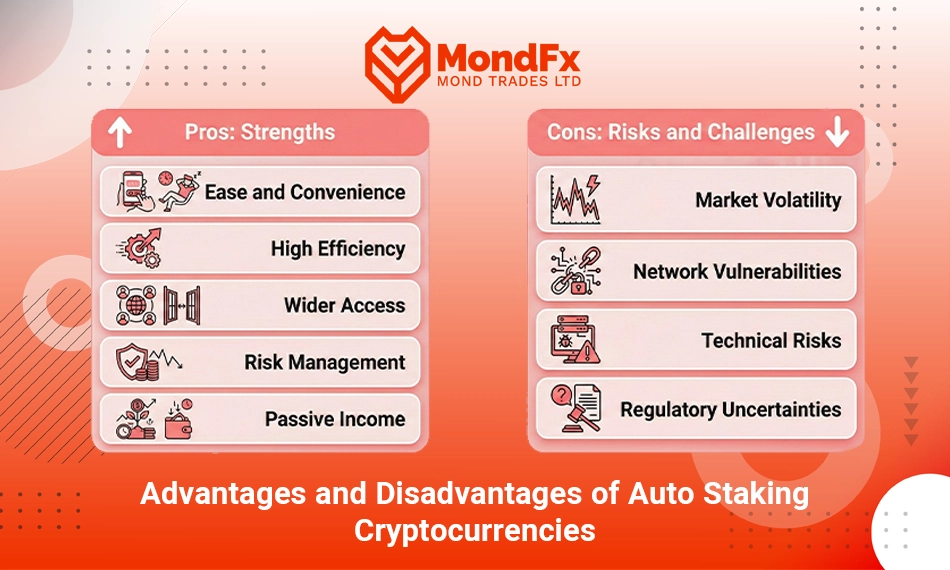
Auto staking offers significant advantages that make it an attractive option for cryptocurrency holders, especially those seeking to increase the efficiency of their investments.
advantages:
Ease and Convenience
The convenience of automated systems cannot be underestimated. These systems eliminate the need for constant monitoring and manual management of staked assets. As a result, you can earn rewards passively without the need for frequent adjustments or checks.
High Efficiency
In auto staking, you only need to define the initial settings once. After that, the system manages everything automatically. This process saves you time and energy and turns staking into a simple and hassle free experience. This feature is particularly suitable for individuals who lack sufficient time or are engaged in other commitments.
Broader Accessibility
Auto staking scripts make the staking process available to a wider range of users. There is no need for specialized knowledge or technical skills to get started. If you can work with a digital wallet or a cryptocurrency exchange, you can easily begin staking through automated platforms.
Risk Management
Many auto staking platforms are equipped with built in risk management tools. These tools help mitigate cryptocurrency price volatility or potential penalties. As a result, you can stake your assets with greater peace of mind, knowing that appropriate protective measures have been considered to safeguard your investment.
Passive Income
Similar to traditional staking, using automated systems also allows you to earn passive income. By participating in the transaction validation process, you receive rewards in the form of additional cryptocurrencies.
Risks:
Although auto staking offers numerous advantages, being aware of its potential risks is equally important.
Market Volatility
The value of cryptocurrencies can fluctuate significantly. If, during the staking period, the price of the selected cryptocurrency declines sharply, you may ultimately incur losses. Therefore, analyzing market trends and assessing price volatility before staking is of great importance.
Network Vulnerabilities
Participating in a blockchain’s consensus mechanism exposes you to certain network related risks, including malicious attacks or software vulnerabilities. Familiarity with the security measures of the network you intend to stake on is essential for mitigating these risks.
Technical Risks
Auto staking requires certain technical configurations and ongoing maintenance. Incorrect setup or failure to keep the system updated may lead to process disruptions or even penalties imposed by the network.
Legal Ambiguities
The legal status of cryptocurrencies is still evolving. Changes in regulations can affect the staking process or the amount of rewards. Therefore, being aware of legal developments and regulations related to cryptocurrencies in your country of residence is extremely vital.
Reputable Automated Staking Platforms in Today’s World
With the advancement of the DeFi space and the growing maturity of users, a new generation of automated staking platforms has emerged which, unlike the high risk and heavily promotional projects of the past, focus on security, sustainability, and transparency. Lido Finance is one of the pioneers in this path, offering liquid staking services on networks such as Ethereum and Polygon, allowing users to stake assets like ETH and receive a token called stETH, which is both tradable and yields daily returns.
As a result, users can receive rewards without locking their assets and can also deploy their assets in other DeFi protocols. Rocket Pool is another platform that, with a decentralized approach, enables ETH staking for regular users (via the rETH token) as well as for node operators.
This project, with its emphasis on distributed validation and the use of secure smart contracts, has become one of the main choices for long term staking enthusiasts. Meanwhile, Frax Ether, with its dual frxETH and sfrxETH model, provides high flexibility in choosing between liquidity and profitability. Users can initially receive frxETH and, if desired, convert it to sfrxETH to earn accumulated yield. This model is especially suitable for those seeking more precise management of liquidity and asset efficiency.
Binance Earn has also made Auto Staking services simpler and more accessible for general users. With just a few clicks on the Binance exchange, users can activate Auto Compound settings and benefit from automated yields without requiring technical expertise. However, it should be noted that using centralized services involves risks such as a lack of full transparency or the possibility of platform intervention.
Finally, platforms such as AutoFarm offer powerful tools for automatic yield compounding on networks like BSC and Polygon. By automatically analyzing the best yield opportunities, these platforms aim to optimize investment returns without user intervention. Overall, these new platforms have not only made staking easier for users, but have also taken an important step toward professionalization and trust building in this field.
Examples of Automated Staking Projects
Olympus DAO
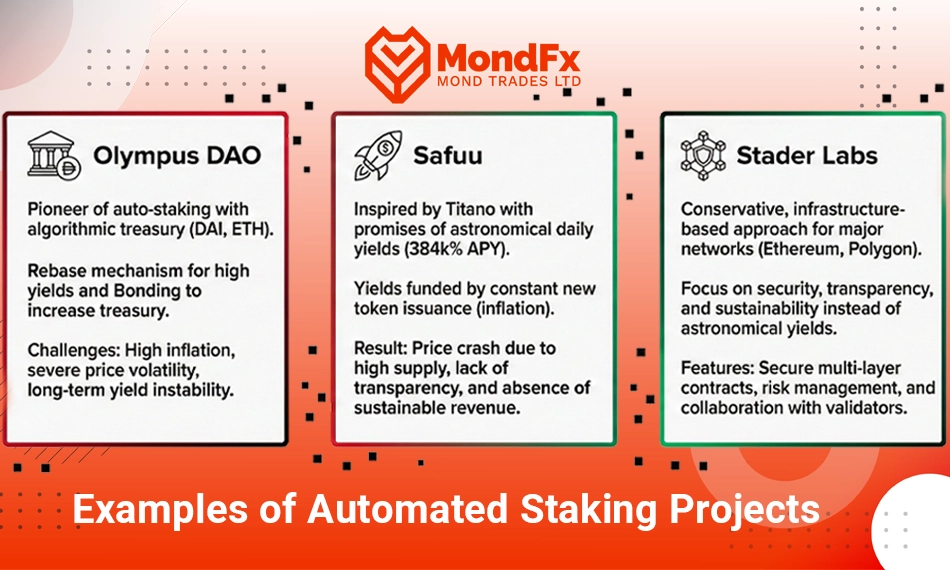
Olympus DAO was one of the pioneers of the Auto Staking concept, which managed to attract significant attention in the DeFi community by introducing an algorithmic money model backed by a treasury. Users could stake the OHM token and receive high returns in exchange, which were funded through the treasury distribution mechanism. Olympus sought to use assets such as DAI or ETH in its treasury instead of traditional backing like the U.S. dollar, thereby offering a stable yet decentralized currency.
The core mechanism of Olympus was built on two pillars. First, staking the OHM token and receiving rewards in the form of additional tokens, which were automatically and periodically distributed through a process called Rebase. Second, the use of Bonding to increase the treasury’s balance; that is, users could provide assets such as DAI to the project and receive OHM at a discounted price.
However, the high complexity of the economic model, the elevated inflation rates in the issuance of new tokens, and the severe price volatility of OHM caused the project to face considerable criticism midway through its journey. Many users, especially during bearish market conditions, suffered losses due to the rapid decline in the value of their assets. In addition, maintaining the high yield rates that were initially promised proved impossible in the long term. Nevertheless, Olympus DAO played an important role in paving the way for other Auto Staking projects and broadly introduced the concept of a decentralized treasury to the DeFi ecosystem.
Safuu
Safuu also entered the field inspired by the Titano model and even promised returns higher than those. By introducing a daily auto staking system and using slogans such as the safest and most profitable DeFi protocol, this project experienced rapid initial growth.
Safuu’s economic model was based on issuing new tokens to pay rewards. This process occurred at extremely high rates (over 384,000 percent annually), which posed serious challenges in terms of long term sustainability. In other words, users’ profits were not generated from real revenues, but rather through the continuous increase in token supply.
This very mechanism led to a collapse in the token’s price; as a large supply entered the market without sufficient demand, the value of Safuu declined and user trust was lost. On the other hand, the lack of transparency regarding the development team and the absence of sustainable revenue sources caused the project to be recognized as an example of the potential risks associated with projects promising astronomical returns. The Safuu experience once again demonstrated the importance of evaluating the economic model and the real revenue backing before entering any staking project.
Stader Labs
Unlike the previous projects, Stader Labs has adopted a more conservative approach based on professional infrastructure. This platform aims to provide automated staking services for well established networks such as Ethereum, Polygon, Avalanche, and Binance Smart Chain.
Stader’s main objective is to create a secure, transparent, and sustainable experience for users. Instead of promising high returns, this project focuses on smart contract security, fair distribution of rewards, and direct collaboration with base blockchains. Key features include the use of multi layer contracts to enhance security, the creation of segregated structures for risk management, and the provision of a simple user interface that enables non technical users to participate easily.
Additionally, Stader has managed to position itself as a professional and institutional option for long term investment by attracting participation from reputable validators on networks such as Terra (prior to its collapse), Solana, and Ethereum. This platform represents a new generation of Auto Staking projects that, rather than focusing solely on profits, emphasize ecosystem sustainability and building trust among users.
Conclusion
Automated staking can be considered the result of the natural evolution of the staking concept in response to users’ need for simplicity, efficiency, and passive income. By eliminating many technical complexities and automating the process of receiving and compounding rewards, this model has transformed staking from a semi specialized activity into an accessible option for a much broader range of users. From early projects such as Olympus DAO which, although unstable, helped pave the way to more mature platforms like Lido, Rocket Pool, and Stader Labs, all demonstrate that Auto Staking is no longer an experimental idea, but rather a serious component of the DeFi ecosystem.
However, the experience of projects such as Safuu clearly reminds us that automation does not mean being risk free. The economic model, the real source of reward payments, the security of smart contracts, and the degree of centralization or decentralization of the platform are factors that matter far more than nominal yield rates. Automated staking can be a suitable option for long term investors, inexperienced users, or individuals seeking passive income without daily management but only if it is accompanied by a precise understanding of the project’s mechanisms and acceptance of its inherent risks.
Ultimately, automated staking is neither a financial miracle nor necessarily an investment trap; rather, it is a tool whose intelligent use requires analysis, informed selection, and realism regarding both returns and risks. The future of this field will belong, above all, to projects that prioritize sustainability, transparency, and security over exaggerated promises of profit.
MondFx provides an opportunity for traders to design their own strategies with discipline and planning, and to gain a practical understanding of the market.